Get Full Government Meeting Transcripts, Videos, & Alerts Forever!
Get email alerts on the Solid Waste Fees topic
No spam. Unsubscribe anytime.
Commissioners approve 1% solid‑waste assessment after lengthy debate over fees and revenue opportunities
Summary
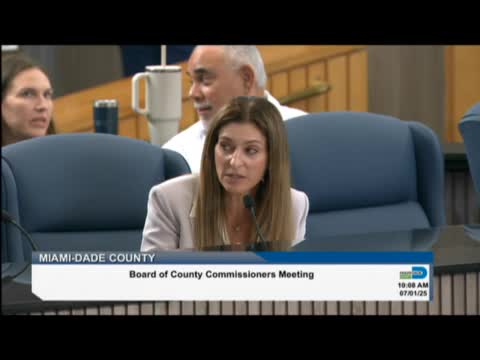
After hours of public comment and commissioner debate, Miami‑Dade County commissioners adopted a one‑percent increase to the county's non‑ad valorem solid‑waste assessment for 2025, capping a proposed two‑percent rise at 1% and approving mailed notice for TRIM. The vote was 8–4.
Miami‑Dade County commissioners voted 8–4 to approve a one‑percent non‑ad valorem solid‑waste assessment for fiscal year 2025, reversing an earlier proposal for a two‑percent increase after more than three hours of discussion on department savings, potential new revenue streams and the statutory notice process.
The measure will be advertised as a proposed 1% increase on the county's TRIM notice and in mailed notices to property owners; the board retains authority at second reading to alter the rate up or down. The administration and the Solid Waste Department said the shorter increase is intended to keep collection and disposal services fiscally balanced while staff explores offsets and new revenue options.
Why it matters: The assessment funds trash collection, illegal dumping cleanup, enforcement and landfill disposal for roughly 352,000 single‑family parcels in unincorporated Miami‑Dade. Commissioners repeatedly framed the decision against a larger countywide budget shortfall and said they wanted more detailed line‑item data and faster progress on revenue ideas before agreeing to a larger increase.
The vote and the vehicle Commissioner Kathleen Gilbert (sponsor) led the motion to advance an assessment proposal after the commission suspended rules to allow fuller discussion. County officials said a flat vote would have required the board to adopt an ordinance before the statutory September 25 deadline if the assessment is to be collected on the tax bill.
The final action adopted a 1% proposed increase for the mailed and TRIM notices; that figure was described on the dais as the highest amount the board would advertise but not a final determination. The county attorney clarified that notice must include a proposed rate when there is an increase and that mailed notice triggers the board's flexibility at public hearing to change the figure up or down.
What commissioners and staff said "Last year, we gave direction to the administration to bring us back the cost'the fee increase or the fee that actually represented the cost to run the system," Commissioner Gilbert said in the debate, describing the action as a mechanism to let the board decide a fee that covers actual operating costs. "It's not a fee. It's an assessment. Pay the assessment."
Commissioner Raquel Regalado pressed administration and department leaders for a detailed accounting and more aggressive pursuit of revenue opportunities before increasing the assessment. "There are revenue opportunities within this department we are not capturing," she said, and pressed for faster steps such as negotiating better contracts for recycled cardboard and accelerating methane‑capture efforts at county landfills.
Mayor Daniella Levine Cava said administration had identified about $5 million in efficiencies and described the proposed 2% figure the administration submitted earlier as reflecting a combination of inflation, collective‑bargaining cost increases and higher equipment costs: "This increase comes to $0.14 per pickup," the mayor said, urging the board to keep working with the department.
Anisha Daniel, director of Solid Waste, told commissioners the department had cut overtime and other costs and had found nearly $5 million in savings in the last year. "Had I not been able to work within the administration ... we would be coming for a 4% increase, instead of a 2% increase," Daniel said. She described vehicle procurement costs that rose from about $330,000 to $480,000 per vehicle and said equipment costs had jumped substantially.
Director (Coley) of Emergency Management (as cited in the meeting) warned that tapping reserves to avoid an assessment risked leaving the county exposed to storm cleanup costs that FEMA might not fully reimburse: that uncertainty contributed to the urgency to adopt a rate and then refine it via committee work.
Process, timing and next steps - The board suspended rules to allow extended discussion and then approved a motion that set the mailed/TRIM notice at 1% (the advertised maximum). Clerk roll call recorded the motion passing 8–4. - County attorneys explained that mailed notice requires listing a proposed rate and gives the board the authority at the public hearing to increase or decrease the published figure. The board intends to bring follow‑up items to committee as discussion items and to consider any final figure at second reading; the administration said it will work with commissioners on negotiated offsets (cardboard revenue share, methane capture) and possible operational changes that could reduce the assessment before final adoption.
Discussion points and directions from the meeting - Commissioners asked the Solid Waste Department to provide line‑by‑line budget detail and supporting data on the areas that drove the proposed increase (fleet costs, labor/CBAs, landfill costs, overtime). Several commissioners requested rapid follow‑up briefings and committee discussion focused on revenue opportunities (cardboard, methane) and options to reshape services to match available revenue. - The board directed staff to pursue revenue‑generation steps and to return with updates; Commissioner Regalado successfully moved for the mayor to advertise two RFPs: one for landfill gas (methane) conversion and one for revenue contracts relating to cardboard sales (these RFPs were later moved and approved separately on the agenda).
Ending/what to watch The board approved a mail and TRIM notice showing a 1% proposed assessment; that notice will be mailed and the item will return for a public hearing and possible final vote. Commissioners signaled they expect additional data and concrete revenue proposals in committee before approving any higher number. The department and administration will present a more detailed budgetary and operational analysis at follow‑up briefings requested by the commission.