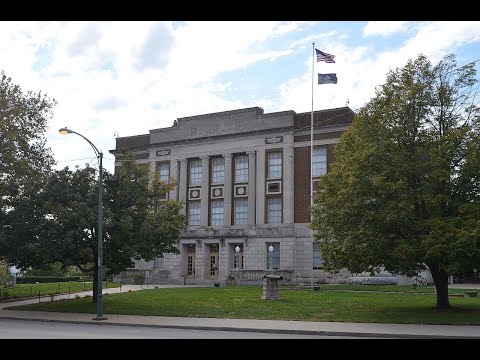
Bourbon County Conservation District urges commissioners to keep $40,000 contribution to preserve state match
Loading...
Summary
Board chair and the district’s sole employee told commissioners that county funding triggers state and federal cost‑share dollars; they warned that cutting county support would end state matching funds and the district’s programs.
Jared Pollack, chair of the Bourbon County Conservation District, and Mandy (the district’s sole employee) asked Bourbon County commissioners to maintain a $40,000 county contribution that the district uses as the local match for state conservation programs.
Pollack said the district serves as a hub for conservation work — coordinating Natural Resources Conservation Service (NRCS) technical assistance, state water resource cost‑share contracts, nonpoint source pollution control funds and cost‑share programs for producers. He told commissioners that county support unlocks larger state and federal investments.
"For every dollar that we get from the county, we give back about $14," Pollack said, adding that the figure is approximate. The district provided a packet showing about $108,000 in state funds and programs flowing through the district in the current year, including state aid and cost‑share programs. Pollack said the district’s direct budget request to the county this year is $40,000.
District representatives described two funding streams: a restricted operating budget (used for payroll, training and limited administrative costs) and an enterprise fund that supports equipment rentals, grass drill operations, firefighting and other fee‑for‑service activities. They said enterprise and special‑levy accounts exist for targeted capital work, such as drill replacement (Pollack cited a 15‑foot drill replacement cost of about $84,000 as a planning benchmark).
Pollack emphasized that the district’s state match is contingent on the county contribution: "If the county commissioners cut us, the state cuts us. So we will cease to exist," he said, noting the district has operated in Bourbon County for roughly 80 years. The district said it has been exploring partnerships with public works and others to direct special‑levy funds to county watershed projects, but those efforts are in early stages.
Mandy described the district’s day‑to‑day operations and outreach to producers, and supervisors on the district board answered questions about capital‑outlay planning and a dedicated account created in the early 1980s to support county conservation projects.
No formal vote occurred at the workshop. Commissioners said they will consider the district’s materials as part of the broader county budget review.