Get Full Government Meeting Transcripts, Videos, & Alerts Forever!
Get email alerts on the Land Use Development topic
No spam. Unsubscribe anytime.
Board rejects Floresta Gardens planned development after traffic, public‑benefit debate
Summary
The Board of County Commissioners, hearing a de novo appeal of the Planning & Zoning Commission denial, declined to approve K. Hovnanian’s Floresta Gardens planned development zoning request, 2–3, after extended discussion about traffic, open space calculations and the public benefits offered by the project.
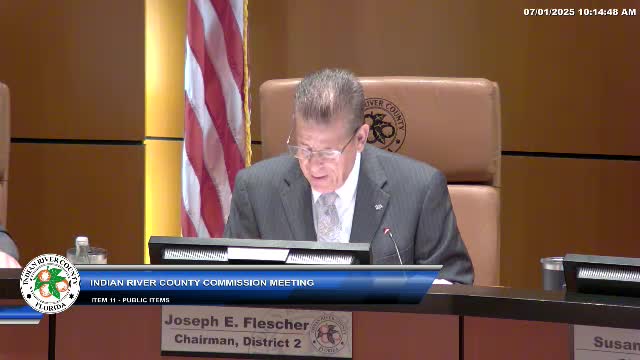
The Indian River County Board of County Commissioners voted 2–3 on July 1, 2025, to deny a requested planned development (PD) rezoning and concurrent preliminary plan for the Floresta Gardens subdivision proposed by K. Hovnanian Southeast Florida Division LLC. The motion to approve staff’s recommendation — with a condition to increase perimeter setbacks on the larger perimeter lots to 10 feet — failed.
The dispute centered on whether the project’s off‑site and on‑site improvements constituted sufficient public benefit to justify reductions in lot width and setbacks the PD requested. The project would have created 44 single‑family lots on roughly 18 acres with an overall density of about 2.43 units per acre and included widening and resurfacing sections of Eighth Street, new curbing and a mid‑block crossing near Glendale Elementary School, a conservation buffer along the property edge, and enhanced tree preservation. Ryan Sweeney, assistant planning and development services director, summarized staff’s analysis and recommendation for approval and said the project’s open‑space calculation — which counts perimeter buffers and stormwater littoral zones — produced roughly 58% open space compared with the L1 underlying requirement of 40%.
The applicant’s attorney, Bruce Barquette, told commissioners the PD would yield only a few more homes than a conventional RS‑3 subdivision and stressed the staff report as the competent, substantial evidentiary basis for approval. “Through the PD process, a project is held to stricter standards and staff has the ability to shape the project to minimize the impact … through things like site design, increased perimeter buffers, and the requirement for public benefits,” Barquette said.
Opponents on the board and some commissioners questioned whether the listed amenities were truly public benefits. Commissioner Moss said she did not see “sufficient public benefit” in the items offered, and Commissioner Erman noted repeated public concerns about Eighth Street’s capacity and long‑term impacts. Commissioners also debated how to interpret the traffic study: staff said the study showed the project did not trigger off‑site capacity improvements and that the county’s level‑of‑service standard allows service down to a D; opponents said even a marginal deterioration on an already narrow local road was a worry.
A proposed compromise to increase setbacks on the 70‑foot perimeter lots from 7.5 feet to 10 feet was offered by the applicant during the hearing and included in the motion that failed. After all discussion, the board recorded the result as a failed motion to approve; the vote count reported on the record was yes 2, no 3 (roll‑call names were not recorded in the meeting transcript). No alternate motion to deny with findings was made on the record; the failure to adopt the rezoning left the Planning & Zoning Commission denial intact.
The hearing was de novo, meaning the Board considered the matter anew, receiving staff presentations, applicant witnesses (including engineer Angie Vitter), and public comment at the podium. Commissioners also requested further guidance and signaled interest in a future workshop on the PD process and how the county defines and quantifies “public benefit.”
The applicant and staff may return with modified proposals or further evidence; no formal schedule for rehearing the application was set on the record.
Votes at a glance: Motion to approve PD rezoning and preliminary PD plan (staff recommendation, conditioned on 10‑foot perimeter setbacks): yes 2, no 3 — motion fails; outcome: no approval recorded.