Get Full Government Meeting Transcripts, Videos, & Alerts Forever!
Get email alerts on the Water Treatment Backwash Pipeline topic
No spam. Unsubscribe anytime.
Amador Water Agency plans pipeline to US Mine to dispose of backwash, says move will cut capital costs
Summary
Amador Water Agency told the Ione City Council its plan to send water-treatment backwash to US Mine via a new pipeline would avoid trucking, cut project costs by about $5 million and reduce sewer discharges that limit plant expansion; council and residents asked about easements, local benefit and oversight.
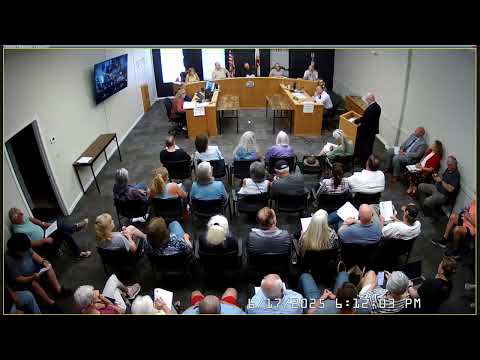
Larry Rose, a representative of Amador Water Agency, told the Ione City Council the agency plans to build a pipeline to deliver filter backwash to US Mine for beneficial reuse, rather than trucking the waste or discharging it to the city sewer system. "The backwash water is considered wastewater. It's not municipal wastewater. It's not, like, domestic sewage, but it is considered wastewater from a regulatory perspective," Rose said.
Rose said the agency currently produces about 75,000 gallons per day of backwash, recycles roughly 90% inside the plant and sends about 7,500 gallons per day to the city's sewer system. Expanding the Ione treatment plant will increase backwash volumes and the agency has concluded it cannot indefinitely rely on the city's constrained sewer capacity. The agency has reached an agreement with US Mine to accept backwash and plans to construct a new pipeline to the mine property.
The agency characterized the arrangement as an avoided capital expense: taking the pipeline-and-connection option reduces the estimated backwash-handling cost from about $11,000,000 at a previous site to approximately $5,400,000 at the mine connection. Rose said the agency has spent about $350,000 on design and forecasted spending roughly $2.5 million on construction in the coming fiscal year. He also described a larger treatment-plant project, at about $19,890,000, and said the board's FY26 budget anticipates spending $9.5 million on that work.
US Mine representatives addressed the council during public comment. Brady Barto, who identified himself as part of ownership and management at US Mine, said the company had agreed to take the backwash after discussions with the water agency but stressed the arrangement was not a guaranteed supply or a profit center. "We're taking it from there. We're spending the money. We're building the pipes inside, and we are obligated to take the water," Barto said, adding the mine could receive no water in some years depending on agency production.
During public comment, residents asked whether the pipeline would require new easements across city property and Howard Park, how the city would be compensated and whether US Mine would receive free water. Rose said parts of the alignment already have easements but other segments need new real-property interests; the agency expects to pay fair market value for any easements it needs to acquire. "Along the alignment of the pipeline that we're planning to construct, there are parts of it where we already have easements, but there are parts that we don't. And so we need to clean that up and make sure that we have the proper real property interest to put a pipeline that's public that's publicly owned by the water agency in there," Rose said.
Some residents voiced concern that the mine could receive an ongoing supply for free. Rose and Barto both disputed that the arrangement primarily benefited US Mine. Rose said the reduced capital cost would lower the agency's revenue needs and therefore be financially superior for ratepayers. Barto said the company did not buy the water for industrial use as part of its operations and that accepting the backwash was not currently a money-making activity for the mine.
Council members and residents also raised questions about capacity and fees. Rose explained that capacity (connection) fees were reviewed and changed in 2021 and that a consultant is recalculating capacity fees as part of a current rate study. He described the agency's long-range financial plan and said the board expects to pursue bonds, apply for a federal low-interest loan and use previously issued bonds to finance roughly $70,000,000 of projects across its service area.
The council took no formal action on the Amador Water Agency presentation. Council members asked to be kept informed about future steps on easements and any city approvals that the agency may request.
Ending: The water agency said it would continue design work and bring property and easement requests to the appropriate bodies as necessary. Residents who pressed for more detail on easements and the distribution of benefits were told the city council would receive specific requests when the agency seeks city action or property interests.