Get Full Government Meeting Transcripts, Videos, & Alerts Forever!
Get email alerts on the Inclusionary Zoning Housing Production topic
No spam. Unsubscribe anytime.
Council asks for interim report on building, demolition and housing policy as developers urge temporary inclusionary relief
Summary
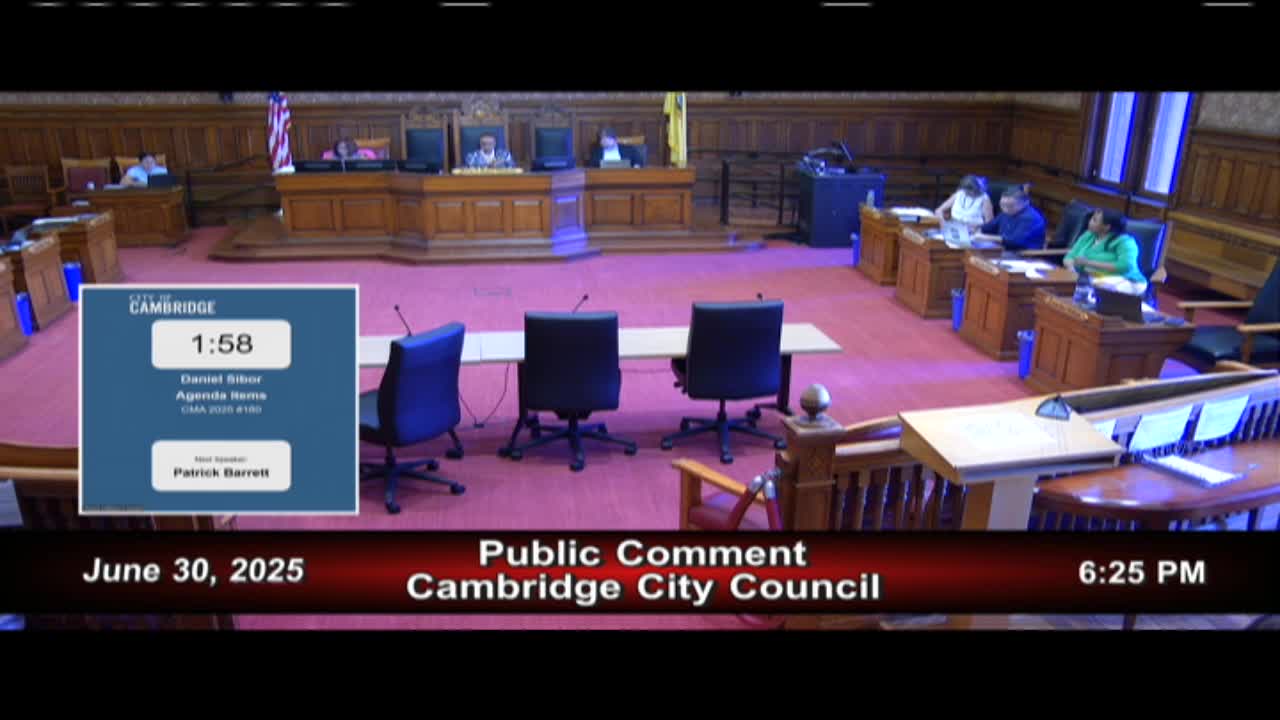
The Cambridge City Council on June 30 directed staff to produce an interim report on demolition and building‑permit trends since the city’s new multifamily zoning took effect and asked planning staff to start a refreshed inclusionary-nexus study in FY26.
What happened On June 30 the Cambridge City Council asked city staff to return with an interim report on demolition requests and building permit applications since the February adoption of the new multifamily (MFH) zoning and requested an expedited RFP and timetable for updating the city’s inclusionary-housing nexus and feasibility study.
Why it matters The inclusionary zoning (IZ) requirement — currently set at 20% — is among Cambridge’s primary tools for creating below‑market housing tied to new development. Developers and some councilors said the higher IZ rate, together with elevated interest rates, tariffs on building materials and other market forces, has made some projects “unfinanceable.” Opponents of changing the IZ rate argued that lowering it would reduce the number of affordable units produced.
What the council asked staff to do - Prepare an interim memo on demolition and building-permit trends under the new MFH zoning for a fall update, and return in September–October with options for policy action; - Begin a full update of the inclusionary “nexus” and feasibility study in FY26, with a final study expected by spring 2026; and - Analyze a menu of possible short- and medium-term interventions staff can present to the council, including a temporary reduction of the IZ set-aside (20% → 10%), tax or fee relief, capital subsidies to underwrite inclusionary units, and exemption/waiver options for permit fees.
What staff told the council CDD and the city manager said the Nexus/feasibility study will start in early FY26 and that a final, legally defensible recommendation on the IZ set‑aside is unlikely before spring 2026. The city manager and planning director outlined a range of actions that differ in speed and complexity: a temporary zoning change lowering the set-aside is technically under council control and could be debated and adopted more quickly; tax incentive programs or capital funding vehicles would require further legal and policy design and, in some cases, state authorization.
What developers and project sponsors said at public comment Several developers and property owners urged the council to move quickly. James Lyman, representing a project at 2400 Mass. Ave., said lowering the set‑aside to 10% would likely turn an unproductive site into one that could produce housing: “10% will be 47 affordable units right now; with 20% we’re building 20% of nothing, which is no affordable units.” Other project representatives said cost increases tied to tariffs, supply chain issues and high interest rates had wiped out margins.
What staff said about transportation and commute trends City staff presented the Transportation Demand Management (TDM) annual report during the meeting. Planner Ryan McKinnon summarized key findings: transit mode share for workers who commute to Cambridge remains depressed compared with pre-pandemic levels, while remote work accounts for a large share of the reduction in single‑occupancy vehicle (SOV) trips. The employee survey showed “more reliable and more frequent buses and trains” as the top levers respondents cited that would make them drive less.
Council debate and likely outcomes Councilors voiced a range of views: some asked for immediate short-term action (temporary IZ reduction) to rescue stalled projects; others urged caution, saying there was mixed evidence that lowering the set‑aside would meaningfully increase housing starts without additional subsidies or changes. Several councilors and staff recommended that any short-term policy be paired with a clear timeline and a commitment to revisit the IZ rate once the updated Nexus study is complete.
Next steps and timing - Interim memo on demolition/building permit trends: requested for the fall 2025 cycle; - Inclusionary zoning nexus/feasibility RFP: to be issued in early FY26, with final analysis expected spring 2026; - Short- and medium-term policy options: staff will return with discrete recommendations and legal analysis (e.g., temporary zoning change language, capital subsidy models, tax/fee relief options) for council consideration.
What to watch The council’s ultimate policy choice will need to balance two aims: increasing the pace of market-rate housing production (and thus the number of inclusionary units delivered) and preserving commitments to high levels of permanently affordable housing. Staff analysis due this fall and the full Nexus study in 2026 will be central to that debate.