Get Full Government Meeting Transcripts, Videos, & Alerts Forever!
Get email alerts on the Land Use And Planning topic
No spam. Unsubscribe anytime.
Planning and Zoning Commission backs land-use and zoning changes to allow sports complex at Golden Ocala World Equestrian Center
Summary
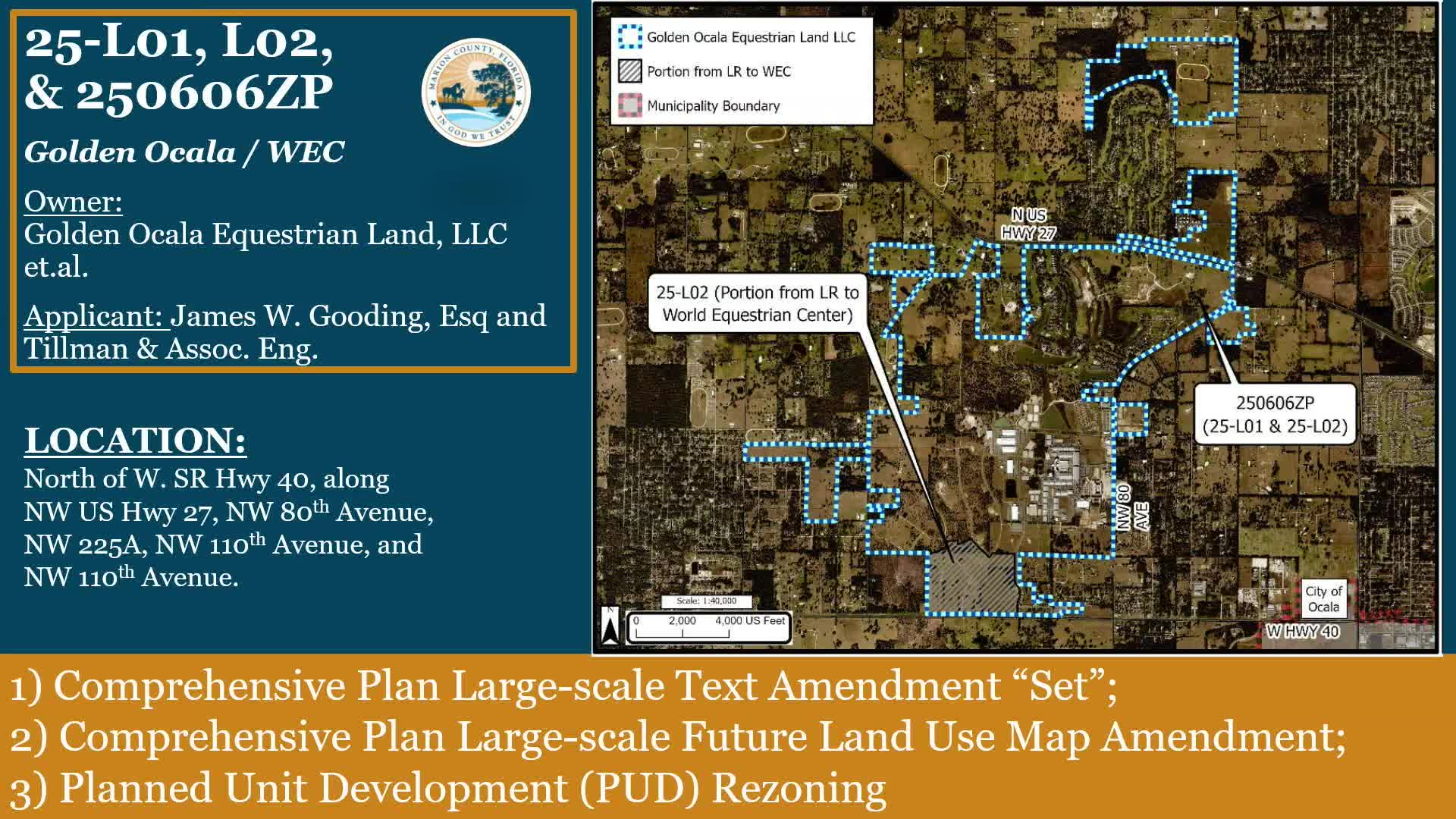
Ocala, Fla. — The Marion County Planning and Zoning Commission on Monday recommended approval of three related applications from the Golden Ocala World Equestrian Center (WEC) to add sports facilities, change about 250 acres of future land use fronting State Road 40, and amend the site's PUD to accommodate new fields, an indoor events building and additional hotel rooms.
Ocala, Fla. — The Marion County Planning and Zoning Commission on Monday recommended approval of three related applications from the Golden Ocala World Equestrian Center (WEC) to add sports facilities, change about 250 acres of future land use fronting State Road 40, and amend the site's PUD to accommodate new fields, an indoor events building and additional hotel rooms.
The commission voted to transmit a text amendment that would expand the WEC future‑land‑use definition to explicitly allow sports facilities, followed by a separate vote to transmit a map amendment changing roughly 250 acres from low‑residential to the WEC designation, and then to recommend approval of the companion PUD amendment. Planning and Zoning Commissioner Mike Behar moved the text amendment recommendation, Andy Bonner seconded, and the motions carried on voice votes.
Why it matters: The proposals would let WEC add multiple synthetic and natural turf fields, multipurpose diamonds, a championship soccer field, an indoor multi‑sport event building and about 300 additional hotel rooms to the Golden Ocala campus. Proponents say the complex would attract tournaments and out‑of‑town visitors who would use on‑site hotels, restaurants and retail, producing measurable economic activity and supporting year‑round use of WEC facilities. Opponents warned the changes would intensify commercial development adjacent to existing horse farms and the county's farmland preservation area, raising concerns about noise, lights, traffic and water demand.
What staff and applicants told the commission: Chris Rising of Growth Services presented the applications and described them as coordinated requests: a text amendment (definitional change to the WEC land‑use), a future‑land‑use map amendment, and a PUD amendment. Rising said the map change area lies within the county's urban growth boundary and is roughly a half‑mile from the farmland preservation area; he also said a traffic methodology was approved and a full traffic study will be completed and reviewed before final adoption.
Applicant representative Jimmy Gooding said the sports complex proposal is intended to be complementary to the equestrian campus, providing indoor and outdoor venues for tournaments, clinics, camps and youth sports. He described high seasonal occupancy at WEC hotels and said additional on‑campus lodging is intended to reduce off‑site trips by keeping visiting teams and families on the WEC campus. David Tillman, the applicant's engineer, said hotel rooms would be added only where demand supports them and that the team intends to phase construction; the Phase‑1 fields could be in service first with indoor facilities and other phases following.
Eric Sullivan, a planning consultant for sports facilities, outlined comparable projects around the Southeast and explained typical program elements: multiple synthetic turf multipurpose fields, grass championship fields, diamond fields for baseball/softball, and a multi‑sport indoor building that can host courts, turf and other activities. Sullivan said such complexes respond to a measurable statewide demand for tournament venues and that integrated hotel and retail space increases internal capture of trips.
Public comment: More than two dozen residents and county stakeholders spoke during the public hearing. Opposition focused on: the location (several speakers said the proposed sports fields should not be sited where they abut large horse farms and the farmland preservation buffer), nighttime lighting and amplified sound, pesticide use on turf fields, water use and potential impacts to springs and the aquifer, and whether the PUD changes would allow non‑equestrian commercial intensification.
Horse Farms Forever and multiple nearby equestrians urged denial or further limitation, saying the WEC brand and surrounding farmland should remain primarily equestrian and agricultural. Several speakers also urged the county to enforce existing buffer and landscaping requirements and questioned whether traffic and public‑safety infrastructure will handle event peaks.
Applicant responses and staff safeguards: Applicants said buffers, cut‑off LED lighting and noise limitations would be incorporated; they have submitted a draft development agreement and told the commission they will provide a more detailed traffic study and a refined sign/lighting plan before final adoption. Staff told the commission the requested map amendment would proceed through a coordinated state review (60 days) and that FDOT and state agencies will be invited to comment on traffic and water impacts. Rising said county staff will coordinate the traffic study, review mitigation proposals and use the development agreement to lock in infrastructure commitments.
Commission discussion and vote: Commissioners asked staff and applicants about the traffic methodology, lighting cutoffs, buffer preservation and building heights. Applicant representatives said they will meet county fire‑service equipment standards (which enable building heights above the old 65‑foot limit) and will work with staff on perimeter height limits. After discussion the commission voted to recommend transmittal of the text amendment (change to the WEC definition), to recommend transmittal of the map amendment, and to recommend the PUD amendment, each by voice vote; the record shows the motions were moved by Commissioner Mike Behar and seconded by Commissioner Andy Bonner.
What happens next: The comprehensive plan amendments (text and map) will be heard by the Board of County Commissioners for transmittal to state and regional reviewing agencies; the county set a tentative transmittal hearing date for July 21. The coordinated state review will run for agency comment (about 60 days), and final local hearings on adoption and on the companion PUD amendment will follow after agencies return comments. The applicant and county staff said a final traffic study will be completed before the adoption hearing and that the development agreement will be revised to reflect mitigation and infrastructure commitments.
Ending note: The Planning and Zoning Commission's favorable recommendation advances the sports facility requests to the county commission and to state review. Opponents stressed that if the commission and county approve the changes, strict, enforceable limits on lighting, noise, water use and permitted commercial activities will be essential to protect adjacent equestrian and agricultural uses.