Get Full Government Meeting Transcripts, Videos, & Alerts Forever!
Get email alerts on the Budget And Finance topic
No spam. Unsubscribe anytime.
Holyoke disability commission seeks revolving account for handicapped-parking fines; finance committee asks for clearer legal language
Summary
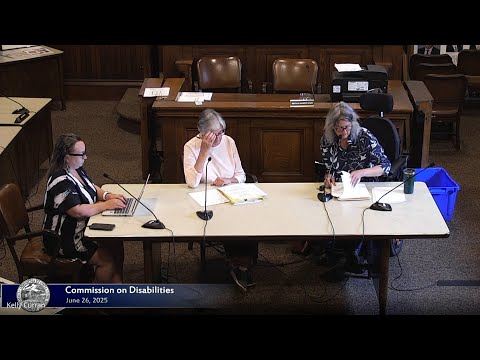
The Holyoke Commission on Disability on June 27 described its multi-month effort to obtain local access to a state-authorized revolving account — referred to in the meeting as “22 g” — that would let the city use handicapped-parking fines for programs serving disabled residents.
The Holyoke Commission on Disability on June 27 described its multi-month effort to obtain local access to a state-authorized revolving account — referred to in the meeting as “22 g” — that would let the city use handicapped-parking fines for programs serving disabled residents.
Lynn Horan, chair of the Holyoke Commission on Disability, said the commission and mayor’s office developed categories for the account and submitted an order to the city finance committee that would create an ongoing, revolving funding source drawn from fines for handicapped-parking violations. “We would like to have access to those funds,” Horan said.
The commission emphasized why it sees a revolving 22 g account as preferable to an annual line-item request: it would give more predictable, multi-year funding for assistive services, transportation and other supports the commission identified. “Stability” was the word Horan used repeatedly to describe the intended benefit to disabled residents.
Commission members and the mayor’s staff told the commission that the mayor’s draft budget included two line items reflecting those categories, and the commission’s budget subcommittee worked with the treasurer and tax-collector offices on practical arrangements. Jessica Libra Martinez, a member of the commission’s budget subcommittee, said she would be willing to serve as the commission’s treasurer if members vote to appoint one after summer recess.
At the same time, Horan said the finance committee has asked the city solicitor to refine the order’s wording. “The order actually wasn’t what we originally submitted,” she said, and the finance committee tabled it to get “a little more firm legal language.” Horan said the solicitor (identified in the meeting as attorney Bissonnette) and other city staff were expected to address those questions, and the commission expected further finance committee review in late summer.
Members discussed one specific implementation question: whether a portion of funds in a 22 g account could be earmarked to support enforcement (parking-ticket enforcement personnel or other enforcement costs). Horan said some councilors raised that possibility during finance committee hearings; she and members plan to weigh whether to recommend giving a share of proceeds to enforcement if that helps secure council support. She said she had reviewed ticket records provided to the commission showing about 850 handicapped-parking tickets issued over the last five years (records include the ticket issuers’ names), and that enforcement is performed by several city staff members.
The commission also described the statutory source of the funds: money derived specifically from handicapped-parking fines, not from other parking revenues. Horan said the commission has been consulting with statewide disability-commission networks and a state witness (identified in the meeting as Jeffrey Dugan) who testified about the statute’s scope and use in other cities.
No formal vote on 22 g access was recorded at the commission meeting; Horan said the commission had previously voted to pursue 22 g and that future votes may be scheduled after the solicitor’s review and the commission gathers additional details. She told members that, if solicitor and finance-committee guidance confirms the approach, the commission should be prepared in August to specify how it would allocate funds — including whether to dedicate a portion to enforcement — so that the commission could respond quickly to the finance committee’s questions.
Horan urged members to review recordings of recent finance committee hearings and the documents the commission has already circulated to councilors. She said the commission had met multiple times with the mayor and staff, and that the mayor had been supportive of pursuing the 22 g account. Horan also emphasized the administrative requirements that would remain in place: accounting to the city and reporting on expenditures even if funds are held in a revolving account.
The commission laid out a next step list that includes awaiting the city solicitor’s revised language, following upcoming finance committee meetings, and preparing a proposed internal spending plan and treasurer appointment for a future commission vote.
The item drew sustained discussion through the meeting but no final local enactment; the finance committee’s direction to seek firmer legal text is the current status.