Get Full Government Meeting Transcripts, Videos, & Alerts Forever!
Get email alerts on the Housing Permitting topic
No spam. Unsubscribe anytime.
Public Works housing coordinator outlines permitting reforms and pushes for predictable, ‘one‑city’ approach
Summary
Housing coordinator Nicholas King described steps to streamline permitting, explained Public Works’ role in right‑of‑way and map functions, and previewed a Clarity software rollout; commissioners urged more proactive predevelopment work for city‑funded projects and discussed potential fee‑for‑service options.
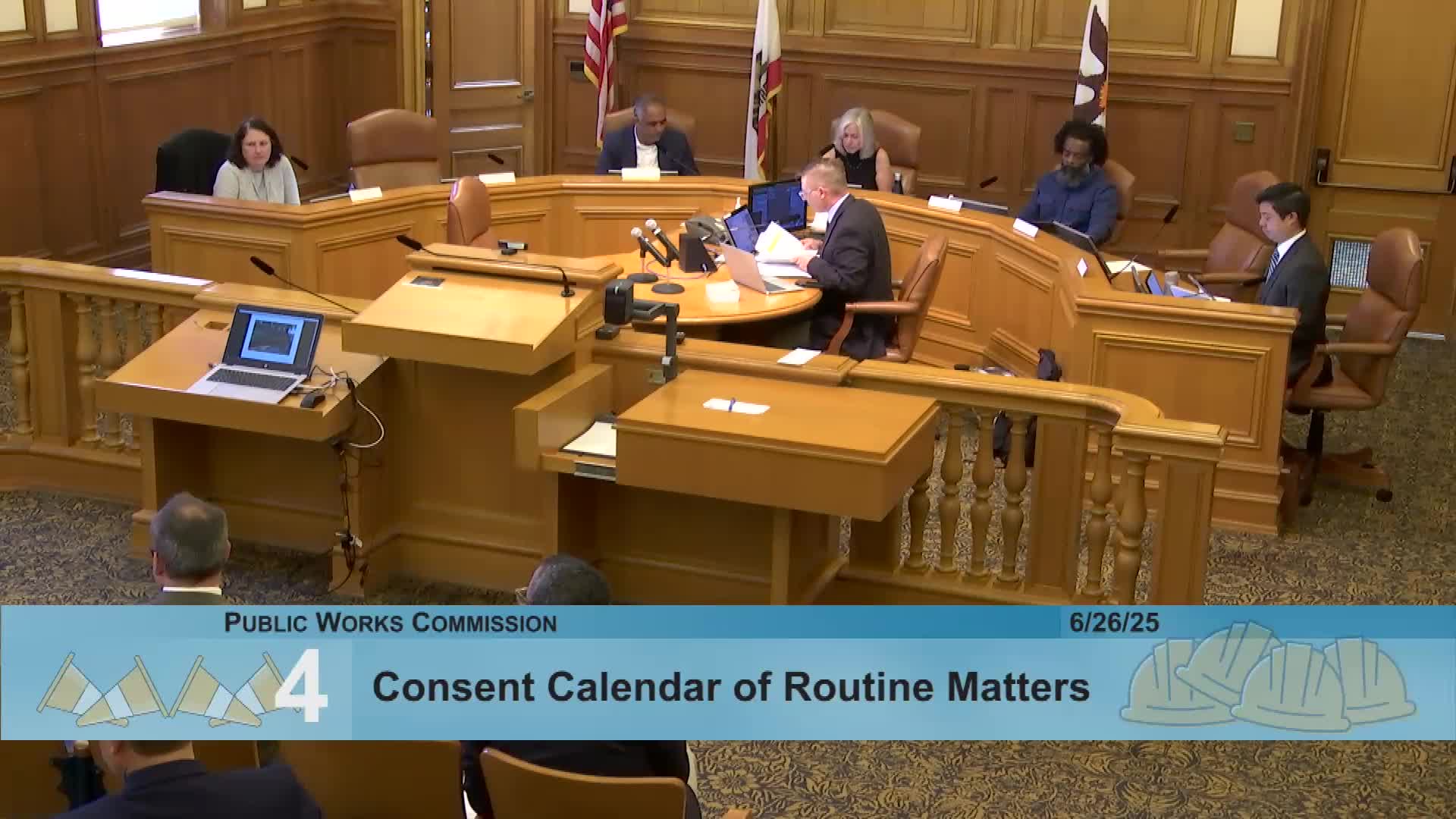
Nicholas King, the department’s housing coordinator, gave commissioners an extensive overview on June 26 of Public Works’ role in housing delivery and the reforms the department is pursuing to make permitting more predictable for builders.
King said the coordinator role dates to at least 2018 and exists to reduce fragmentation so applicants see the city as one client rather than many separate departments. He described the department’s responsibilities when projects touch public land: mapping and addressing curb ramps, sidewalks, right‑of‑way access, tree protection and loading zones. He said a single building project can require reviews from many offices and agencies, and that Public Works often acts to route plans and reconcile competing requirements from fire, MTA, DBI, PUC and others.
King said the department is pursuing clearer checklists at the front door, a software system called Clarity to route and track plan review across agencies, and use of pre‑application processes such as the Street Design Advisory Team (SDAT). He said the department wants to make permit expectations "reasonable and predictable." King also noted external pressures including state housing element requirements and regional housing needs allocations.
Commissioners pressed King on where Public Works can exert leadership with other agencies. Chair Chet Post and several commissioners urged the department to be more assertive with the mayor’s office and other agencies now that city leadership has shifted. Director Carla Short and King said much of the work is collaborative and requires staffing and technical resources at partner agencies, and they pointed to the Clarity rollout as a vehicle to improve visibility and accountability across departments.
Commissioner Gerald Turner pressed the idea of proactive, front‑end site investigations—destructive or investigative predevelopment work—to reveal subsurface or utility constraints before an RFP or financing is issued for city‑funded projects. Turner suggested Public Works could offer those services for city agencies such as the Office of Community Investment and Infrastructure (OCII), the Housing Authority, and HSH, and recover costs via a fee for service to reduce later schedule and cost overruns. King and other managers said similar early‑engagement programs exist (for example SDAT and preapplication meetings) and that the department will explore how to expand proactive services and fee recovery while balancing resource constraints.
King described the current ‘‘Clarity’’ initiative to improve cross‑department plan routing and said Public Works will continue outreach to clarify requirements that frequently surprise applicants. No members of the public spoke on the item.