Get Full Government Meeting Transcripts, Videos, & Alerts Forever!
Get email alerts on the Entertainment Permits topic
No spam. Unsubscribe anytime.
Committee forwards ordinance to streamline entertainment permits to full Board
Summary
San Francisco supervisors’ Public Safety and Neighborhood Services Committee voted 3-0 to send an ordinance that would simplify entertainment permitting — removing some referrals, eliminating certain obsolete permits and changing notice and fee rules — to the full Board of Supervisors with a positive recommendation.
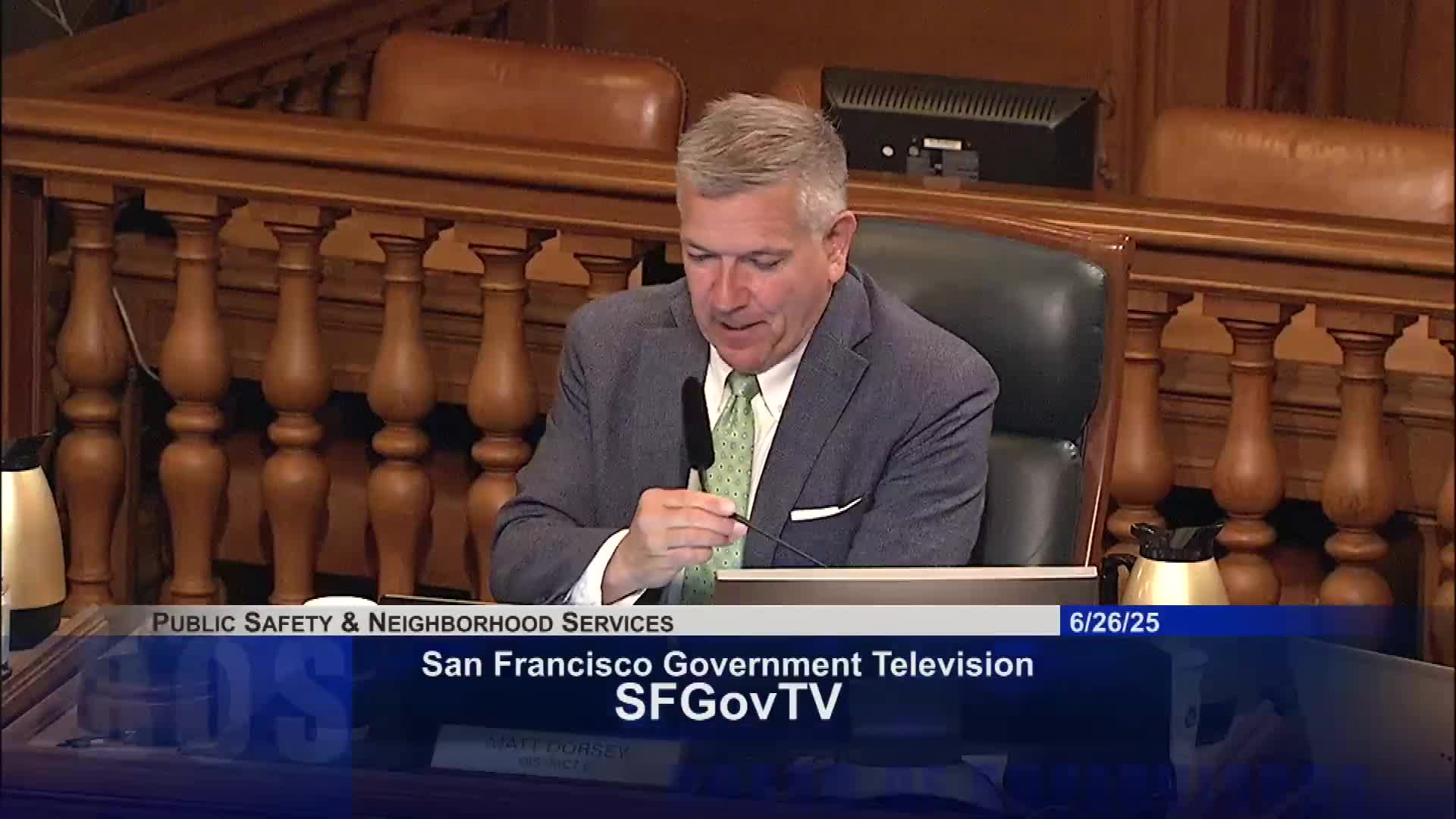
The Public Safety and Neighborhood Services Committee of the San Francisco Board of Supervisors voted 3-0 Thursday to forward to the full board an ordinance that would revise city police-code permitting for entertainment venues and one-time outdoor amplified sound events.
The committee approved the motion to forward with Vice Chair Bilal Mahmood, Supervisor Danny Sauter and Chair Matt Dorsey voting aye. Supervisor Danny Sauter made the motion to send the item to the full Board with a positive recommendation; roll call recorded Member Sauter, aye; Vice Chair Mahmood, aye; Chair Dorsey, aye.
The ordinance, sponsored by the mayor’s office and cosponsored by Supervisors Connie Chan and Danny Sauter, would change multiple elements of the Entertainment Commission’s permit rules. Maggie Wyland, executive director of the Entertainment Commission, told the committee the package is part of the citywide “PermitSF” effort to “cut red tape and modernize entertainment permitting while maintaining essential health, safety, and zoning protections.”
Wyland said the ordinance would remove some referrals that she called duplicative: place-of-entertainment and extended-hours permits would no longer require referral to the Department of Building Inspection; limited live-performance and fixed-place outdoor amplified sound permits would no longer require referral to the Planning Department. “These referrals often delay applications,” Wyland said, adding that both Planning and DBI supported the change.
The measure would also replace an outdated 30-day leaflet requirement with a two-week written notice, retain the code requirement for a 30-day large yellow facade posting and change the filing fee for a one-time outdoor amplified sound permit to a flat $5.58. The ordinance would eliminate permit requirements for “long obsolete” activities such as ball-or-ring-throwing games, masked balls and dance-hall keeper permits, and would align city noise-enforcement definitions with modern sound-measurement practices and national standards.
Supervisor Danny Sauter, a cosponsor, said the changes aim to remove redundant steps that slow small businesses and venues. “Operators and small businesses are fine with going through a process, but they need to know what that process is,” Sauter said, adding that consolidating referrals under one department can reduce last-minute restarts of the permitting process.
The Entertainment Commission’s presentation said the ordinance would change how the commission treats frequent applicants: rather than counting past permits on a rolling 12-month window, a hearing would be required if an applicant had obtained 12 or more permits in the same calendar year. The ordinance would also relax some public-notice requirements for applicants and the Entertainment Commission while keeping existing facade-posting rules.
Wyland said fee-waiver pathways would continue, including waivers tied to city grant funding, and she described the changes as drawn from stakeholder feedback and years of operational experience. “Each change in the ordinance was mapped to a real barrier,” she said.
No members of the public spoke during the committee’s public-comment period for this item. After the presentation and brief discussion, Supervisor Sauter moved to forward the ordinance to the full Board of Supervisors with a positive recommendation. The committee’s clerk recorded three aye votes; the motion passed.
What happens next: the ordinance will appear on the Board of Supervisors agenda on July 8, 2025 unless otherwise stated by the clerk’s office. If the Board adopts the committee recommendation, the code amendments would proceed through the normal ordinance-adoption process.