Get Full Government Meeting Transcripts, Videos, & Alerts Forever!
Get email alerts on the Land Use Data Center topic
No spam. Unsubscribe anytime.
Hearing examiner recommends rezoning for 467-acre data center campus amid neighborhood protest
Summary
Metropolitan Development Commission hearing examiner recommended approval of a rezoning request to allow a multi-building data center campus in Franklin/Warren township area, subject to 35 commitments. Neighbors raised concerns about noise, water use and long-term community impacts.
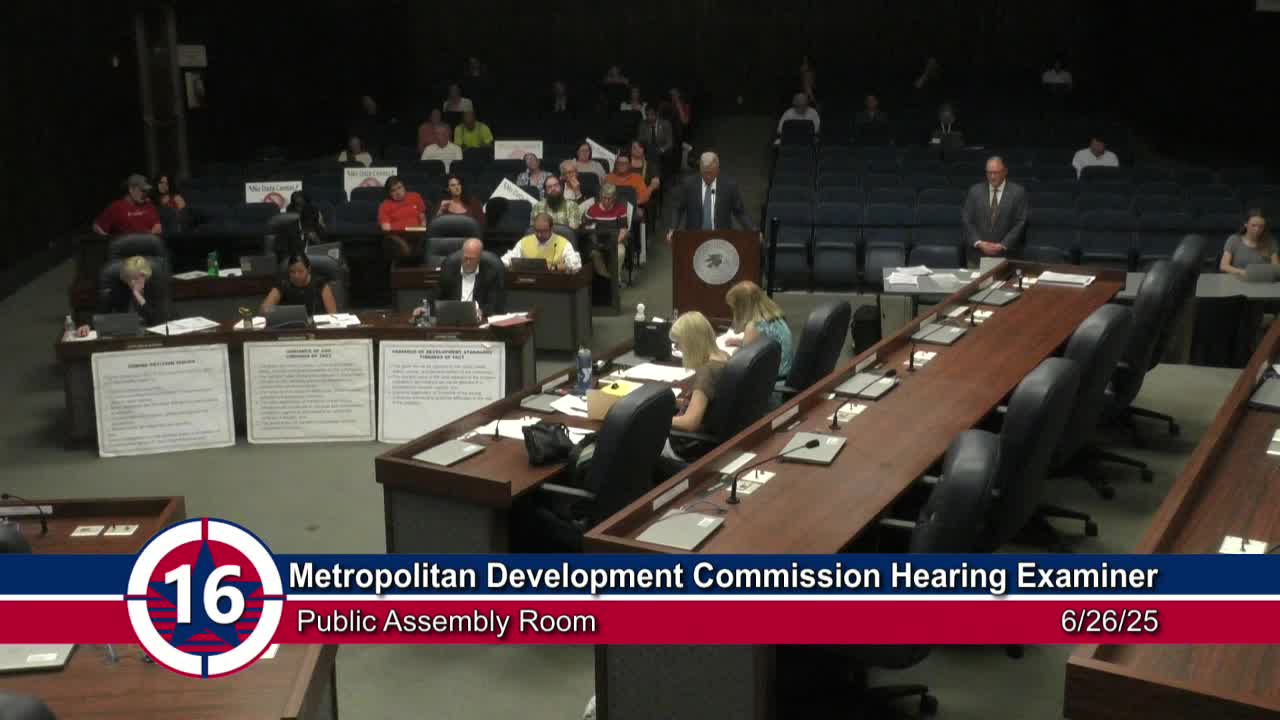
The hearing examiner recommended approval on June 26 of a rezoning petition to allow a multi-building data center campus on about 467.7 acres on the Franklin/Warren Township border, after a contested public hearing with dozens of neighbors in attendance.
The petitioner, represented by attorney Joe Calderon, asked to rezone a large group of parcels to the CS (Commercial Service) district and to grant variances including building heights up to 75 feet and increased front-yard setbacks to permit a campus of data center buildings. “What we're proposing is actually a data center campus,” Calderon said as he described multiple buildings and the project’s utility requirements.
Neighbors and community members urged denial. Several speakers described health, environmental and infrastructure concerns. “My 6‑year‑old son has recurrent autoimmune encephalitis. Environmental overload makes him very ill and causes his brain to swell,” said Meredith Sharp, a nearby resident, who asked for more detailed information on water, noise and electromagnetic fields. Julie Goldsberry, vice president of the Greater Troy Neighborhood Association, said residents worry that utility and emergency‑generator demands will increase local rates and that the project could leave the township paying for infrastructure upgrades. Andrew Filler and other neighbors cited flooding and construction‑traffic impacts.
Staff and utility representatives told the hearing examiner that they had evaluated feasibility and that letters from AES Indiana and Citizens Energy Group were on file. Staff reported an initial noise study showing a peak property‑line level of about 63 dBA under worst‑case conditions and said petitioner commitments set a 65 dBA maximum at the property line for routine operation, with higher levels allowed only for emergency generator testing or emergency operations. Staff also described commitments to bury above‑ground utilities where feasible, to preserve stream protection corridors, and to work with Trails and Greenways on trail routing. The petitioner confirmed commitments to upsize water and sewer mains to the site and to dedicate a large no‑build area between Fisher Ditch and Troy Avenue as open space and trail corridor.
The hearing examiner told speakers she understood the depth of neighborhood concern but noted the comprehensive plan’s recommendations in much of the site for light industrial/office‑industrial uses and the property’s proximity to I‑74 and existing transmission infrastructure. After public comment and staff discussion, the examiner recommended approval “subject to the 35 commitments being proposed,” and said the petition would be placed on the Metropolitan Development Commission agenda for July 16 for final commission action.
The petition drew broad public interest at the hearing. Supporters pointed to potential infrastructure investment and guaranteed commitments for trail connections, upgraded utility lines and buffers. Opponents cited unclear long‑term water and electricity impacts, the possibility of increasing utility rates, noise/light/security concerns, impacts to wildlife and to property values, and the potential that the site could become functionally obsolete in a few decades. Councilor Hart (City‑County Council) said she had reviewed economic models and, while acknowledging utility interest and letters of support, said she could not back the proposal in its current form because of concerns about long‑term opportunity costs for the district and the potential restraints the project could impose on other, job‑creating industrial development nearby.
The hearing examiner’s recommendation does not finalize the rezoning. The petition will appear on the Metropolitan Development Commission agenda on July 16; any final decision may be appealed in accordance with MDC rules.