Get Full Government Meeting Transcripts, Videos, & Alerts Forever!
Get email alerts on the City Governance topic
No spam. Unsubscribe anytime.
Galveston council workshop: Juneteenth museum backing, hot-tax transfer, STR overhaul and budget risks
Summary
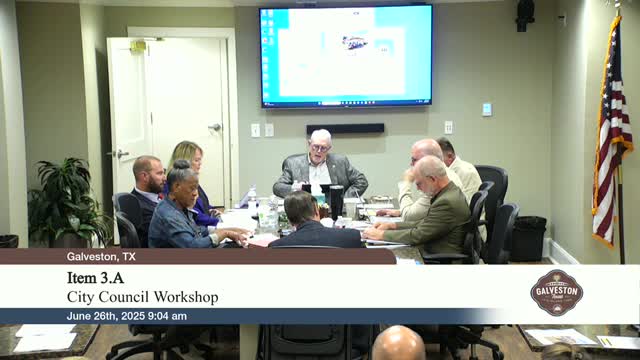
Galveston — Council members and staff used a June 26 workshop to review a broad set of policy items, front‑loading a statement of intent on a Juneteenth Museum, advancing plans for the city to resume collection of hotel‑occupancy tax and STR registration, and previewing a long‑range financial forecast that shows growing gaps between projected revenues and budget requests.
Galveston — Council members and staff used a June 26 workshop to review a broad set of policy items, front‑loading a statement of intent on a Juneteenth Museum, advancing plans for the city to resume collection of hotel‑occupancy tax and short‑term‑rental (STR) registration, and previewing a long‑range financial forecast that shows growing gaps between projected revenues and budget requests.
The meeting mixed early policy signals and technical updates. City staff and outside counsel briefed the council on next steps for the Rosenberg School property conveyance, municipal setting designation (MSD) requests for contaminated sites, water and drainage projects — including the South Shore pump station — and the short‑term‑rental draft ordinance the STR committee is refining.
Why it matters: the workshop threaded several linked choices that affect city finances and services — how the city manages hotel and STR revenues, whether the council asks voters to approve bonds for streets and a replacement fire station, and how much the city can cover growing operating costs without tax increases.
Juneteenth museum: non‑binding city support, not a pledge
Councilmembers discussed a resolution listed as item 12B that would express the city’s support for a Juneteenth Museum and allow city participation in planning and limited technical or financial assistance. "It allows us to look at some funding to provide some technical assistance that will help us with location, with community involvement, with, the decision making that it's gonna take for this major project," said Sharon (staff member). Council members made clear the draft resolution does not commit the city to building or controlling the museum; it is a statement of support and a vehicle to consider future funding requests after a community group presents a plan.
Park Board hot‑tax transfer, Deckard software and STR registration
Staff reviewed a multi‑month effort to move collections and administration of the local hotel‑occupancy tax and STR registration back from the Park Board to the city (target date discussed: October 1). Officials said the shift aims to reduce duplicative transfers and centralize collection and enforcement. Finance staff explained the city previously collected the tax until 2015 and that returning collections to the city would simplify flows and auditing. The council discussed operational impacts on the Park Board and the likely transfer of Park Board staff who handle collections.
Council also discussed the Deckard STR software contract the Park Board currently uses. "The Deckard contract still contains the call center, but as of right now, we don't plan to be using that to answer questions," a staff member said, summarizing the city plan to run customer service through a municipal call center after training. Councilors pressed staff to address reported address errors and mailing problems that led to incorrect notices going to residents. Staff said the city will inherit the software contract for a limited one‑year extension while staff learn the system and evaluate alternatives. The council and STR committee also discussed a short‑term plan to increase weekend enforcement and to expand education and “good‑neighbor” materials for hosts and guests.
STR committee and parking enforcement
The short‑term‑rental committee told the council it will push for short‑term steps now and a broader ordinance rewrite this summer. The committee passed three actions: (1) recommend a short‑term enforcement/education push (more weekend enforcement resources and a customer‑facing education campaign); (2) expand education materials for hosts and guests; and (3) ask planning staff to prepare a draft regulatory amendment based on the committee’s earlier STR ordinance draft and return that to the committee for detailed review (timing discussed: a draft for committee review in August and follow‑up edits thereafter).
Long‑range financial forecast and possible bonds
Finance staff presented a five‑year forecast that shows modest revenue growth but rising costs, leaving a structural gap. Staff used conservative assumptions for property values and modest sales‑tax growth; they forecast general fund revenues near current levels for FY26 and gradual increases thereafter. The forecast showed public safety accounts for roughly 60% of the operating budget, and staff warned that Galveston’s high visitor‑to‑resident ratio (about 167:1 in 2023) creates unusually large public‑safety and infrastructure demands paid largely by a smaller resident base.
As part of longer‑range planning, staff modeled a possible $60 million general obligation bond program (two tranches) to fund fire‑station replacement and street improvements (mill and overlay). Debt modeled as two issues would increase the city’s debt service levy beginning in FY27; staff described a typical approach of partially offsetting debt service through the infrastructure and debt‑service fund to limit the property‑tax increase. Staff said a first tranche might be issued in 2027 and a second tranche two to three years later if voters approve the bond in November 2026.
Fire Station No. 2 replacement: a likely bond candidate
Public safety staff presented a program for a replacement of Fire Station No. 2 near Fifth and Broadway. The existing facility is small, cannot house new ladder/tower apparatus and offers limited crew quarters and storage. Chief M. Varela and staff described apparatus size increases and the department’s desire to house a modern pumper and a reserve tower; building constraints on the current lot mean a two‑story replacement with pull‑through bays must be explored. Staff estimated a planning and construction cost in the multi‑million range (rough order of magnitude discussed $7.5M for a station component inside larger bond assumptions), and chief and staff asked council to consider placing the project in a November bond package.
Rosenberg School conveyance and third‑party fundraising
Assistant City Attorney Trevor Fanning briefed council on negotiations with Galveston ISD and the third‑party donor group whose funds would be used to purchase, demolish and remediate the former Rosenberg School site before conveyance to the city. "They will — the money comes from the third party to them and they convey the property to us," Trevor said, describing the agreed approach: the district receives donor funds, the nonprofit coordinates demolition and environmental work, and Galveston receives the property when remediation and conditions meet council direction. Council and staff emphasized the city will only accept the property when it is clean and ready for the agreed park uses; donors and private contractors are asked to complete core samples and any necessary remediation in advance.
Drainage and pump stations: updates and next steps
Engineering reviewed the Drainage Improvement Pilot (DIP) program and the South Shore pump‑station project. Staff described recent work on Fourteenth Street and other chokepoints and said the South Shore pump station procurement is advancing: utility relocations are underway (gas and communications lines), easements are being negotiated and the contractor is preparing submittals. Staff noted the project remains sensitive to the hurricane season and warned that construction schedules may shift; they promised monthly email updates to council when work begins and said grant conditions (and some GLO reporting) require progress toward an 18‑ to 24‑month timeline for key milestones.
Municipal Setting Designation (MSD) for Sandpiper Cove
A developer representative and environmental consultant briefed council on a request for a Municipal Setting Designation (MSD), a voluntary Texas cleanup tool administered by the Texas Commission on Environmental Quality (TCEQ). The MSD would record a restriction on potable use of groundwater at a specific property that has undergone cleanup; staff reminded council TCEQ must approve the MSD and that the MSD is limited to the parcel enrolled and protective measures recorded with the state.
Arts & Historic Preservation reserves and overage funds
Staff and the Arts and Historic Preservation Advisory Board chair reviewed the board’s budget, the 5% reserve rule set in the municipal ordinance, and an accumulated overage the council can allocate because the ordinance caps the board’s internal reserve at 15% and the council controls unallocated fund balance. Finance staff explained that when the city assumed Park Board budgeting for the arts allocations the fund carried a larger balance; those excess funds have accumulated and, by charter, council determines any use above the ordinance cap. The board asked council to consider directing part of the surplus toward city priorities, including the Juneteenth Museum effort.
Other items discussed
- Short‑term updates: Stewart Beach master planning (RFP expected; a developer prospectus in negotiation) and arts mural awards were discussed by parks staff and Cultural Arts members. - Airport, parking and passes: staff reviewed Seawall and Pocket Park parking passes and enforcement changes as part of a seasonal rollout; council asked for written details on pass types and where they may be purchased. - Sanitation and utilities: staff summarized recent rate adjustments that stabilized sanitation and recycling funds, while water utility modeling suggests future rate work will be needed to match infrastructure recommendations in the forthcoming water‑and‑sewer master plan. - Manhole “super‑covers”: public works has deployed an initial batch of anti‑backflow manhole covers in key problem areas and ordered follow‑on units. - Lasker Pool: community groups asked about extending seasonal hours and options for additional funding to support longer or year‑round lap‑swim hours; staff said they will return cost estimates for extended winter heating and operations.
Where things go next
Staff will bring a number of items back to the council for formal action: the Juneteenth Museum resolution in a regular meeting packet; draft STR regulatory amendments after further committee and planning commission review (committee requested a draft back in August for detailed edits); updates to the budget timeline (staff proposed August 28 for the budget hearing with a follow‑up tax‑rate hearing in mid‑September); pump‑station easement progress and a construction schedule; and a bond package framework (timing and amounts to be finalized by council ahead of any November vote).
Ending
Council members closed the workshop by asking staff to return with written updates on the STR software transition and Park Board HOT transfer, an August draft of STR ordinance changes for committee review, an updated DIP spending and priority list, a public engagement plan for the South Shore pump‑station construction, and written cost estimates for a longer Lasker Pool season. Several council members urged faster short‑term enforcement and expanded weekend marshal coverage to address parking and littering during high‑visitor periods.
Sources: City of Galveston June 26, 2025 council workshop transcript and staff presentations.