Get Full Government Meeting Transcripts, Videos, & Alerts Forever!
Get email alerts on the Homelessness topic
No spam. Unsubscribe anytime.
Irving council hears pleas to reallocate ARPA funds, outlines short- and long-term 'clean and safe' steps for downtown homelessness
Summary
City staff and downtown service providers described elevated patrols, bench removals and coordination with nonprofits; residents urged council to reallocate $2 million in HOME-ARPA funds to homelessness services and form a diversion task force.
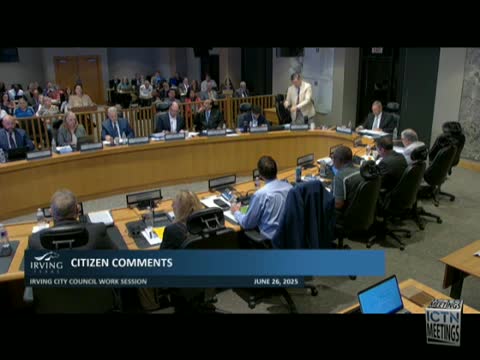
Several Irving residents and nonprofit leaders urged the City Council on June 25 to redirect federal HOME-ARPA dollars and to pursue longer-term housing solutions for people living outdoors in the Heritage District and other parts of Irving.
At the start of the meeting, Laura Anderson, a resident who identified her address in Irving, told the council the presentation they were about to receive on “clean and safe strategies” was too narrow and did not reflect service-provider input. Anderson asked council members to “place this item on the next council agenda” to consider reallocating $2,000,000 in HOME-ARPA funds now set for a domestic-violence shelter toward homelessness services and to form a homelessness diversion task force including nonprofits, churches, the school district, the Housing and Human Services Board and Irving Police Department outreach officers.
Lana Hansen, founder and executive director of Many Helping Hands, said her organization regularly brings about 40 people a day to its day center for meals, showers and services and urged the council to return the $2,000,000 to homeless services while a longer-term domestic-violence shelter remains uncertain. “Criminalizing homelessness is costly and ineffective,” Hansen said, urging funding to expand day-center hours, case management and job opportunities for people who are homeless.
Business owners also spoke. Tammy Kane, who operates Do’s Coffee Shop in West Irving Boulevard, said she allows some people to stay on a small area behind her business under rules set by her staff and asked what would happen to those neighbors if enforcement increased. “They are safe, and they take care of my property,” Kane said.
After public comment, city staff presented the council with a multi-department summary of current responses and possible next steps. Imelda Stec, senior manager for housing and redevelopment, described short-term actions already under way: elevated police patrols, removal of benches on Irving Boulevard and Main Street, increased litter abatement and a review of permitting and sanitation requirements for public food distributions. Katherine Johnson, manager of health inspections, said temporary food permits are required for some feedings involving time/temperature-controlled foods and that stricter enforcement or permit conditions could be applied, including cleanup responsibilities.
Scott Crossmill, assistant director of parks, described bench removals over a Memorial Day weekend and plans to retrofit benches with center armrests to deter overnight sleeping until a permanent approach is adopted. Stec said the city is coordinating with Housing Forward, the regional Continuum of Care lead, which is deploying outreach workers whose work can be paired with Irving Police Department’s Homeless Outreach Team (HOT). The city also plans to open a Catholic Charities–run diversion program in August. Stec noted the city’s HOME-ARPA allocation (about $2.9 million) remains largely unspent while $2 million was designated previously for shelter development and $400,000 for supportive services.
The staff presentation listed policy options for council consideration: ordinance updates (including defining abandoned property and reviewing solicitation and camping rules), design and infrastructure measures (bench retrofits and public-space design), a multidisciplinary outreach team that pairs enforcement with housing and behavioral-health outreach, and funding mechanisms (for example, a property-owner funded district) to finance ongoing downtown maintenance and safety measures.
Council members and attendees debated next steps and the pace of action. Several council members urged more coordination with local nonprofits and greater use of existing city outreach tools, including HMIS (the regional homeless-management information system) and earlier, small-city grant experiments that funded hotel placements and other emergency assistance.
No formal council vote was recorded during the work session portion on reallocating HOME-ARPA funds; staff told council they would return with additional analysis and potential ordinance language if council wanted to pursue changes.
Ending: Council members asked staff to continue coordination with Housing Forward, nonprofit operators and Irving Police Department’s HOT unit and to return with options and timelines for ordinance changes, permitting adjustments and possible funding mechanisms. Several council members signaled interest in amending the HOME-ARPA plan if federal funding or timelines for the domestic-violence shelter change.