
Brownsburg council rejects MI Homes rezone for Auburn Ridge West after traffic and process concerns
Get AI-powered insights, summaries, and transcripts
Sign Up Free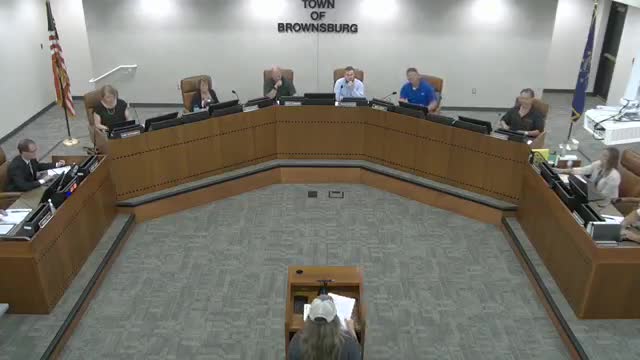
Summary
The Town of Brownsburg Town Council voted 3-2 to defeat an ordinance that would have rezoned farmland west of Auburn Ridge from agricultural to R2, after extended public comment and council debate about traffic, infrastructure and whether the revised application was substantially different from the version denied in February.
The Town of Brownsburg Town Council voted 3-2 on June 26 to defeat Ordinance 20-25-10, a rezoning request from agricultural (AG) to R2 for the Auburn Ridge West development proposed by MI Homes.
Supporters and opponents clashed over whether the application had changed enough since it was denied in February and whether local roads could handle added traffic. The weeks-long revision process reduced the proposal from an initial request for 124 units (R3) to a final plan for 90 lots under R2 zoning. Jonathan Isaacs, director of land acquisition for MI Homes, told the council the company had reduced the unit count “down to 90 units” and committed $3,000 per lot to an escrow account the town could use for road improvements. He also said an additional $2,750 per unit would be held in a joint pot the town and county must agree how to spend.
The revision and the developer’s commitments did not satisfy several residents who addressed the council during the public-comment period. Emily Simmons of Autumn Trail said the plan “is the same proposal that you reviewed and found unfavorable just 4 months ago,” citing the Unified Development Ordinance’s (UDO) refile restrictions. David Wyant told the council, “If I don't see any substantial changes between A and B, I don't even know why we're talking,” and asked staff to explain why the item was on the agenda after its February denial. Bill Gosnell and Rob Kendall also urged the council to reject the rezone, arguing the proposal did not match the surrounding neighborhood’s character and would strain roads and schools.
Council discussion focused heavily on traffic. The developer said a traffic study had been submitted and reviewed; Isaacs said the study showed intersections would remain at acceptable levels of service and that the proposed lot count of 90 produced no traffic study “identified issues.” Several council members and residents disagreed that background growth and nearby projects had been fully accounted for, pointing to nearby construction and planned warehouses as additional loading on the network. Councilors and staff discussed longer-term improvements, including potential Northfield/Green Street upgrades and a future interchange on Ronald Reagan Parkway that officials estimated could take seven to eight years to complete through federal and state processes.
The council also discussed whether the application met the UDO standard that a denied rezoning cannot be refiled within one year unless “substantial changes” address the reasons for denial or the administrator waives the waiting period. Town staff noted the plan commission had reviewed the revised application and forwarded it to council with a 6-1 favorable recommendation; staff said the UDO’s refile provision applies to council action and that the administrator may waive the waiting period based on adjacent land uses or other factors. Several residents said they had not been given a written explanation for any claimed waiver.
When the motion to approve Ordinance 20-25-10 on first and second reading was called, the roll call vote was: Councilor Adams — no; Councilor Lacey — yes; Councilor Simpson — no; Councilor Hillman — no; Council President — yes. With two votes in favor and three opposed, the motion failed and the ordinance was defeated. Town counsel subsequently confirmed the council’s rejection constituted a defeat under applicable Indiana law.
The developer said the project would have been built in phases and estimated earliest building permits in summer 2027 if approved, with streets placed in spring 2027 and permits available three months after that. Isaacs also described site details the developer had offered: about 90 lots on roughly 64 acres (approximately 1.04 dwelling units per acre), a mix of larger lots south of the creek with side-load garages and brick wainscot requirements, preservation of tree lines adjacent to certain lots, adherence to the town’s recently adopted UDO architectural standards, and flexibility that would allow the $3,000 per-lot escrow to be used for a broader set of road improvements beyond Tilden Drive.
The council’s vote preserves the status quo zoning for the property. Several residents and councilors signaled they expect the developer to revise the proposal or return with additional studies or commitments. The council also noted the applicant has a 90-day window certified May 28 at the plan commission level; staff said that certification starts a 90-day period in which action is required if the applicant pursues further readings or resubmittal.