Get Full Government Meeting Transcripts, Videos, & Alerts Forever!
Get email alerts on the Invasive Species And Water Quality topic
No spam. Unsubscribe anytime.
County staff report rising cyanobacteria calls, expanded invasive-species work and roadside buckthorn concerns
Summary
Ashland County staff reported increased inland lake cyanobacteria (blue-green algae) monitoring, expanded invasive-species removal and education, and committee members raised roadside buckthorn control and coordination with highway and utility contractors.
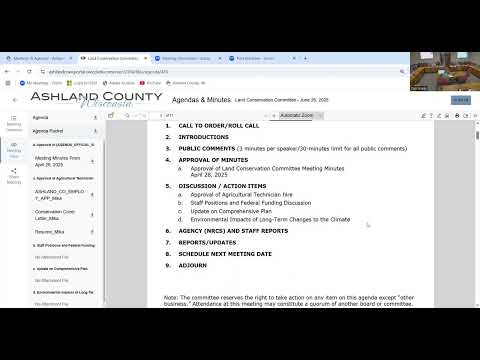
County conservation staff reported higher-than-normal interest in cyanobacteria (blue-green algae) on inland lakes, updated their aquatic invasive species (AIS) monitoring plans, and described expanded school and public outreach. Separately, committee members pressed for coordinated roadside buckthorn control with highway and utility contractors.
Scott Keaven, land-and-water specialist, said the department will monitor at least eight inland lakes and about 15 high-traffic Lake Superior sites this season and has received an increasing number of public reports. He said cyanobacteria conditions have prompted public-health coordination: "...it can be really, really harmful to, both humans and also pets as well. So, dogs and then also, I would say small children as well. Probably dogs are the the most susceptible... it can lead to definitely severe illness or even death." Scott said the department will post state blue-green algae public-health signs at affected lakes and coordinate messaging with public-health partners.
Ellie, the watershed project coordinator, described a busy outreach season: tree plantings with schools, classroom visits, invasive-species hand-pulls (garlic mustard and yellow iris), and a social-media "creature feature" to educate residents.
On invasive-species prevention at boat launches, staff will continue Clean Boats, Clean Waters outreach at launches such as Kreher and Second Landing and said Lake Superior has seen fewer blue-green events than inland lakes but that low lake levels raise concern.
Committee members also raised buckthorn growth along roadsides. Pat Kinney and others proposed seeking state-funded roadside brushing or coordinated treatments so that after county or state brushing, contractors could apply herbicide or otherwise treat regrowth. Pat noted that cutting alone can stimulate resprouting and recommended follow-up treatment; the committee discussed referring the matter to the highway committee to pursue funding and operational coordination with utility contractors that do power-line brushing.
The committee also discussed the proposed pipeline (Line 5) construction timeline and raised the possibility that heavy construction might offer opportunities for conservation-enhancement actions if landowners or contractors were willing to coordinate. Dan noted permitting and construction were moving quickly and that an Army Corps permit could be issued soon.
Next steps: staff will continue AIS monitoring and public-health notifications, coordinate outreach with partners, and committee members suggested forwarding a roadside-buckthorn agenda item to the county highway committee to explore funding and operational options.