Get Full Government Meeting Transcripts, Videos, & Alerts Forever!
Get email alerts on the Broadband topic
No spam. Unsubscribe anytime.
Fiber2Go outlines South Texas Broadband Coalition and BEAD grant approach to Dimmit County
Summary
A Fiber2Go representative presented a regional coalition model tied to the federal BEAD program for Dimmit County to consider; the presentation was informational and no action or MOU was taken at the meeting.
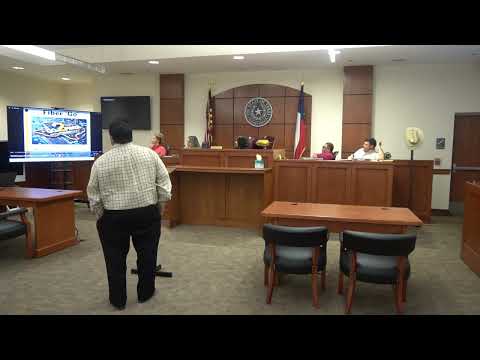
A representative of Fiber2Go Corporation presented the South Texas Broadband Coalition to the Dimmit County Commissioners Court as an informational item, describing a coalition-based approach to pursuing federal Broadband Equity, Access, and Deployment (BEAD) funding for unserved and underserved areas.
The presenter said the coalition would link 15 South Texas counties with a proposed 600-mile fiber backbone, offer a hybrid deployment model (fiber, fixed wireless, free-space optics) and allow each county to retain local control of its individual grant while benefitting from coordinated planning, cost sharing and redundancy. "Forming a regional broadband coalition and partnering with a telecom carrier alliance is a strategic way for counties to maximize their BEAD application score, reduce deployment costs, and strengthen long term infrastructure resilience without giving up local control," the presenter told the court.
The presenter described BEAD as a federal initiative to expand high‑speed internet across the U.S. and said Texas had been allocated approximately $3.3 billion. He said Fiber2Go is a Texas-based competitive local exchange carrier and is leading the formation of the coalition and offering services including engineering support, match-waiver strategies and application assistance.
Commissioners and court staff clarified that the item was on the agenda for information only and no memorandum of understanding (MOU) or other binding action was before the court. A county representative confirmed a local contact — identified in the presentation as working with Fiber2Go on grant matters — had registered to apply for BEAD but did not appear at the meeting. Premier Engineering delivered part of the presentation and said the coalition would submit a unified application subdivided by project-area units so each county’s plan remains administratively separate.
The presentation included estimated costs and scale: the presenter described a Phase 1 investment estimate of about $125 million to serve an estimated 6,200 residential, business and public sites across the 15 counties, and a conceptual statewide ring described at a much larger scale. Court members were shown maps and technical descriptions of proposed backbone capacities and redundancy features.
Because the item was informational, the court took no formal action. Court staff said any MOU or formal participation agreement would have to be placed on a future agenda if the court wished to consider authorizing a signature or committing county resources.
The presenter provided contact information and invited counties to sign a nonbinding MOU to begin detailed technical and application work.