Get Full Government Meeting Transcripts, Videos, & Alerts Forever!
Get email alerts on the Comprehensive Planning topic
No spam. Unsubscribe anytime.
Committee advances comprehensive-plan outreach; discusses NIACS guides, tree sale materials and poster contest
Summary
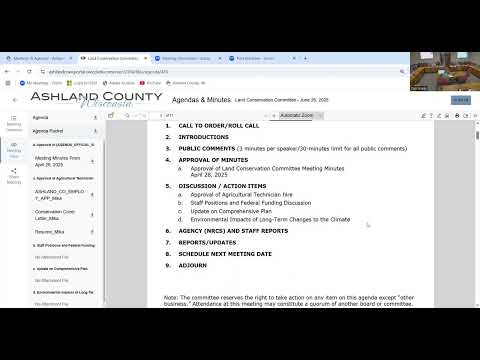
Ashland County's land conservation committee updated the comprehensive-plan process, discussed using Northern Institute of Applied Climate Science (NIACS) resources in outreach and tree-sale materials, and considered avenues to raise public awareness including the NACD poster contest and partner outreach.
The Ashland County Land Conservation Committee reviewed progress on the county comprehensive plan, agreed outreach and public awareness are priorities for the next phase, and discussed using climate-adaptation resources in public-facing materials.
Pat Kinney, a planning committee member, said the county has started working with the Northwest Regional Planning Commission to update data in the plan and that individual committee members have divided sections of the plan among working groups. "Right now, we're at a level of needing to begin working as working groups to gather information from experts and residents of the county," Pat said, emphasizing publicity to solicit public input.
Committee members discussed using the annual conservation poster contest as one publicity tool. Scott Keaven, land-and-water specialist, explained the poster theme is set at the federal level by the National Association of Conservation Districts (NACD) and adopted state-wide, limiting local changes unless the county ran a separate contest.
Several members proposed inviting the Northern Institute of Applied Climate Science (NIACS) to present to the public or to make its resources available via the county website. George Boussay suggested distributing NIACS adaptation material at the county tree sale: "...allocate part of the proceeds of the tree sale, to have the copies of that as a handout when people come to pick up their trees." Scott said the department already links NIACS resources and a one-page handout to the county site and that the full adaptation guide is more technical and intended for resource managers, but additional one-page summaries could be made broadly available.
Members discussed delivery formats (public workshops, working-group meetings, school outreach) and partners who could draw audiences, including UW Extension and regional organizations. Charlie Ortman and others suggested co-sponsorships and seeking continuing-education credits for teachers and government staff to boost attendance for multi-week workshops.
Next steps identified by the committee included continuing the consultant contracting (Northwest Regional Planning), raising public visibility for plan sections as they are reviewed, and exploring targeted events or workshops in coordination with partners to gather public input that will feed into the comprehensive-plan update.