Get Full Government Meeting Transcripts, Videos, & Alerts Forever!
Get email alerts on the Recycling Modernization Act topic
No spam. Unsubscribe anytime.
Benton County officials outline what Oregon—s Recycling Modernization Act will add to curbside recycling starting July 1
Summary
Benton County staff and a Republic Services recycling educator explained the state—s Recycling Modernization Act (RMA), what items residents can place in curbside carts beginning July 1, how the program will be administered statewide, and where additional depot services may expand locally.
Bailey Payne, Benton County solid waste program coordinator, and Kenny Larson, municipal administrator and recycling education coordinator for Republic Services in Western Oregon, reviewed the state—s Recycling Modernization Act and how it will change local recycling collection and depot services.
The program will add specified packaging items to the statewide curbside list beginning July 1 and phase in additional depot-accepted materials later, speakers said. "On average, each Benton County resident recycles or composts 2.1 pounds per person per day," Payne said, and currently residents throw away about 4.6 pounds per person per day. He said Oregon—s overall recovery rate had fallen to 31.5 percent and the state is targeting higher recovery rates.
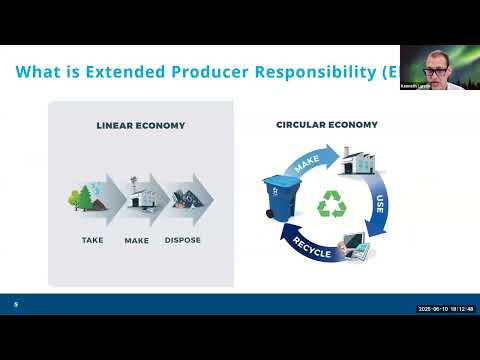
Why it matters: the RMA establishes an extended-producer-responsibility framework, shifting part of the cost and administration of recycling to product manufacturers and a state-selected administrator. County staff said the law aims to standardize what is recyclable across all Oregon jurisdictions, improve domestic markets for recycled materials and fund infrastructure and education in areas that currently lack services.
The state selected the Circular Action Alliance to run the producer responsibility organization (PRO) that will collect payments from producers and allocate funding for program expansion and processor support, Larson said. Larson said the PRO will also support audits and a certified chain-of-custody process for materials sold to end markets and include requirements intended to raise processor labor standards.
What changes July 1: speakers said the curbside additions mandated by the state include polycoated (aseptic) cartons such as milk and broth cartons, a broader set of plastic tubs (including some #1, #2 and #5 tubs), buckets when they meet resin and cleanliness standards, and other packaging types that the statewide list specifies. "Empty, clean and dry" will remain the guideline for curbside items, Larson said.
Depot expansions to follow: county and Republic Services staff said more materials will be accepted at local depot sites on a phased schedule. Possible depot-accepted items mentioned for phased rollout include aerosol containers, aluminum foil, shredded paper (in a separate depot stream), polyethylene film, scrap metal, and large appliances (with restrictions for appliances containing refrigerants). Styrofoam and certain thermoformed "clamshell" containers were described as unresolved or excluded for now because of market and processing constraints.
Apartment and multifamily outreach: speakers said reaching multifamily complexes is logistically harder because landlord billing addresses are the default contact point. Larson said the state has allocated roughly $2,000,000 for a statewide public-information campaign that will include TV, radio and online advertising, and the PRO and local haulers will distribute guides and mailings. The RMA also directs study and eventual requirements for multifamily recycling access, Larson said.
Local notes and timeline: county staff said the state—s phased rollout prioritizes rural areas with little or no recycling access; Benton County and nearby Willamette Valley areas are already comparatively well served. Speakers said Republic Services will continue to perform collection operations; implementation for curbside acceptance follows the state rule effective July 1, and depot expansions and other operational details will follow as the state and PRO finalize implementation.
Questions from attendees covered mixed-material items, lids and small metal items. Larson said bottle caps may remain on containers so long as containers are empty, clean and dry; small scrap metal will be accepted if less than 10 pounds and shorter than 18 inches on the longest dimension, while wires and "tanglers" will be excluded because they can damage sorting equipment. He said many thermoformed clear clamshells are not on the initial list because the cost to process and find markets remains high.
Speakers directed residents to mailed guides, county and hauler email lists, and a forthcoming recording of the presentation. Payne asked attendees to register or provide email addresses to receive the recording and the county—s RMA materials. "If you email me, I can make sure you get on any county mailing lists," Payne said.