Get Full Government Meeting Transcripts, Videos, & Alerts Forever!
Get email alerts on the Personnel Budget topic
No spam. Unsubscribe anytime.
Committee presses Office of Collective Bargaining, Division of Personnel on vacancies, backlogs and retro pay during FY26 budget hearing
Summary
Legislators questioned staffing levels, vacant-position accounting, collective bargaining backlog and retroactive pay as the Office of Collective Bargaining and the Division of Personnel presented their fiscal 2026 budgets.
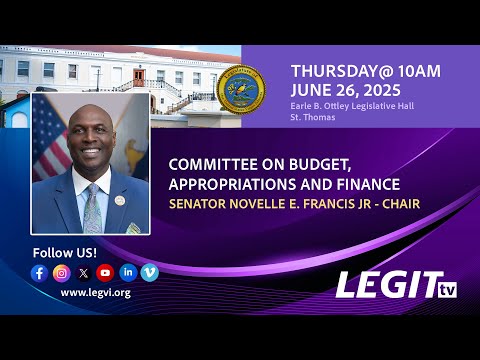
Legislators on the Committee on Budget, Appropriations and Finance pressed the Office of Collective Bargaining (OCB) and the Division of Personnel about staffing levels, vacant-position funding and a backlog of unresolved cases during a fiscal 2026 budget hearing.
The committee heard that OCB requested a FY26 operating budget of $1,263,391 and that the Division of Personnel sought just over $63,300,000 to run human-resources functions for the government. Committee members focused most of their questions on the number of vacant positions, retroactive pay calculations and OCB's capacity to negotiate outstanding contracts.
Why it matters: committee members said the combination of many expired contracts, a large number of pending arbitration or grievance cases and budgeted but unfilled positions creates fiscal uncertainty and potential for repeated retroactive payments to employees. Lawmakers pressed agency leaders for clearer broken-out accounting of vacant positions and their fringe costs and for steps to reduce negotiation backlogs.
Key facts and exchanges
- Staffing and vacancies: Director Richardson (Division of Personnel) told senators the government employs 5,887 people and that the reported average salary is $55,219. Committee members asked for and received a breakout of vacant-position salary totals: an unclassified vacant salary total reported as $143,800 and a classified vacant salary total reported as $663,000. OCB later provided its own breakout for vacant positions, saying the personnel portion totaled $186,421 and fringe $90,941. A staff response to a committee question noted 49 vacant positions were included in the personnel variance discussion.
- OCB caseload and contracts: During questioning Senator Joseph asked whether the OCB structure should be changed, saying, "you have 33 bargaining units. You have 32 collective bargaining agreements, 17 expired, 15 current." Josh Springer, identified as chief negotiator for the Office of Collective Bargaining, replied, "I'm open to reviewing the structure and taking suggestions on, whether the structure should be changed." Springer said the office has been reviewing procedures and that past budget hearings raised similar concerns.
- Backlog and closures: Committee members cited that OCB had about 367 pending cases and that the office had closed about 9% of cases between October 2024 and 2025; those figures were discussed on the record during the hearing.
- Referrals and hires: Director Richardson said the Division of Personnel produced 2,945 referrals to agencies for interviews; the agency reported roughly 126 resulting hires from that referral pool and said the number of hires from those referrals was under 200 in the most recent reporting period. Richardson attributed part of the difficulty to applicants applying to multiple positions and to mid‑May data pulls that were later adjusted because of retroactive salary processing.
- Contract negotiations and timelines: Josh Springer confirmed SIU Masters' contract expired Sept. 30, 2023, and said negotiations for that unit were scheduled to resume in July. Springer reiterated that some suggested structural changes (for example, deputy negotiators) had been discussed previously but that operational details, approvals and the scope of delegated authority would shape any reforms.
- Compensation and retro pay: Committee members placed figures from the compensation report on the record, stating the governor's salary was listed as $201,692 and the lieutenant governor's as $176,642.55 with an effective date of Jan. 13, 2025. Committee members and staff discussed whether retroactive pay had been processed and noted that Department of Finance must confirm actual retro amounts if processed. Director Richardson and other staff said reconciling retroactive data remains a priority to avoid payment disputes.
- Use of data and workforce analysis: Director Richardson said the Division of Personnel is updating old job descriptions and using demographic data to guide recruitment and policy decisions. She said the division does not have internal staffing capacity for a full workforce restructuring analysis and would likely need external consultants to undertake a comprehensive review. Richardson added that some automation and AI pilots are under way in a few agencies and that agency heads have been encouraged to re-evaluate organizational structure where automation has changed job functions.
Context and next steps
Committee members repeatedly urged clearer line-item breakouts for vacant positions and their associated fringe costs for FY26, and they requested corrected figures in the post-audit report so the committee can complete its review. Senators and staff asked OCB and the Division of Personnel to reconcile retroactive-pay calculations, provide public-facing templates showing how retro amounts were computed, and to provide a corrected post-audit report where line items for "classified" and "unclassified" vacant positions were reported in the wrong places.
No formal votes or budget approvals occurred during the hearing; the session proceeded as part of the committee's ongoing reviews of agency FY26 budget requests. The committee adjourned after hearing testimony from OCB, the Division of Personnel, the Department of Labor and the Public Service Commission.