Get Full Government Meeting Transcripts, Videos, & Alerts Forever!
Get email alerts on the Alternative Standards Road Design topic
No spam. Unsubscribe anytime.
Hideout planning commissioners recommend revised standards allowing limited street and sidewalk alternatives
Summary
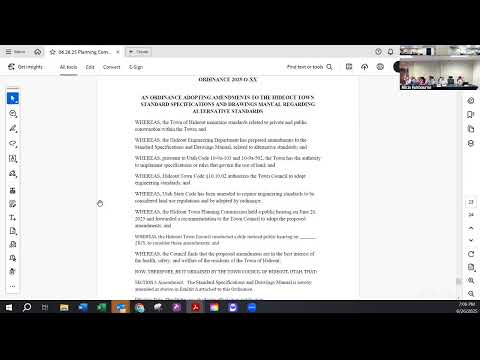
The Hideout Planning Commission voted to forward a positive recommendation to the town council for amendments to the town's Standard Specifications and Drawings Manual that would allow objective-based alternatives for certain short, dead-end streets and add technical pavement and utility clarifications.
The Hideout Planning Commission on June 26 voted to forward a positive recommendation to the Town Council for an ordinance amending the town's Standard Specifications and Drawings Manual to allow defined alternative standards for limited new streets and clarify several technical public-works specifications.
Commissioners discussed objective criteria that would allow narrower or modified street cross sections on short, low-use streets. The proposed alternatives apply when a development meets set conditions (for example, a dead-end with fewer than 13 residences and no potential pedestrian destination); if those conditions are met, some requirements such as sidewalks and on-street parking could be modified, provided compensating measures (public access easements for pedestrian passage, snow-storage easements recorded on plats and finished pedestrian surfaces) are included.
Gordon, the staff presenter, said the alternatives are intended to be objective rather than subjective and grew from the general plan steering committee's work to address specific contexts such as short dead-end streets. He said the provisions would not automatically apply to existing streets and would only be available to developments that meet the stated criteria.
Commissioners pressed for clarifications during the discussion. They agreed to: (1) change the terminology from "variance" to "alternative" or "criteria for alternatives" to avoid confusion with variance procedures in code; (2) clarify that the pedestrian-destination test should explicitly list common destinations such as commercial facilities and trailheads; (3) require designation of snow-storage areas on plats (public utility easements); and (4) make the standards explicitly subject to approval by the Wasatch Fire District where fire-code dimensions govern street width, turning radii and other safety dimensions.
The manual amendments also include several technical updates to pavement and utility standards: the pavement-specification method was updated to a newer industry practice (Superpave-style language) and local-street pavement thicknesses were changed to reflect current geotechnical recommendations (examples in the presentation showed a 4-inch minimum for some local pavements rather than an older 3-inch figure). The packet also added wording to require removal (plugging) of duplicate water and sewer services when parcels consolidate, and clarified subgrade testing and pavement deflection testing requirements tied to geotechnical reports.
Commissioners discussed operational details that would limit use of the alternatives: the cap on residences (13 doors) was vetted by the general plan steering committee and draws on comparables from other communities; fire-district requirements (for example, wider widths where hydrants or other conditions exist) would supersede alternatives; and the alternatives are intended for new developments that choose to employ them rather than retrofitting existing streets.
After the amendments and clarifying edits discussed on the record were read back by staff, a commissioner moved and another seconded to forward a positive recommendation to the Town Council with those amendments. The motion passed with a majority: the roll call recorded multiple "yes" votes and one "no" vote (Rachel). The commission agreed to send the ordinance and the amended manual language to the Town Council for final action.
The commission closed the item and moved to other agenda business, noting two emailed comments (from Frick and Leoni) were received and incorporated into the record.
The recommendation now goes to the Town Council, which will consider whether to adopt the ordinance and the revised manual language as town policy.