Get Full Government Meeting Transcripts, Videos, & Alerts Forever!
Get email alerts on the Budget topic
No spam. Unsubscribe anytime.
Cartwright Governing Board adopts 2025–26 expenditure and desegregation budgets
Summary
After a public hearing and presentation of revenue projections and planned savings, the Cartwright Governing Board voted unanimously to adopt the district's 2025'1026 annual expenditure budget and desegregation budget.
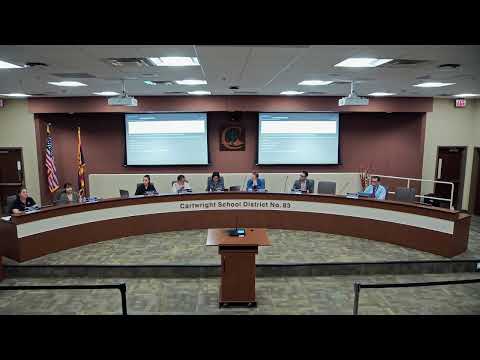
The Cartwright Governing Board on June 25 adopted the district's 2025'1026 annual expenditure budget and the 2025'1026 desegregation budget following a public hearing and a detailed presentation of revenues, projections and proposed savings.
Business officer Dr. Ethridge opened the budget presentation by explaining fund structure, average daily membership and revenue drivers, telling the board that "student enrollment drives our funding and more particular, average daily membership." He said the district's maintenance and operations (M&O) revenue control limit was projected at about $88.4 million and that total M&O-related resources, including carryover, would give the district roughly $112 million available next year.
The presentation outlined several changes from FY25 to FY26: an anticipated decrease in average daily membership (ADM) of roughly 370 students, a projected drop in weighted ADM from about 17,400 to about 16,900, and a resulting $2.1 million reduction in the state-derived allocation. Dr. Ethridge said the district is conservatively assuming no additional statewide funding until the legislature finalizes a budget but noted the administration expects a likely 2% base-support increase from lawmakers.
To close a roughly $4 million gap between projected allocations and expected expenditures, staff described a package of measures including teacher reductions through attrition, non-staff expenditure cuts, district-office position consolidations and shifting half of a school psychologist to Medicaid-funded activities tied to employee child care. The administration estimated those measures would reduce M&O spending by about $4 million and leave a remaining projected deficit of about $52,000 on a roughly $104 million operating allocation.
Dr. Ethridge and board members also reviewed capital and classroom-site funds, noting capital allocations of roughly $7 million (plus carryforward) and classroom site funds of about $12.4 million. He said expected capital outlays included Chromebook replacement and textbook adoption (the latter described as a likely one-time capital expenditure not yet budgeted).
After the public hearing portion closed, the board considered the formal adoption as an action item. The motion to adopt the 2025'1026 annual expenditure budget and the 2025'1026 desegregation budget passed on a roll-call vote: all present board members recorded "aye."