Get Full Government Meeting Transcripts, Videos, & Alerts Forever!
Get email alerts on the Battery Storage Safety topic
No spam. Unsubscribe anytime.
Committee advances Clean Energy Safety Act to tighten battery storage siting, inspections after Moss Landing fire
Summary
SB 283 would require fire authority consultation, inspections and adoption of NFPA battery standards for industrial battery energy storage systems; committee members and emergency responders said the bill is needed after the Moss Landing incident and other multi‑day fires, and the measure passed to local government as amended.
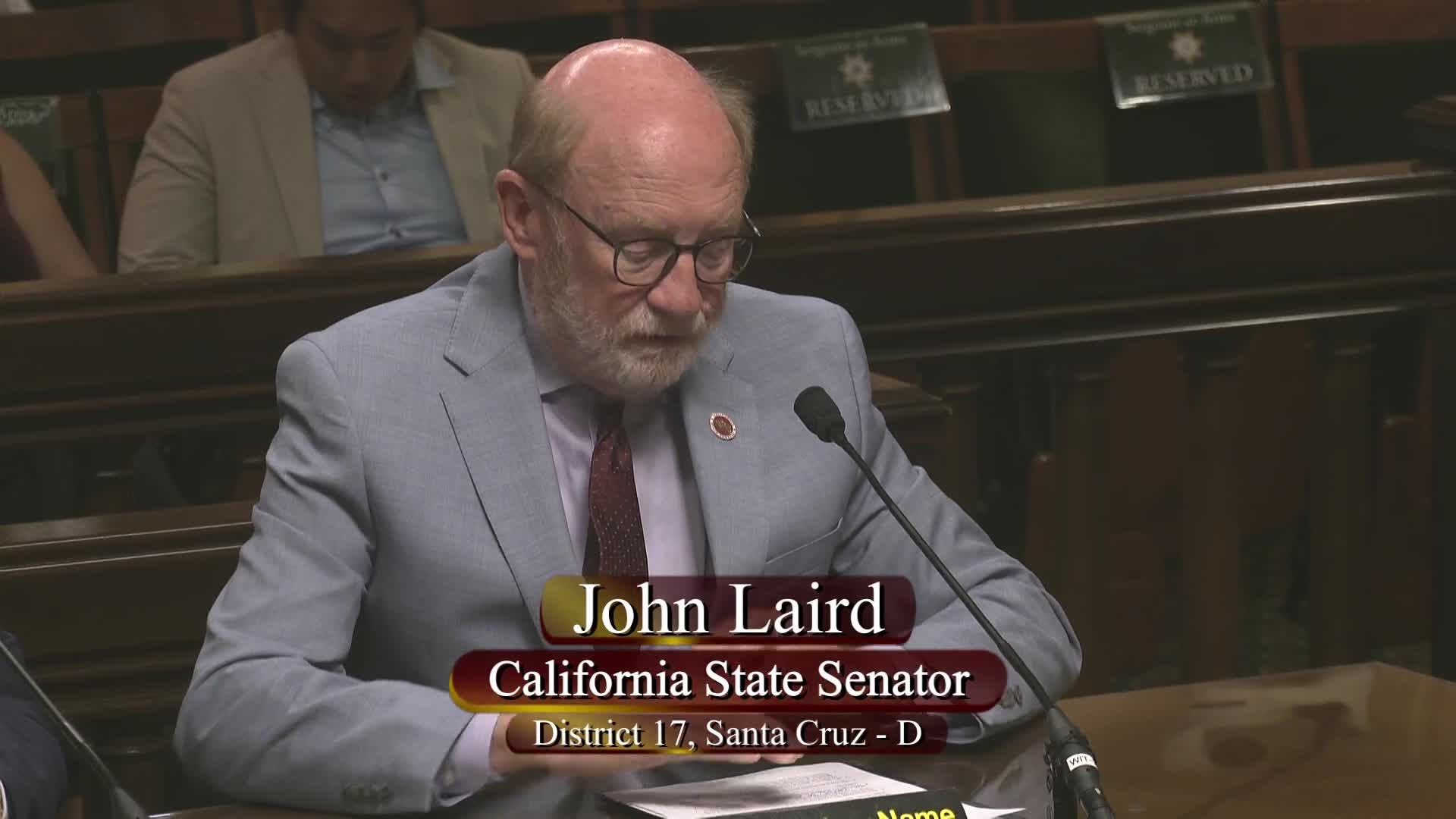
Sen. John Laird urged the Assembly Committee on Utilities and Energy to advance SB 283, the Clean Energy Safety Act of 2025, arguing the measure would ensure safer development and operation of large battery energy storage systems (BESS) after the Moss Landing fire earlier in the year.
Supporters — including firefighters, local governments, utilities and industry groups — told the committee the bill would add inspection, consultation and minimum‑standard requirements (including National Fire Protection Association guidance) and prohibit indoor siting of certain large battery arrays in combustible structures. Witnesses described past incidents that burned for days, forced evacuations and closed Highway 1.
Why it matters: Sen. Laird said California’s battery storage fleet has expanded rapidly and policy and operations have not kept pace. “If we really want to meet our goals of renewable energy ... we have to have storage,” he said, adding that deployments rose from roughly 500 megawatts in 2018–19 to between 13,000 and 14,000 megawatts today, with a target near 52,000 megawatts by 2045.
The bill would require compliance with up‑to‑date National Fire Protection Association (NFPA) standards and state building and fire codes, require fire‑authority consultation at multiple stages of a project, and mandate inspections paid for by the developer prior to commercial operation. Sen. Laird said an amendment clarified that the NFPA standard is a floor, not a ceiling, allowing local governments to impose stricter rules.
Firefighters and emergency managers described complex, resource‑intensive incidents involving battery fires. Doug Suebers of the California Professional Firefighters said a recent Southern California BESS blaze burned for eight days and required hazardous‑materials teams and specialty resources. He urged the committee to adopt the bill to ensure developers design projects to current standards and to give fire agencies a seat at the table.
The bill drew broad support in the hearing room from counties, city agencies, the California State Association of Counties, the California Community Choice Association, IBEW Local 1245, Fluence, PG&E and San Diego Gas & Electric (SDG&E) — many expressed a support‑if‑amended stance after committee clarifications. Several local elected officials and fire authorities said projects had been permitted at the local level without adequate expertise, and they urged clearer statewide minima for high‑risk projects.
Questions from legislators focused on definitions, local control and whether the bill would impede newer, safer battery designs. Sen. Laird and witnesses said newer systems and many modern projects are sited outdoors or compartmentalized and that the bill targets configurations and siting that present the highest risk; he said his SB 38 from 2023 had required safety plans but compliance was uneven and the Moss Landing incident showed the need for firmer standards and oversight.
Votes and next steps: The committee voted to pass SB 283 as amended to the Local Government Committee. Roll calls in committee show the bill passed on a mostly unanimous record in that hearing (reported tallies in committee proceedings ranged from unanimous to large majorities depending on the roll being taken as members joined). The author asked for an “I” vote and the committee advanced the bill.
Community impact and context: Testimony referenced specific public‑safety risks including smoke and ash exposures, long suppression times, evacuations and risks to water and sensitive sites where siting had occurred near homes, childcare and senior housing. Supporters emphasized that modern installations differ from the Moss Landing configuration but said state standards and fire‑agency engagement are needed to reduce future risk.