Get Full Government Meeting Transcripts, Videos, & Alerts Forever!
Get email alerts on the Utility Spending Policies topic
No spam. Unsubscribe anytime.
California committee advances bill to stop utilities from charging ratepayers for political ads and municipalization campaigns
Summary
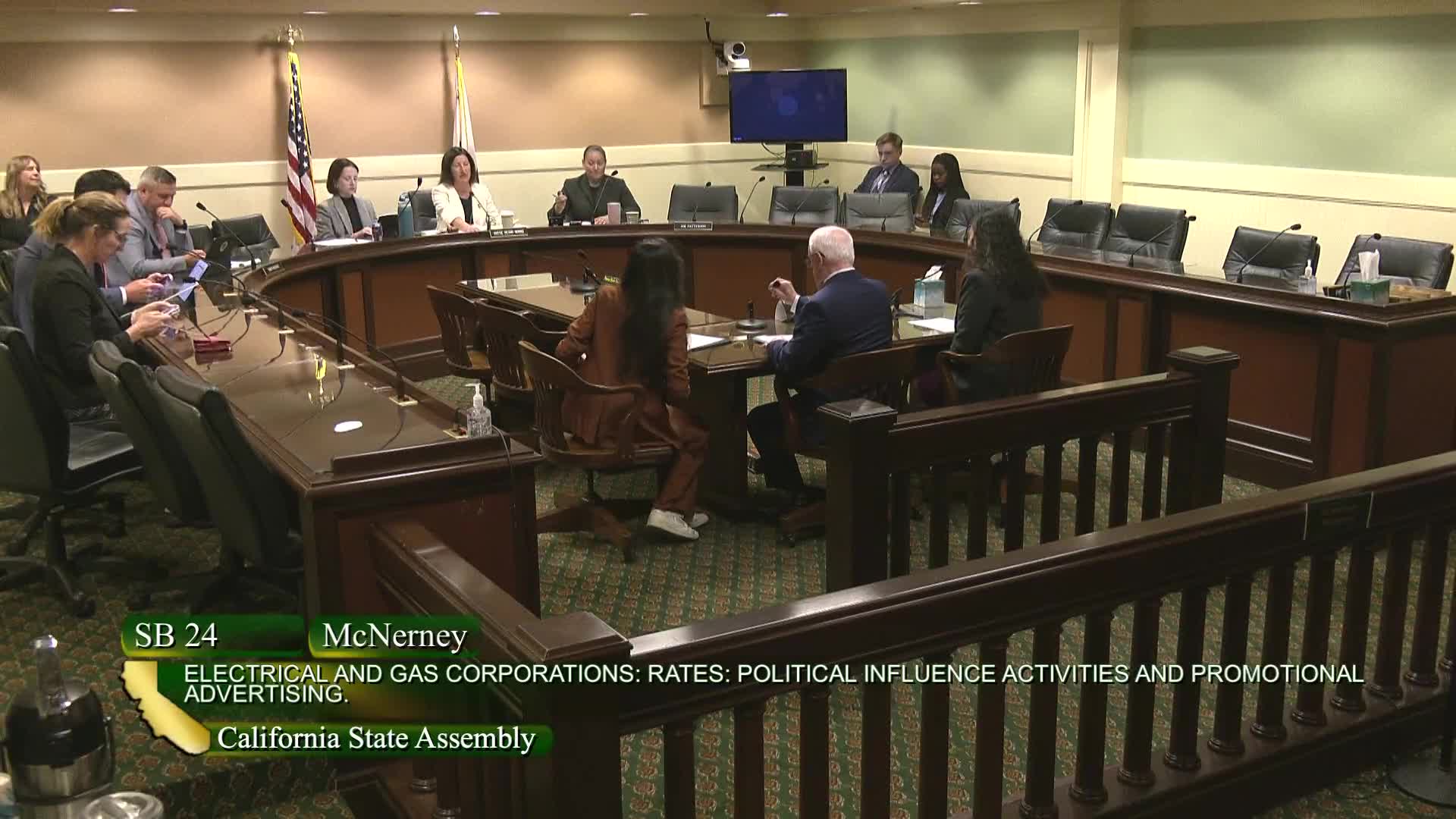
The Assembly Committee on Utilities and Energy voted to pass SB 24 as amended to appropriations after debate over whether the bill is overly broad; supporters said it will stop investor-owned utilities from using customer funds for lobbying and ads, while utilities warned it could curtail needed communications and legal work.
Sen. Mark McNerney, author of SB 24, asked the Assembly Committee on Utilities and Energy to pass a bill that would bar investor‑owned utilities from using ratepayer funds for political advertising and for efforts to oppose local municipalization efforts.
Supporters told the committee the measure would increase transparency and hold utilities accountable for spending they said had been charged to customers inappropriately. Opponents — including utilities and business groups — said the bill as written could be overbroad and inadvertently limit public‑safety and customer‑service communications and the ability to retain outside legal experts.
SB 24 would restrict the use of ratepayer revenue for political advocacy, lobbying and advertising the author and supporters said are not appropriate customer costs. “This is a common sense bill really that will close legal loopholes and strengthen California law to prevent IOUs ... from using rate payer funds to pay for political campaigns and political advertising,” Sen. McNerney said in opening remarks.
Why it matters: Supporters said Californians face high utility bills while some utilities post record profits, and they cited instances where customer funds were used for broad promotional advertising or to oppose municipal utilities. Adria Tinnan, director of race, equity and legislative policy at TURN, said SB 24 “prohibits utilities from abusing rate payer dollars to pay for lobbying, advertising, and to work against municipalization efforts,” and argued the bill would create meaningful consequences and require correct accounting so such costs are borne by shareholders rather than customers.
Key evidence and claims cited in committee testimony included: SoCalGas reportedly used at least $36,000,000 of customer‑funded spending for political lobbying since 2019; PG&E spent more than $10,000,000 opposing SMUD’s attempt to expand into Yolo County; and an opposition group in San Diego received about $400,000 tied to utility activity. Supporters also said more than 100,000 households were disconnected last year because they could not pay utility bills.
Opponents told the committee the issue is largely one of accounting and the California Public Utilities Commission (PUC) already reviews requests to recover costs from ratepayers. Kent Kals, representing San Diego Gas & Electric and SoCalGas, said the company’s contested spending was an accounting matter and “there was never any accounting or attempt to recover those costs.” He raised First Amendment and shareholder‑funding concerns and urged that any statutory restriction focus on direct above‑the‑line rate recovery rather than below‑the‑line accounting issues.
A Pacific Gas & Electric representative argued most advertising is shareholder funded and said the PUC reviews any customer‑funded advertising proposals in rate cases or balancing account reviews. The witness said, “we are not allowed to spend any customer dollars on municipalization,” and warned that caps on attorney or consultant fees could hinder utilities’ ability to retain necessary experts.
Several committee members expressed sympathy with the bill’s goal while raising concerns about breadth. Vice Chair Patterson and Assemblymember Ziffer said they supported the principle but worried that language restricting legal fees and other communications could prevent utilities from providing factual information to customers or from hiring expert witnesses. Sen. McNerney said he would work with stakeholders on tightening consultant‑fee language.
Votes and next steps: The committee voted to pass SB 24 as amended to the appropriations committee. The transcript indicates the measure passed the committee roll calls and was reported out (final reported tally shown in committee proceedings: yes 11, no 1, several not voting). The author said she would accept committee amendments and continue to work on narrowing consultant‑fee language.
Community impact and context: Testimony referenced municipalization efforts in Yolo and San Diego counties and nationwide debate over when customer funds should support communication that may influence public policy. Supporters framed the bill as protecting affordability for customers; opponents emphasized existing PUC oversight and the risk of unintended constraints on public‑safety, outage or PSPS communications.
The bill’s author and supporters asked the committee for an “I” vote; members advanced the measure to appropriations to continue policy and fiscal review.