Get Full Government Meeting Transcripts, Videos, & Alerts Forever!
Get email alerts on the Budget Shortfall And Personnel Rightsizing topic
No spam. Unsubscribe anytime.
Miami-Dade leaders warn budget shortfall will force staff cuts as state tax changes erode revenues
Summary
Commissioners, the commission auditor and county officials flagged a multi‑hundred‑million‑dollar general fund gap and identified state tax changes as a key driver that could require layoffs, program reductions and other “right‑sizing” steps.
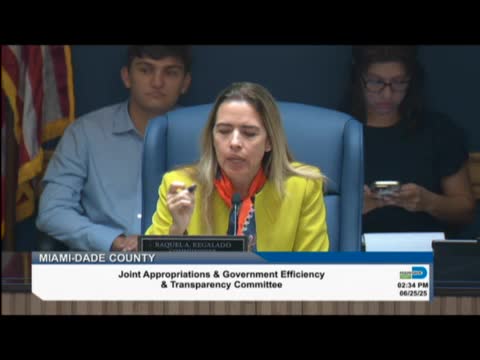
Miami‑Dade County commissioners and senior budget staff said at a joint meeting of the county’s Appropriations Committee and Government Efficiency & Transportation Ad Hoc Committee that a shortfall in the general fund, combined with recent state tax changes, will require difficult decisions including workforce reductions and program cuts.
"This is a good opportunity for us to discuss the budget," Commission Chairwoman Rebeca Sosa Regalado said as the meeting opened, urging a focus on protecting services while “streamlining staff.”
The county’s commission auditor and a state policy adviser outlined the largest near‑term fiscal pressures and provided specific figures commissioners said they would use as the mayor prepares a balanced budget for the board.
Jess McCarthy, speaking from Orlando during meetings of the Florida Association of Counties, said the Legislature’s tax package (the conference report voted June 16) eliminated the business rent tax, a change McCarthy said would reduce the county’s share of certain state revenue streams. "It eliminated the business rent tax, and that was a savings to businesses of about $900,000,000," McCarthy said, and county staff estimated the county’s losses associated with that change at roughly $26 million to the transit half‑penny and $26 million to the Jackson Hospital half‑penny, plus about $12 million in revenue‑sharing losses to the general fund.
McCarthy also said removal of the doc‑stamp matching mechanism for federal New Starts transit projects would reduce state matching support for large transit projects; he estimated the three most affected counties combined would lose roughly $40 million to $50 million, with Miami‑Dade bearing an unspecified share of that reduction.
David Cloudfilter of the county Office of Management and Budget told commissioners the business‑rent tax reduction was not included in the general‑fund gap the board had already been reviewing. "The $12,000,000 that Jess mentioned was directly related to that general fund amount," Cloudfilter said, and noted the previously discussed general fund gap — roughly $387 million — rose after those changes.
Commission Auditor Yinka Majakodimic summarized five‑year trends to show where the county spends and where there is potential flexibility. "The overall budget grew from $9,000,000,000 to about $12,700,000,000," Majakodimic said, and the operating side increased from about $5.7 billion to about $8.0 billion. She reported position growth from about 28,000 positions in 2021 to about 31,000 positions today and said there are roughly 4,000 to 5,000 vacant positions at times during the year.
Majakodimic emphasized that roughly 57% of the operating budget is personnel costs and that many department budgets include multi‑year contractual obligations that limit immediate flexibility. "Once you get past that, you have only about 3 to 18% of what we consider non‑contractual obligations," she said, pointing to the narrow slice of purely discretionary spending.
County Chief Operating Officer Jimmy Morales and other administration officials said they are reviewing the impacts on major capital and transit projects and will return with recommendations. Morales said the administration is "relooking at our smart plan" and funding plans for the Northeast Corridor in light of state changes, and he indicated the county will present options for the board.
Commissioners and staff discussed specific tools the county could use to reduce costs and limit layoffs, including freezing open positions, offering separation or early‑retirement options, repurposing employees to other county or constitutional office roles, and reducing marketing and advertising spend. Several commissioners urged that reductions focus on lower‑priority programs or duplicative services rather than simply applying last‑in, first‑out across the board.
Chairman Raquel A. (Bermudez) Bermudez said the meeting was intended to produce guidance for the administration while the mayor finalizes her proposed budget. The mayor's staff is expected to deliver a proposed budget on July 15; the commission’s tentative millage decision is scheduled for July 16, and members noted that setting a flat millage rate can still raise taxes for homeowners when property values increase.
Board members and staff committed to further analysis and to provide additional data at upcoming meetings, including task‑level breakdowns of positions, validation of performance measures and targeted line‑item reviews. The commission auditor said the office will validate department performance measures (the county tracks roughly 600) and focus line‑item reviews on material transactions to produce an actionable report for commissioners.
The meeting produced no immediate formal votes. Commissioners said they expect more detailed budget documents and analysis ahead of the mayor’s July 15 proposal and planned additional committee review.
The joint session closed with repeated appeals from commissioners that any reductions be guided by service priorities and fairness to affected employees, and with an acknowledgement that balancing the budget will entail difficult choices.