Get Full Government Meeting Transcripts, Videos, & Alerts Forever!
Get email alerts on the Wireless Communications topic
No spam. Unsubscribe anytime.
Planning Commission recommends approval of wireless facilities zoning amendment with screening, anti-graffiti and design-guideline requirements
Summary
The Jurupa Valley Planning Commission voted to recommend that the City Council approve Zoning Code Amendment ZCA 25004 to update Chapter 9.275 of the Jurupa Valley Municipal Code governing wireless communication facilities and determined the amendment is exempt from the California Environmental Quality Act (CEQA).
The Jurupa Valley Planning Commission on an unspecified date voted to recommend that the City Council adopt Zoning Code Amendment ZCA 25004, a comprehensive update to Chapter 9.275 of the Jurupa Valley Municipal Code regulating wireless communication facilities. The commission also determined the adoption is exempt from the California Environmental Quality Act.
City Principal Planner Tamara Campbell told the commission the update was initiated by the City Council in December 2022 to “take a look at the existing wireless communications ordinance and update it and improve its effectiveness and organization.” Campbell said the rewrite aims to balance public and private interests, protect the city from future visual blight and preserve environmental resources while promoting access to advanced wireless services.
The draft ordinance would make most new towers and facilities subject to a conditional use permit and would generally prohibit new wireless facilities in residential, agricultural, scenic highway commercial, open-space preservation and open-space conservation zones and in zones that permit single-family residences. The draft sets an order of preference for facility configurations: co-location with existing facilities first, then roof- and building-mounted equipment, mounting on existing poles, replacement poles, and, last, new towers. For accessory equipment the preferred options are undergrounding, placement inside buildings or screening where appropriate.
Staff also proposed detailed design standards, including a 36-foot maximum height for most facilities, required zoning setbacks, additional setbacks for disguised facilities (125% of facility height from the nearest home in nonresidential settings; 200% of facility height adjacent to residential zones or a distance equal to 100% of facility height from residential property lines, whichever is greater), paved or “all-weather” access roads, decorative block equipment enclosures with landscaping, and limits on illumination and signage. Campbell said repairs and restoration must typically be completed within 48 hours of notification and described abandonment and removal requirements, permit terms and extensions.
Maricela, a city staff member who walked the commission through substantive edits in the draft, said the screening requirement will read: “All wireless communication facilities and equipment must be screened by a decorative block wall that is 6 feet in height. The decorative block wall shall be coated with an anti graffiti coating.” She also described required pedestrian gates with solid metal backing, a prohibition on chain-link and barbed-wire fencing, and a requirement that perimeter landscaping be installed and maintained pursuant to landscape plans with a one-year establishment period secured by performance bond.
Campbell noted the draft also distinguishes ministerial "eligible facility requests"—requests to collocate, remove or replace equipment at existing facilities that must be processed as objective, ministerial actions—and provides that applicants may receive a deemed-granted remedy if the city does not act on a complete application within 60 days.
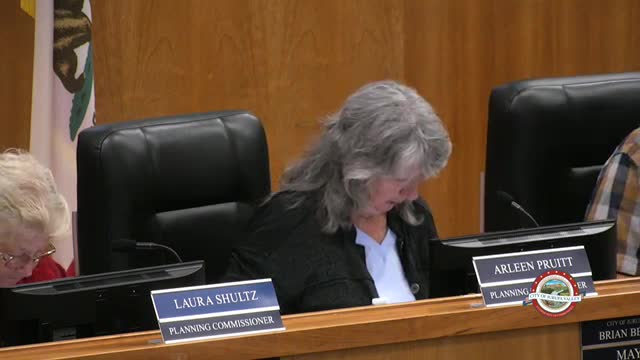
Commissioners asked several clarifying questions during the hearing. Commissioner Schultz asked what the ordinance means by an “all-weather” road; Campbell said examples include decomposed granite or permeable pavers and that the building department would evaluate the appropriate surface on a case-by-case basis. Commissioner Cristobal raised whether the anti-graffiti requirement should explicitly cover screening walls as well as equipment; staff said they would draft language to extend anti-graffiti treatment to block walls and incorporate that change into the recommended ordinance. No members of the public spoke during the public hearing.
After deliberation, a commissioner moved to approve ZCA 25004 with the additional recommended standards and the clarified screening/anti-graffiti language and to find the action exempt from CEQA; the motion was seconded and the commission voted to recommend City Council approval. The motion passed with all commissioners voting in favor.
The ordinance draft also gives the City Council authority to adopt more detailed design guidelines by resolution: staff will prepare those guidelines for council consideration, rather than embedding the full standards in the code. The Planning Commission’s action is a recommendation; the amendment and any implementing design guidelines will next be considered by the Jurupa Valley City Council for final action.