Get Full Government Meeting Transcripts, Videos, & Alerts Forever!
Get email alerts on the Economic Development Report topic
No spam. Unsubscribe anytime.
Economic development staff reports pipeline, explores film locations and lab space; warns of EPA emission limits
Summary
Economic development staff reported May pipeline totals — 27 active prospects estimated to represent about 4,000 potential jobs and roughly $4.5 billion in capital investment — and described marketing work on film locations and early talks about wet-lab space in partnership with UNT.
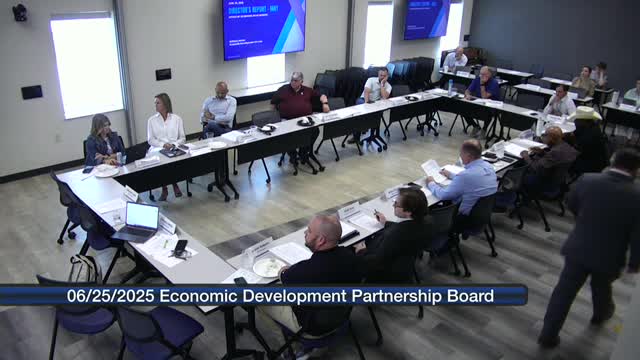
Economic development staff updated the board on May activity and longer-term strategy at the June 25 meeting, reporting pipeline metrics, promotion work for film-location recruitment and initial conversations about life-sciences space tied to the University of North Texas.
"We currently have 27 active projects in the pipeline — that's close to 4,000 potential jobs and about $4.5 billion in potential capital investment," Britney Saltillo, economic development staff member, told the board. Staff said May produced two new leads (one broker-sourced, one direct) and one incentive application; the downtown team rolled out a new newsletter for property and business owners called the Downtown Lowdown.
Staff reported receiving leads from the state economic development division and regional partners — the presentation cited five RFI leads for the month and seven RFI submissions — and said the Dallas Regional Chamber and governor’s office are among regular sources. The presentation also reviewed the status of active projects in the pipeline: several were in early lead or application stages, a few were in incentive negotiation, and three were at board approval.
On film and creative industries, staff noted a recently passed state-level film incentive. "The state passed an incentive that can provide up to $300 million every session — roughly $125 million per year — for the next 10 years, a total program value staff cited as about $1.5 billion," Saltillo said. Economic development staff said they are marketing Denton locations to the state's location database and encouraging property owners to submit sites for potential productions.
Staff also described outreach at the Bio International Conference and discussions with UNT about demand for wet-lab or life-sciences incubation space. "UNT’s entrepreneurship and research units have startups that have requested wet-lab space," Saltillo said; staff said the city is exploring whether local incubators, spec lab space or partnerships with developers or broker firms could meet that demand.
Board members raised an important constraint for future manufacturing and R&D recruitment: the Dallas–Fort Worth nonattainment designation for ozone/NOx and the lowered federal major-emitter threshold (discussed in the meeting as 25 tons per year of NOx) can trigger lengthy federal review for major emitters and materially delay site readiness. A board member described the change from a prior 50-ton threshold to 25 tons and urged staff to target low-emission industries and align recruitment accordingly.
Staff said downtown reinvestment grant leads and TRS 1 activity continue (the TRS 1 annual report was approved by the board) and that staff will return with updates on several potential projects (codenamed Project Loom, Project Good Print and Project Recharge) and an RFI overview. The board asked staff to schedule an operational retreat to refine industry targets and to coordinate a future agenda item on utility rates and broader utility-package impacts for manufacturers.