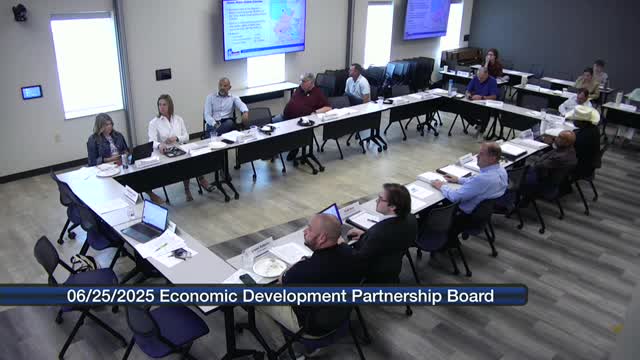
Denton utilities outline regional approach to serve growth in extraterritorial areas
Loading...
Summary
City utility staff told the Economic Development Partnership Board that rapid growth in the extraterritorial jurisdiction will require regional water/wastewater projects and close coordination with MUDs and developers to deliver conveyance and treatment capacity.
City utility staff told the Economic Development Partnership Board on June 25 that Denton will need a regional approach to water and wastewater infrastructure to serve projected growth in the extraterritorial jurisdiction (ETJ).
"The utility serves around 171,000 people through roughly 45,000 service connections," said Kyle Henson, planning and engineering division manager for utilities, describing current demand and seasonal variations. He told the board typical winter water usage is about 18 million gallons per day and summer peak average demands can reach about 42 million gallons per day.
Henson said growth in and around areas served by municipal utility districts (MUDs) could add roughly 110,000 people to the city's service area — roughly a 65 percent increase over current population — and that the utility must plan both conveyance infrastructure and treatment capacity. "Everything flows downstream," he said while explaining how many localized wastewater approaches create regional variables and downstream impacts on surface water intakes and lake water quality.
Staff reviewed existing planning documents: the 2023 wastewater master plan (adopted) and a 2024 water master plan the utility expected to adopt in August. The presentation mapped three drainage basins that staff said will necessitate three regional water reclamation facilities and showed candidate conveyance and treatment projects coded by timing: 0–5 years (near-term), 5–10 years (mid-term) and 25-year horizon projects.
Key capital projects discussed include Clear Creek and Hickory Creek interceptors, regional wastewater conveyance to open basins north to Highway 380, and an expansion at the Ray Roberts water treatment plant. Henson said the Clear Creek interceptor is in design and that the Hickory Creek interceptor designs are progressing through partner agreements with utility and development organizations. Staff also described pursuing capital funding through the Texas Water Development Board, including a state loan the utility secured last year for Ray Roberts expansion, and said the city is pursuing federal Water Infrastructure Finance and Innovation Act (WIFIA) opportunities for larger elements of the capital program.
Board members and staff emphasized coordination with planning and economic development so that line extensions align with likely growth areas. Board members also raised concerns about wells and small package wastewater plants in the ETJ: unregulated or dispersed wells can deplete groundwater and create long-term monitoring and quality challenges, staff said. Henson urged that partnerships with MUDs, developers and regional stakeholders accelerate infrastructure deployment rather than leaving development to a purely localized approach.
Funding and policy notes in the discussion included reference to a Denton MUD policy adopted in 2022 that sets expectations for MUD creation and operation, and a request from board members to track state-level funding opportunities. Henson said staff is pursuing multiple funding paths, including state and federal loans and grants for large plant expansions and regional conveyance projects.
Board members asked staff to prioritize projects where economic development demand and vacant buildable land overlap so the city captures quicker returns on infrastructure investments. Staff said much of the near-term focus is on the northern basins (Clear Creek/Hickory Creek area) and the Ray Roberts corridor west of town, and that timing on many of the 0–5 year projects depends on a mix of developer-led off-site improvements and city-led capital projects.
The presentation included risk items utilities are tracking: supply (surface water and well dependence), water quality, wastewater package-plant proliferation, and regulatory permitting. Board members suggested the city continue proactive outreach to secure water rights, coordinate with neighboring jurisdictions, and pursue creative reuse and capture strategies to increase available supply.
The utility presentation run time and the detailed map materials will be posted with the master plan documents on the utility website, staff said.