Get Full Government Meeting Transcripts, Videos, & Alerts Forever!
Get email alerts on the Housing Affordability topic
No spam. Unsubscribe anytime.
Portland Housing Bureau reports $130 million invested in North/Northeast strategy; leaders urge continued funding and policy expansion
Summary
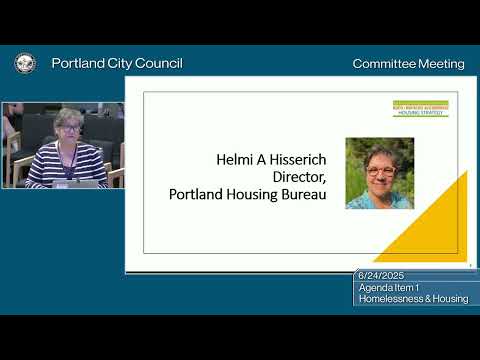
At a June 24 Homelessness and Housing Committee presentation, Portland Housing Bureau staff and neighborhood leaders reviewed a 10‑year North/Northeast housing strategy, detailing investments, program outcomes and recommendations to preserve homeownership and prevent further displacement of Black Portlanders.
PORTLAND — The Portland Housing Bureau presented a 10‑year report Tuesday on the North and Northeast neighborhood housing strategy, detailing about $130 million channeled into displacement prevention, homeownership and rental development and warning that affordability gaps remain for many Black families.
The presentation to the Homelessness and Housing Committee explained how tax increment financing (TIF), construction excise tax (CET), short‑term rental (STR) fees and Metro bond funds have been deployed since the strategy began in 2015 to support home repair grants and loans, down‑payment assistance, land acquisition and affordable rental development. Leslie Goodlow, equity and business operations lead at the Portland Housing Bureau and project manager for the strategy, said, “So far, since the inception, $130,000,000 of TIF, CET, construction excise tax, short term rental fees, and Metro bond funds directly [went] into strategies tied to displacement prevention, homeownership, and rental housing.”
Why it matters: City and community leaders said the strategy is designed to restore opportunities for families displaced from historic Albina and adjacent neighborhoods to return and build wealth, while also preventing future displacement. Dr. Steven Holt, chair of the North/Northeast Oversight Committee, said the work is a “pathway” rather than a complete solution and invoked the refrain, “promises made, promises kept,” to underline the committee’s concern that commitments be sustained.
Key outcomes and programs
- Home repair and stabilization: PHB reported more than $12 million spent on home repair and stabilization programs, assisting nearly 1,300 families with critical repairs through a mix of grants and forgivable loans. Goodlow read a client story describing new heating, roofing and other repairs arranged by PHB and partner agencies.
- Down‑payment assistance and homeownership: Down‑payment assistance has been raised three times since 2015. Within the Interstate Urban Renewal Area (URA), the bureau now offers up to $150,000 in assistance (previously $60,000). Those loans were described as no‑interest, no‑payment loans, with a forgiveness schedule beginning in year 15 (50% forgiven) and annual forgiveness thereafter until full forgiveness in year 30.
- Rental development and preference policy: The strategy has supported development of 11 buildings and 877 affordable rental homes; PHB said about 739 units are subject to the North/Northeast preference policy, which prioritizes applicants with historic ties to the area. Land acquisition investments exceed $12 million, and PHB said three additional projects are under construction or development.
- Applications and verification: PHB said 411 homeownership applicants have verified preference points, bringing the total verified homeownership applicants to 850 since the preference policy began in February 2015. The rental application remains open; PHB reported more than 7,000 individuals have applied for preference points to date and 2,113 rental applications in 2024 alone.
Challenges and equity context
Presenters acknowledged persistent affordability challenges. PHB displayed income and rent‑burden comparisons showing that median incomes for many Black households fall well below area median income (AMI) benchmarks, leaving two‑bedroom units priced at 60% AMI still out of reach for most. Goodlow said only one neighborhood in outer Southeast Portland currently had a two‑bedroom unit considered affordable to the households profiled in the presentation.
Recommendations and next steps presented by committee members and community leaders
Speakers and oversight committee members outlined specific recommendations, including: adjusting affordable housing targets and AMI bands (adding 40% and 50% AMI options), expanding homeownership resources beyond the Interstate URA, leveraging Housing Choice Vouchers with Home Forward for mortgage support, maintaining long‑term funding for the preference policy, strengthening home retention tools, increasing MWESB and workforce participation access, and exploring extension of the place‑based preference model to other URAs such as Cully.
John Washington, a member of the oversight committee, said the committee "helps hold builders and property managers to a higher standard," while Jillian Seraj Felton, housing director for Community Partners for Affordable Housing, urged fuller engagement from the council: “This work may seem like a drop in the bucket to right the wrongs of the past … The North Northeast housing strategy has been used as a model in other cities.”
Public testimony
Five people provided public comment. Arlen Smith warned of a broad affordability crisis and urged clearer language and political courage to protect residents. Terrence Hayes, who said he and his wife explored the bureau’s homeownership programs, urged attention to rules that limit homeowners’ ability to access equity for new opportunities. Todd Littlefield asked council members to champion the committee’s work.
Process note: The presentation was informational only; no formal action or vote was taken at the June 24 committee meeting. Committee leadership said the remainder of the agenda was canceled because of quorum issues and that the strategy item will be carried forward for further council engagement and follow up.