Get Full Government Meeting Transcripts, Videos, & Alerts Forever!
Get email alerts on the Housing topic
No spam. Unsubscribe anytime.
Eugene work session outlines policies and actions after state analysis shows need for 26,000 new homes
Summary
City of Eugene planners presented draft policies and a package of actions to address the city’s housing and jobs needs at a June 23 council work session, saying a new state housing analysis requires planning for more than 26,000 new dwelling units over the next 20 years.
City of Eugene planners presented draft policies and a package of actions to address the city’s housing and jobs needs at a June 23 council work session, saying a new state housing analysis requires planning for more than 26,000 new dwelling units over the next 20 years.
The presentation, led by Terry Harding, the city’s principal planner for community planning and design, and senior planners Leah Rausch and Heather O’Donnell, laid out draft chapters of Eugene’s comprehensive plan and a set of near- and mid-term actions intended to increase housing production, affordability and compact job growth inside the urban growth boundary (UGB).
Staff emphasized the scale of the challenge. “Using the 2025 ONA, we know that Eugene will need to support the production of more than 26,000 new dwelling units in the next 20 years,” senior planner Leah Rausch told council. Rausch and Harding said that number is roughly a 30% increase over the city’s current stock of about 90,000 dwelling units and would require increasing annual production from an average of about 965 units per year in the last decade to roughly 1,600 units per year in the coming decade, including about 700 annually affordable to households with the lowest incomes.
Why it matters
Planners said the requirement to plan for that growth is largely driven by state rules and the Oregon housing needs analysis (ONA). The urban growth strategies project will produce updated comprehensive-plan chapters, land supply studies and changes to Eugene’s land use code; the work could also identify a need to expand the UGB, staff said.
What staff proposed
Terry Harding summarized draft planning work that will be included in upcoming comprehensive-plan chapters for compact development and housing. The housing chapter, staff said, includes four goals and 29 draft policies that direct city planning to increase housing production, affordability, choice and equity, with special emphasis on lower- and moderate-income households. Harding highlighted policy 4.7, which directs the city to “consider a wide array of incentives, fees, and exemptions that encourage the production of housing across [the] income spectrum.”
Leah Rausch reviewed a suite of actions staff plan to propose for adoption in two packages: a 2026 package of actions to increase capacity and reduce regulatory barriers and a 2027 housing production strategy required by state law. Actions highlighted at the work session include:
- Creating a new housing type called microvillage housing — clusters of very small detached units with private sleeping areas and shared common facilities — intended to speed development of housing for people transitioning from homelessness. - Adjusting density standards in the city’s largest residential zone (R-1) by exploring minimum densities, smaller lots or reduced lot maximums to increase average density citywide. - Site-specific zoning changes and code amendments to support redevelopment in and around identified centers and key corridors. Staff presented a first-draft map of centers built from nearly 600 community responses and research on existing land use and zoning. Key corridors cited included portions of Coburg Road, Franklin Boulevard, South Willamette Street, West 11th Avenue, River Road and Sixth/Seventh avenues. - Considering incentives such as deferred payment of system development charges (SDCs), loan or tax-exemption programs, a housing acceleration pilot, and downtown fee assistance already in place. Staff said any new incentives will require administration and funding resources. - Removing SR site-review and planned-unit-development overlays where they act as barriers in some centers (staff mentioned Willakenzie and River Road/Santa Clara areas and climate-friendly areas). - Revising employment zones (E1/E2) that have seen little development, including allowing more uses and easing some site and building regulations to better support local jobs.
Staff noted some concepts are not yet on the table or would require additional council direction or resources, such as time-limited, broad development waivers like those being debated in Portland and removing some process requirements such as neighborhood applicant meetings.
Community engagement and equity
Planners described a community outreach program that included a Community Advisory Panel (focused on underserved populations), meetings with the Youth Advisory Council, housing providers and developers, and presentations at neighborhood events. Staff said equity concerns raised in engagement informed policy directions to prioritize underserved communities in housing, affordability and site selection.
Timing and next steps
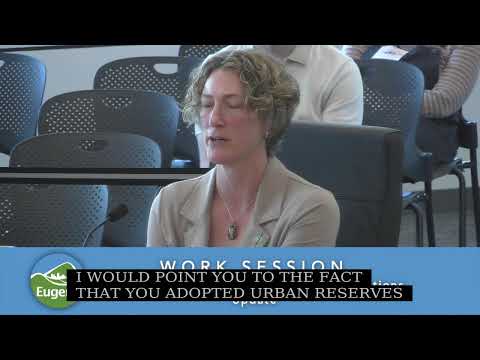
Staff told council they will return in the fall seeking initiation of the 2026 adoption package (comprehensive-plan chapters and first package of actions) with a 2027 adoption for the housing production strategy and additional actions. The sequential, state-mandated approach to accommodating growth starts with using existing capacity, then maximizing additional capacity inside the UGB, and finally evaluating whether an expansion of the UGB will be needed; staff said land-supply work next year will show how far the city can go without expansion. Council had previously adopted urban reserves in 2023; staff said that reserve mapping will be a starting point if expansion is required, but that the new ONA may reduce the years of capacity urban reserves were estimated to hold.
Infrastructure, wetlands and mitigation
Planners noted the city owns and manages a wetlands mitigation bank and is seeking to add property to it to provide credits that developers can purchase as part of wetland mitigation requirements. Staff said wetland and mitigation constraints will affect some site-specific zoning decisions, for example in the Royal Avenue node and other West Eugene areas.
Questions from councilors
Councilors asked about differences between the city’s new centers approach and earlier nodal development, ownership versus rental outcomes, the balance between housing and jobs, and implementation details such as parking, design standards, and permitting capacity for middle housing. Staff said the centers approach is less prescriptive than earlier special-area overlays and is intended to be implemented citywide through policy-supported tools and incentives. On ownership, planners said the city tracks tenure through census data and the American Community Survey rather than building permits and will include tenure considerations in the housing production strategy. On jobs, staff said an economic opportunities analysis and an updated growth monitoring report will inform job-targeted actions.
What staff did not decide
No formal council votes or binding decisions occurred at the work session. Council feedback was used by staff to refine the proposed actions and policy language before staff return with an adoption package. Staff also flagged items that would require additional council direction or funding before they could be proposed, including larger-scale fee waivers and major changes tied to state climate- and housing-related rulemaking.
Ending
City staff will continue community engagement and technical land-supply analyses and return to council with a 2026 adoption package for the first set of comprehensive-plan chapters and housing and jobs actions, followed by the state-required housing production strategy in 2027 and, if needed after land-supply study work, an urban growth boundary expansion analysis in later years.