Get Full Government Meeting Transcripts, Videos, & Alerts Forever!
Get email alerts on the Facilities Finance Realignment topic
No spam. Unsubscribe anytime.
Financial advisers present $95M K3 realignment and $250M high-school scenarios; board debates referendum path
Summary
Financial advisers from Raymond James and PFM updated the board on the K3 realignment financial plan and presented scenarios that compare a $95 million realignment to a hypothetical $250 million high-school project, including tax and fund-balance impacts and the possibility of a voter referendum.
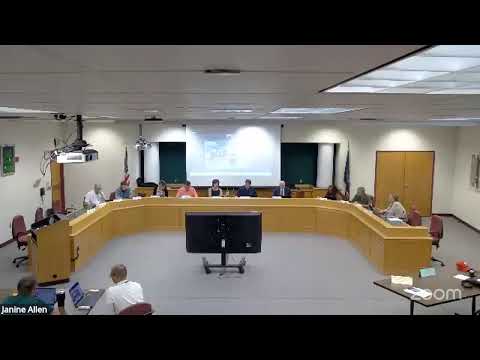
A financial update on the district's facilities planning dominated discussion at the East Penn School District Board meeting on June 23, 2025, where advisers from Raymond James and Public Financial Management outlined modeling for the proposed K3 realignment and compared it with a potential high-school project.
The administration opened the facilities discussion by reminding the board that advisors had returned to respond to questions from an earlier June 9 briefing. Scott Shearer of Public Financial Management and Ali Maki of Raymond James presented scenario analyses comparing three options: the realignment plan (an estimated $95 million construction cost), an immediate high-school project (modeled at $250 million), and a delayed high-school approach that phases tax increases before construction.
The advisers emphasized that East Penn currently holds a strong credit profile in the AA category and that the long-range planning undertaken by the district supports that standing. "Being able to maintain such a good credit rating is a hard feat," Shearer said, noting that the realignment plan was modeled to preserve a healthy fund balance while addressing the district's capital needs.
The presentations included estimated taxpayer impacts. For an average assessed-value home of about $215,000, the advisers' model showed a cumulative total real-estate tax-bill increase of roughly $809 for the realignment scenario from fiscal 2026 through 2031, compared with about $1,100 and change under the early-start high-school scenario. The high-school scenario would require taxes above the Act 1 index and, if pursued quickly, would likely require voter approval via a referendum to be financially viable. "We feel like $250 million is probably a good proxy to use for this analysis," Shearer said when asked about the high-school cost estimate.
Public comment at the start of the meeting asked the board to reassess the realignment. A parent who identified herself as Nguyen said she and other families have concerns about the project given economic and demographic shifts and asked the board to "please reassess the alignment project of the fifth, sixth, seventh, and eighth graders." Nguyen added she supported reassessment because she did not want the district to spend money on a plan that might not make sense in five or six years.
Board members pressed advisers on timing, the effect on fund balance and the role of a referendum. The advisers said a referendum would ask district voters whether to proceed with borrowing that would permit tax increases above the Act 1 index; referendums are often held as special or general-election ballot questions and historically have mixed success in Pennsylvania. The advisers noted scenario trade-offs: starting a large high-school project quickly would increase near-term tax pressure and require voter approval; delaying a high-school project would push the timetable out a decade but would reduce the need for an immediate, large tax increase.
Board members expressed divergent views. Several trustees said the realignment addresses capacity and equity at K8 for two-thirds of the district's students and is relatively more affordable. Others said concerns at the high school (crowding, aging facilities) warrant more attention and that community communication needs to improve to secure buy-in for any path forward. "The answer to our high school problem is staring us in the face," Board Member Michael Smith said, arguing the district cannot realistically pursue both projects at once without significant long-term tax increases.
Administration and advisers said the district will continue analysis and that the full board will receive additional briefings. The advisers provided detailed spreadsheets and millage studies for board review. The district also noted that a referendum remains an option but not a recommendation at this meeting.
Next steps: administration and advisers to circulate the detailed financial scenarios and continue community outreach; the board will discuss next actions at future meetings.