Get Full Government Meeting Transcripts, Videos, & Alerts Forever!
Get email alerts on the Transportation Funding topic
No spam. Unsubscribe anytime.
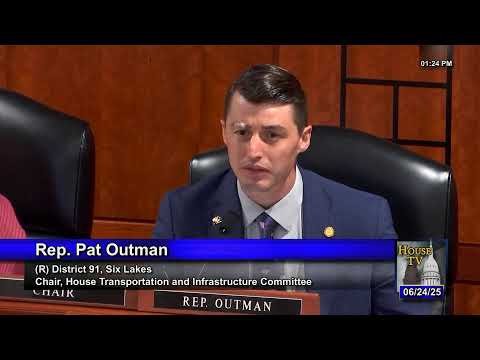
House committee hears experts on mileage‑based user fees, discusses pilot to shore up declining fuel tax revenue
Summary
The Michigan House Transportation Infrastructure Committee heard detailed presentations on mileage‑based user fees — also called road‑usage charges or vehicle‑miles‑traveled (VMT) fees — and the logistics of running a state pilot to replace declining fuel‑tax revenue.
The Michigan House Transportation Infrastructure Committee heard detailed presentations on mileage‑based user fees — also called road‑usage charges or vehicle‑miles‑traveled (VMT) fees — and the logistics of running a state pilot to replace declining fuel‑tax revenue.
Committee members heard from Baruch Feigenbaum, senior managing director of transportation policy at the Reason Foundation; Ankur Agarwal, CEO of Geotoll; Tom Gustafson, Geotoll chief strategy officer; and Ed Noyola and Denise Donahue of the County Road Association. Presenters described collection options, privacy safeguards, equity issues for rural drivers, and cost estimates for running a pilot program.
The presentations came amid concern that improvements in fuel efficiency and more electric vehicles are eroding Michigan’s motor fuel tax revenues, the primary source for road funding. Feigenbaum said the fuel tax has lost purchasing power and will not be a sustainable long‑term revenue source: “The fuel tax is like a rock star on his farewell tour,” he said, arguing that a mileage‑based system is a practical alternative.
Why it matters: State and county road agencies rely heavily on fuel‑tax receipts to maintain roads. Presenters and committee members framed a pilot as a way to test technology, privacy protections and payment options before any permanent policy change.
What presenters said - Baruch Feigenbaum (Reason Foundation) gave an overview of mileage‑based user fees and said the approach should apply to all vehicle types (light duty and higher rates for heavy trucks). He described three collection approaches — high‑tech GPS/OBD devices, a medium‑tech device that records miles only, and low‑tech odometer/photo verification — and recommended a voluntary pilot with multiple vendor options and a technical advisory committee. He noted existing programs and pilots nationwide and said five states have permanent programs (Hawaii, Oregon, Utah, Vermont and Virginia). He urged careful vendor selection to reduce collection costs and emphasized that successful pilots sample urban and rural drivers alike.
- Ankur Agarwal (Geotoll) described vendor solutions including OEM telematics integrations, an odometer/photo mobile option, and a GPS approach that retains only mileage data on the server. On privacy he told the committee, “privacy concerns have been completely addressed,” saying modern implementations can extract miles without retaining location traces on the server or the user’s device.
- Tom Gustafson (Geotoll) framed pilots as a policy tool to gather public preferences and operational data before statewide implementation. Gustafson recommended offering participants several reporting choices and using pilot results to design a fair long‑term system.
- Ed Noyola and Denise Donahue (County Road Association) presented Michigan‑specific data, including an estimate that by 2030 electric vehicles could reduce annual Michigan Transportation Fund (MTF) receipts by about $90 million and a cumulative shortfall approaching $470 million without new revenue measures. Their analysis compared per‑vehicle annual contributions under current fuel taxes: an average internal‑combustion vehicle at about $302 per year, a battery electric vehicle about $298, plug‑in hybrids about $237 and hybrids about $215 (figures presented by the County Road Association and attributed to a study they referenced).
Key questions and committee concerns - Cost of collection: Representative Coontz and others pressed on collection costs; presenters said current pilot collection costs commonly fall in the 5–10% range but can decline with scale and competitive contracting; a back‑of‑the‑envelope pilot estimate cited was about $6.9 million.
- Payment timing and low‑income impacts: Representative Banders raised the concern that an annual reconciliation could be burdensome; presenters said pilots and existing programs offer payment choices (monthly, quarterly, prepay options) to smooth cash flows.
- Rural drivers, equipment and exemptions: Representatives asked about tractors, off‑road vehicles and other equipment. Presenters said program policy choices (vehicle classes, exemptions, caps) are determined at the state‑policy level and that a properly designed mileage fee can reduce the disproportionate burden rural drivers currently face under the fuel tax because rural fleets often have lower fuel efficiency.
- Privacy and technology: Presenters emphasized multi‑option pilots (high/medium/low tech) to respect privacy preferences; several committee members voiced skepticism about GPS/OBD devices while acknowledging opt‑in and low‑tech alternatives.
What the committee discussed next: Multiple committee members and presenters urged the committee to authorize a voluntary pilot that samples urban and rural drivers, provides multiple reporting options, and includes a technical advisory committee. Presenters said pilots answer practical questions about interstate travel, cost of collection, vendor competition and whether to transition pilots into permanent programs.
The committee did not take a formal vote on a pilot during the hearing; presenters encouraged a measured, multi‑vendor pilot that is voluntary and produces a public report for elected officials.
Evidence in the record: The transcript includes the presentations, direct technical descriptions, pilot cost estimates and the committee’s questions and comments. The record shows bipartisan interest in exploring a pilot but no formal adoption of a statewide VMT program during this session.
Looking ahead: Presenters urged a pilot with broad representation (urban, rural, multiple vehicle types), competitive contracting to lower costs, multiple collection options for participant choice, and transparent reporting to elected officials to guide any transition to a permanent program.