Get Full Government Meeting Transcripts, Videos, & Alerts Forever!
Get email alerts on the Fy26 Budget topic
No spam. Unsubscribe anytime.
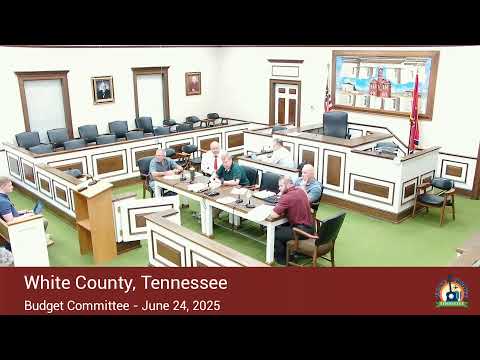
White County budget committee approves two technical amendments and sends FY26 proposals back for revision
Summary
The White County Budget Committee approved two budget cleanup amendments and spent most of the meeting debating competing FY26 pay proposals — a tiered pay scale versus across‑the‑board increases — and whether to fund a full‑time emergency management director. The committee recessed to continue work July 2.
The White County Budget Committee on Tuesday approved two budget cleanup amendments and opened an extended discussion of competing proposals for the fiscal year 2026 county budget, focusing on employee pay and emergency management funding. The committee recessed and set a follow-up meeting for Wednesday, July 2, at 5:30 p.m.
The committee approved minute corrections and two budget amendments offered by staff. Budget staff (Chad Markham) told the committee the amendments are accounting cleanups tied to final payrolls: $73,699 to the general fund and $38,008.98 to the highway/public works fund. Committee members voted to approve both amendments and to accept the minutes of the June 9 budget committee meeting.
The main portion of the meeting returned the FY26 budget to the committee after a full-court vote earlier in the week failed to approve the committee’s prior recommendation (the full court vote was reported as 12 to 2). Commissioner Mason said the process calls for the committee to refine the proposal and try to reach a package that will pass the full court at its next meeting in July.
Discussion centered on several competing baselines and how to reconcile the county’s operating needs with taxpayer tolerance for higher levies. The fiscal options discussed included the executive’s lower baseline (referred to in the meeting as roughly $1.38), a staff proposal near $1.42 described as a starting point by budget staff, and a previously advanced $1.57 package that had been rejected by the full court. Commissioners debated trimming items from the larger proposals (for example, ambulance remounts, deputies and new administrative positions) or changing the pay approach (a tiered classification/pay scale versus flat dollar or percentage raises).
A substantial portion of the meeting was devoted to employee compensation. Several commissioners argued that market adjustments and a multi‑year step/scale are necessary to retain deputies, paramedics and other front‑line staff; other commissioners urged more modest increases or a more targeted plan focused on public‑safety positions. The committee heard arguments that a tiered system (a market-based pay scale with longevity steps) would correct long-standing compression and recruitment problems, while others warned that the county needs a simpler, more affordable approach that is more likely to secure eight votes at full court.
Members also debated funding a full‑time emergency management (EMA) director. The current EMA director addressed the committee and said a full‑time director would increase the county’s eligibility and competitiveness for state and federal emergency preparedness grants, but several commissioners said earlier full-court support for a full‑time EMA position was uncertain and that the committee should not assume those votes. Staff and the EMA director noted that grant programs (including EMPG-like state/federal grant scoring) can reimburse a share of a director’s salary but are not guaranteed until the county achieves higher program scores and until those grant awards are made.
Committee members asked staff to produce clear, short options that show the fiscal impact of (a) keeping the tiered pay scale with adjustments to reduce cost, (b) an across‑the‑board dollar or percentage increase, and (c) a hybrid that targets public safety while trimming other line items (such as new assistants, some equipment or vacancy delays). Several commissioners volunteered to take one‑on‑one calls with colleagues over the next week so staff can package a revised proposal ahead of the reconvened committee meeting.
The committee closed the public portion by inviting public comment. Speakers urged prioritizing EMS, deputies and fire equipment, questioned longevity pay proposals, and asked for transparency about how landfill host/tipping fees and other one‑time receipts are being used. Staff reiterated that revenue tied to a prospective landfill tipping contract is not included in FY26 because permits and tonnage flows (and therefore host fees) are not yet guaranteed.
Votes at a glance: the committee approved the June 9 minutes and two budget amendments (both passed by voice vote).
Minutes approved: committee voted to approve the June 9, budget committee meeting minutes (motion/second recorded in the minutes; outcome: approved).
Budget amendments approved: general fund amendment, $73,699 (described as category corrections/cleanup; no new funds appropriated); highway/public works fund amendment, $38,008.98 (category corrections/cleanup; no new funds appropriated). Both amendments were approved by voice vote and are to remain in committee for further work on the FY26 package.
Next steps: staff will email revised spreadsheets and a short menu of options based on committee directions and individual commissioner feedback. The committee recessed and will reconvene Wednesday, July 2, at 5:30 p.m. to consider updated options intended to produce a package that can pass full court.
The meeting record shows extensive debate over tradeoffs among employee compensation, public‑safety staffing and one‑time revenue. The committee did not adopt a final FY26 budget; it directed staff to prepare revised options for the reconvened meeting on July 2.