Get Full Government Meeting Transcripts, Videos, & Alerts Forever!
Get email alerts on the Zero Dollar Bail topic
No spam. Unsubscribe anytime.
Study session examines reinstating $0 bail; court explained limits and county requested data to inform magistrate reviews
Summary
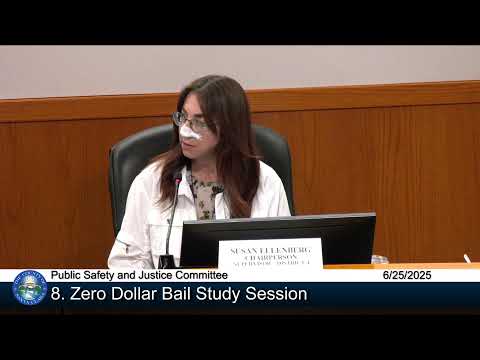
The committee held a study session on reinstating a $0 bail schedule, hearing presentations from county administration, the district attorney, the superior court, pretrial services and community advocates.
The Public Safety and Justice Committee held a study session on reinstating a $0 bail schedule in Santa Clara County, bringing together county administration, the District Attorney's Office, the Superior Court, pretrial services and community advocates.
County administration (Casey Halkin, Deputy County Executive) and the District Attorney's Office framed the county's jail-population data. Administration noted that Santa Clara's jail population dropped sharply at the start of the COVID pandemic and during local $0 bail implementation; since then the population has risen but remains substantially below pre-pandemic levels. The administration said the county's investments in pretrial services, diversion and collaboration among system partners helped keep the jail population from returning to pre-pandemic levels.
Assistant District Attorney David Angel summarized the practical operation of bail and pretrial release in the county: judges adopt an annual bail schedule but, in practice, many custody decisions occur through magistrate review and a robust, county pretrial services program. Judge Giffon (Superior Court) said judicial ethics prevent judges from publicly advocating a policy position but explained that in this county the court already uses nonmonetary release options frequently. He also described how, after an arrest, magistrate review of custody can occur within hours and that judges often rely on pretrial services reports during that review.
Community advocates from Silicon Valley DeBug and Civil Rights Corps asked the committee to reinstate $0 bail. Raj Jayadev (DeBug) said $0 bail reduced incarceration during the pandemic without producing the predicted spike in crime and warned that recent laws and city policies could criminalize homelessness and mental-health crises, making $0 bail protections more urgent for vulnerable groups. Civil Rights Corps attorney Salil Dudani summarized research showing short-term pretrial jailing increases future crime and harms individuals' economic and family stability: he cited studies finding a sharp rise in post-conviction incarceration associated with even a few days of pretrial detention and noted Los Angeles County's $0-bail practices as a comparative example.
Committee members and presenters agreed on several practical next steps: request and review pre-arraignment screening data, measures of magistrate override rates (how often bench decisions depart from any schedule), the percentage of people who are actually screened and released pre-arraignment, and the practical authority county agencies hold for cite-and-release practices. Supervisor Lee asked pretrial services to report back on the agency's risk-assessment tool and its efficacy; pretrial services agreed to provide that report.
Judge Giffon reiterated the bench's independence and said annual bail-schedule discussions occur internally among judges (the county may submit information to the court for those deliberations). He also noted that "$0 bail is being used every day in courts throughout the county" even though the current written schedule does not list $0-bail offenses.
No formal policy change was made; committee members agreed the topic requires more data-sharing with the court and expanded pretrial metrics. The committee did not vote to change the county's approach but asked system partners to produce the data needed to inform judicial deliberations.
Why it matters: advocates and some supervisors said reinstating a $0 bail schedule is the single-most impactful way to reduce the jail population and to avoid the documented harms of short pretrial detention to individuals and families; prosecutors and court representatives said decisions about bail schedules and custody are ultimately judicial and urged data-driven dialogue to inform the bench.
Next steps: the committee asked pretrial services and other partners for detailed pre-arraignment data, a report on the risk-assessment tool the agency uses, and analysis of magistrate override rates so supervisors and the court can evaluate the likely effects of any bail-schedule change.