Get Full Government Meeting Transcripts, Videos, & Alerts Forever!
Get email alerts on the County Budget topic
No spam. Unsubscribe anytime.
Butler County previews balanced $146.2 million general fund budget for 2026, flags sales-tax risk
Summary
County administrator presented a 2026 general fund tax budget showing estimated revenues of $146.2 million and projected expenses of $132 million, highlighting reliance on sales tax and a projected long-term expense/revenue pressure pushed to 2030.
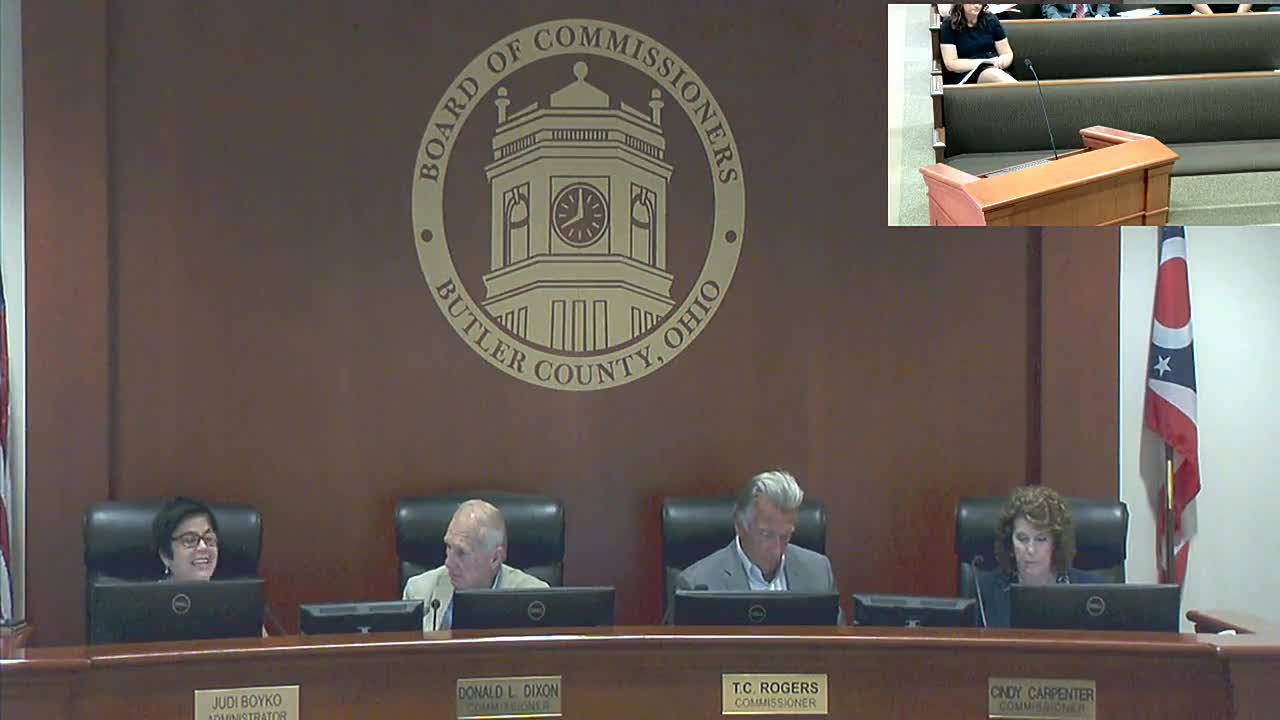
Butler County administrators told commissioners on June 24 that the proposed 2026 general fund tax budget is balanced on paper, with estimated revenues of $146.2 million and projected expenses of $132 million.
County administrators said the projection reflects a 9.8% increase in revenues compared with the adopted 2025 operating budget and a 4.5% increase in expenses. Much of the revenue gain is attributed to continued strength in sales tax receipts and higher investment income.
Administrator Waco said the county is recommending $59 million in sales-tax receipts for 2026, up from the $57 million forecast in the 2025 adopted budget. "As long as large, robust retailers continue to come into the county we can probably foresee a stabilization or an increase in the sales tax," Waco said. He warned, however, that "if the retail sector does not continue to expand we will come to a point where we are going to hit a plateau in our sales tax."
The administrator told commissioners staff had applied a more detailed method to forecast investment earnings and is estimating $17.5 million in interest income for 2026, a roughly $5.5 million increase over the 2025 forecast. County staff also noted 2026 will be the first full year that reflects the most recent property revaluation and the county expects ancillary fees to make up the rest of the revenue increase.
On the expense side, staff said much of the $5.7 million increase from 2025 is tied to wage adjustments across agencies and elected offices aimed at remaining competitive in the labor market. Administrator Waco said county projections account for both collective-bargaining and non‑bargaining wage changes.
Staff also reported a long-term outlook metric that estimates when expenses would begin to exceed revenues. That date has shifted from an earlier projection of 2027 to 2030, with a forecasted revenue/expense ratio of about 96.5% in 2030.
The administrator reminded commissioners that a public hearing on the tax budget — which staff described as required by statute — is scheduled for July 1 and the board may be asked to vote on the budget at its July 8 meeting.
Commissioners asked a procedural question about how internet retail sales are reported. Administrator Waco said the county receives 0.75% of those collections as the Butler County sales-tax share and noted state reporting systems do not currently allow the county to separate internet sales receipts in more granular detail.
Why it matters: The general fund budget funds core county services; the county’s revenue outlook depends heavily on continued retail growth and higher investment earnings, while projected wage increases and other operating pressures are moving the structural balance point farther into the future.
What’s next: Public hearing July 1; anticipated board vote July 8.