Get Full Government Meeting Transcripts, Videos, & Alerts Forever!
Get email alerts on the Housing Homelessness topic
No spam. Unsubscribe anytime.
Adams County staff outline housing-and-homelessness “spectrum” and urge regional coordination
Summary
Adams County staff presented a cross-department overview of homelessness services, prevention and housing development, emphasizing data trends, recently decommissioned encampments, and next steps to convene municipal and regional partners. No formal decisions were made at the study session.
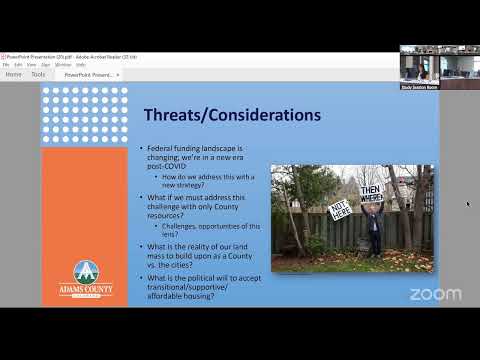
Adams County officials gave commissioners a briefing on the county’s “housing and homelessness spectrum” during a study session, outlining service volumes, recent encampment resolutions and next steps for regional coordination.
Alicia, convener of the county’s cross-departmental encampment committee, told the board the presentation was an information session and not a decision meeting: “We don't necessarily have a decision point today, but we're gonna be kicking off this conversation and getting everyone up to speed and answering questions.” The briefing brought staff from community safety and well‑being, human services, community and economic development, public health, the county attorney’s office and other departments.
The county’s data analyst, Max Sercombe, data analytics and evaluation manager for Community Safety and Well‑Being, framed recent trends. He said the county saw a 7% increase in the total number of people accessing homelessness services between 2024 and 2025, but also noted limitations of the HUD point‑in‑time (PIT) count used to measure visible homelessness: “Point in time is a HUD mandated activity…that we count 1 day in January…that's 1 of the primary limitations.” Sercombe showed PIT totals the county reported in recent years — 948 in 2023, 970 in 2024 and 730 in 2025 — and cautioned those counts can vary with county counting capacity and methodology.
Staff described the county’s multi-pronged approach, which mixes prevention programs, street outreach, emergency shelter and housing placement. Allison Blakeney, homelessness resolution supervisor for the county’s poverty reduction unit (PRU), described outreach and encampment work and said the county’s encampment resolution approach emphasizes rapid, intense support and housing placement: “We have housed 17 households and 19 individuals so far, and we are in line with the rapid rehousing numbers right now.” Blakeney said the county recently decommissioned a second encampment after placing people into housing.
Human Services staff described casework, benefits access and eviction prevention supports that county residents can access, including mobile client services (on‑site application and recertification), transportation assistance, emergency rental assistance (deposits/first month rent) and partnerships for legal support in mobile home parks. Cricket Bob Sporio, division director for economic mobility in Human Services, described on‑site benefit navigation and partnerships with school district McKinney‑Vento liaisons for youth experiencing homelessness.
Housing and development staff outlined programs to increase or preserve housing supply and to use multiple funding sources — including county general funds, Community Development Block Grant (CDBG), HOME, Community Services Block Grant (CSBG), American Rescue Plan Act (ARPA) allocations and other sources — to support shelter, rapid rehousing and permanent supportive housing. Chase Evans, deputy director for Community and Economic Development, described ongoing projects, developer partnerships and policy work intended to coordinate planning and funding across jurisdictions.
Public health and behavioral health staff emphasized housing’s role in health outcomes and recommended naming behavioral‑health assessment resources explicitly in county materials; county staff acknowledged behavioral health is a recurring driver of housing instability and flagged the need for deeper assessment and partnerships. Staff also acknowledged data limitations: the county’s HMIS (Homeless Management Information System) fields are largely self‑reported and some conditions (for example, traumatic brain injury) can be undercounted without clinical assessment.
What happened next: commissioners asked staff to share follow‑up materials and additional data (for example, average length of homelessness broken down by age group and deeper detail on youth homelessness). Staff said they have the age‑group breakdowns and will circulate them. Commissioners and staff discussed a next step of convening municipal and regional executive leadership more regularly to align resources, and staff said they would return with recommendations on where the county could lead a regional working group or convening.
No formal motions or votes were taken during the session.
The session included multiple concrete program figures and examples: the county reports an average length of homelessness of about four years among active clients (staff said they can break this down by age group), a recent encampment decommissioning resulted in housing placements noted above, Salvation Army rapid‑rehousing assistance tied to safe‑parking programs has rehoused dozens of people (staff cited 18 households / 32 individuals in that program), and the county continues to pilot regional financing/collaboration efforts such as Built for Zero and an evidence‑based funding collaborative.
Next steps noted in the meeting: staff will circulate the homelessness assessment update (the presentation referenced the county’s earlier 2016 “burn study” and a University of Denver update), provide requested demographic breakdowns and continue planning a county‑led convening of municipal and regional leaders to coordinate sheltering, behavioral health, prevention and housing development strategies.
Why it matters: county staff characterized the issue as cross‑jurisdictional and multi‑sectoral — involving municipalities, nonprofit partners, schools and health systems — and stressed that coordinated leadership and sustained funding will be required to move people from crisis to stable housing. Commissioners emphasized the need to make county materials and frameworks usable for municipalities and state policymakers so elected leaders can better understand and support scalable solutions.