Sedgwick County to begin statewide Medicaid functional assessment July 1; documentation and payment rules change
Loading...
Summary
Sedgwick County service-access staff will begin using the Medicaid Functional Eligibility Instrument (MAFE/MIFI) on July 1 to determine HCBS waiver eligibility. The county said most prior documentation requests will end and the assessment will determine eligibility but not provider payment rates during the first year.
Sedgwick County service-access staff on a county-hosted webinar outlined changes to the Medicaid Functional Eligibility Instrument, a new standardized assessment the state will use beginning July 1 to determine eligibility for Home- and Community-Based Services (HCBS) waivers.
Heather Pace, Sedgwick County service access manager, said the assessment — referred to in training materials as the MAFE or MIFI and built on the interRAI tool — will replace the BASIS assessment and be scored by a state algorithm. "The MAFE assessment is not tied to provider reimbursement at all at this time. It's only use is to determine whether or not the individual meets the minimum score in order to be level of care eligible for the waiver," Pace said.
Why it matters: The change separates the eligibility determination from the payment model that had been tied to BASIS tiers. For providers, case managers and families, the most immediate operational changes are narrower documentation requirements, new look-back windows on questions, and a longer, more detailed assessment format expected to take up to two hours initially.
Key points from the briefing
- Start date and purpose: Sedgwick staff said the county will begin using the MAFE on July 1. The instrument determines whether an individual meets the level-of-care threshold for HCBS waiver funding; it does not itself set provider payment rates during the transition year.
- Documentation: County staff said assessors will not request the wide set of supporting documents previously required. Pace told attendees, "we will not be asking for those" documents as of July 1, and that the only documentation the assessor will still require is written verification for any newly added intellectual-developmental-disability (IDD) or mental-health diagnoses (diagnoses that affect eligibility).
- Appeals and accuracy: The county emphasized that only the individual or the individual's guardian has appeal rights if the person is found not eligible for the waiver. Providers do not have appeal rights for MAFE scoring. Sedgwick staff urged teams to provide full information during the meeting because once the MAFE is entered in the state system it cannot be changed without state approval.
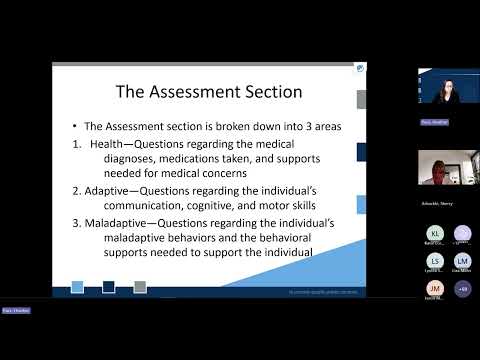
- Structure and new questions: The MAFE has two parts: an information section (demographics, diagnoses, guardian and case manager details) and an interRAI-based assessment. The assessment uses varied look-back periods (e.g., a three-day look-back for behavior items, 30/31–90/91–180 days for falls) and separates performance (what was done) from capacity (what the person could do), a distinction assessors will use when scoring adults. Youth assessments omit capacity and instead use "effect" questions.
- Maladaptive behavior and supports: The maladaptive/behavior section is more detailed than under BASIS. It asks (1) whether a behavior occurred in the look-back period, (2) what staff typically do to respond or prevent the behavior, and (3) how often staff must use those supports. Support levels for behaviors were expanded (examples range from monitoring to line-of-sight or within-arm's-length staffing). The instrument also introduces a separate item for overnight behavior supports and a lifetime-capture item for "extreme behavioral disturbance" (severe past acts such as serious self-harm attempts, severe violence, cruelty to animals or fire-setting).
- Employment and education addenda: An employment addendum is triggered for people who worked during the look-back period and scores performance and capacity across workplace logistics, scheduling, social interaction, work efficiency and risk of unemployment. Education items for youth are pulled in when education status indicates they are applicable.
- Billing and tiers: The county and a Sedgwick staff member who answered questions said current tiered reimbursement will not be driven by MAFE scoring. During the transition year, individuals already receiving services will keep their current tier rates for the next year; anyone assessed for the first time after July 1 will receive a single rate determined by KDADS and the managed care organizations. Sedgwick staff said the exact payment model and rates remained under negotiation and that more concrete guidance from the state and MCOs was expected.
- Phased rollout and logistics: Sedgwick asked providers to make clients available for the assessment and recommended minimizing reschedules because initial meetings may be up to two hours. The county said it is phasing in assessments — performing about 50% of the volume that would normally be done in July — and is hiring additional assessors to handle workload increases. Pace asked providers to flag sensitive topics in advance so assessors can hold the assessment and discuss private issues separately.
Quotes from the session
"We will not be asking for those. You don't need to send that in," Heather Pace said about prior documentation requirements, adding that this includes behavior-tracking data and behavior-support documentation unless a new IDD or mental-health diagnosis is being added.
"So during this first year the individual's current tier level will continue into the next year," said Sherry Arbuckle, a Sedgwick staff participant, describing how existing service tiers would be handled for people already in services.
What was not decided or remains to be provided
- Final provider payment details (rates and whether the single rate will use the same 15-minute unit structure) were not available at the training. Sedgwick staff said they would follow up with state and MCO information as it becomes available.
- The county said it would publish the webinar recording, the PowerPoint, and written guidance about when documentation is still required (particularly the rules for new IDD/mental-health diagnoses).
Ending
Sedgwick County staff said they will monitor the rollout closely, welcome feedback from providers and guardians, and make operational changes where possible. They asked providers and case managers to come to assessments prepared to answer questions, to have clients present when possible, and to notify assessors in advance if the team needs to discuss sensitive information off the record before final submission to the state system.