Get Full Government Meeting Transcripts, Videos, & Alerts Forever!
Get email alerts on the Sobering And Crisis Stabilization topic
No spam. Unsubscribe anytime.
County health department updates board on Pathway Center sobering program and plans for permanent crisis stabilization center
Summary
Multnomah County interim Behavioral Health Director Anthony Jordan and health department staff told the Board of Commissioners that the Pathway Center sobering program began 24/7 law‑enforcement referrals on April 28 and that work is underway on a permanent sobering and crisis stabilization center at 1901 SE Grand Avenue.
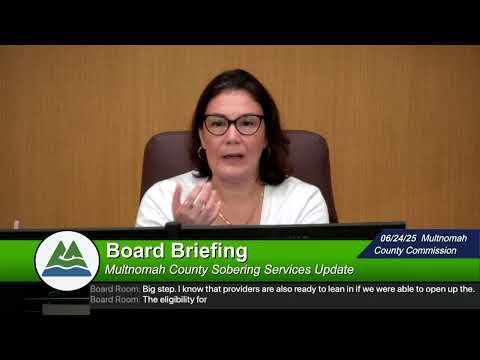
Multnomah County interim Behavioral Health Director Anthony Jordan and health department staff updated the Board of Commissioners on the Pathway Center sober‑in program and progress toward a permanent sobering and crisis stabilization center at 1901 Southeast Grand Avenue.
The briefing said the Pathway Center sobering program opened for law enforcement referrals 24/7 on April 28 and currently operates 13 sobering stations, including a designated quiet room and provision of comfort medications and care coordination. "Since our opening, we'd like to share that 26 individual utilized the sobering program as of June 16," the presentation said, and staff reported an average length of stay of just under 12 hours for individuals served in the temporary stations.
Staff described expanded referral partnerships. Anthony Jordan said the county recently began sending referrals to five partner teams including Portland Street Response, Project Respond, Community Health Access and Treat (CHaT), 4D Recovery and the Mental Health and Addiction Association of Oregon (MHAO). Those partners can provide transportation to the Pathway Center when clients meet referral criteria: appearing to need sobering services, not requiring immediate medical attention, not experiencing acute danger to self or others, being age 18 or older, alert and voluntarily willing to participate. The briefing noted that the transport mode for recent referrals was recorded in briefing materials as "PPP." Staff said June 15 was the first full day that referrals were opened to these partners.
The presentation outlined the permanent facility at 1901 SE Grand Avenue, which will offer deflection services, sobering, withdrawal management, medication‑assisted treatment, care coordination, transportation and basic needs (showers, meals, laundry). Facilities staff said the project has completed conceptual and schematic design phases; the county’s general contractor is reconciling new cost estimates and schedules from schematic‑phase review, with an updated cost and schedule expected in July and a briefing to leadership in August. The briefing stated that the FY 2026 budget contains "just under $15,000,000" for the project and that the county will seek board approval to proceed with construction next spring.
Commissioners focused on utilization and operational flow. Commissioner Brim Edwards asked about numbers and how people were arriving; staff provided weekly breakdowns in the briefing (first week 2; weekend of 05/12 five; weekend of 05/19 nine; week ending 05/26 five; weekend 06/09 three; weekend 06/16 two). Staff said the average length of stay was just under 12 hours and that Portland Police (as reported in briefing materials) provided the recent transports. Commissioners and staff discussed options to increase utilization, including adding referral partners, better field protocols and potential transportation models that do not rely on law enforcement.
Commissioner Moyer and others pressed county staff to ensure the sobering and withdrawal management services can serve people with co‑occurring substance use and mental‑health conditions when clinically appropriate. Health department staff said the permanent facility and crisis stabilization design work will incorporate lessons learned from the temporary operations and that the county is assessing feasibility for directly operating medically assisted detox versus contracting with providers.
Neighborhood engagement and governance: staff described a four‑stage neighborhood engagement plan focused on the HOSTER/Abernathy neighborhood district (HAND), including mailers, a March 20 community meeting, a good‑neighbor advisory group, a good‑neighbor agreement during construction, and ongoing collaboration once the facility is operational. Program governance described in the briefing includes a sobering and crisis stabilization leadership team, facility executive stakeholder committee and advisory groups that include people with lived experience and system partners.
Next steps and timeline: the county plans to issue a request for proposals (RFP) in July, complete schematic design reconciliation with a new cost estimate in July, provide a schedule and updated estimate to leadership in August, and seek construction authorization from the board next spring. Staff said they will continue to monitor utilization of the temporary sobering beds, refine referral protocols with partners and report back on barriers to referrals and timeline risks.
Ending: Commissioners requested regular updates on utilization, referral flows, transportation options and any permitting or cost issues that could delay the project. Staff said they will return with updated cost and schedule estimates and further operational data.