Get Full Government Meeting Transcripts, Videos, & Alerts Forever!
Get email alerts on the Sheriff Office Staffing topic
No spam. Unsubscribe anytime.
Curry County commissioners agree in principle to fund patrol lieutenant and second jail sergeant amid staffing, reporting and animal-control talks
Summary
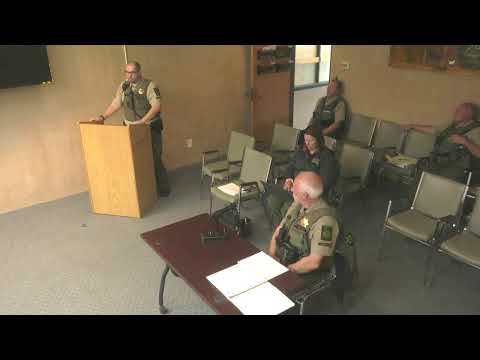
Curry County commissioners and the sheriff reached a working agreement June 24 to add a patrol lieutenant and a second jail sergeant to the county's 2025–26 budget and to provide monthly public reports on patrol activity, staffing and response coverage.
Curry County commissioners and the sheriff reached a working agreement June 24 to add a patrol lieutenant and a second jail sergeant to the county's 2025–26 budget and to provide monthly public reports on patrol activity, staffing and response coverage.
The decision grew from a multi-hour workshop focused on organizational design, public-safety outcomes and the county's limited resources. Commissioners said they want clear, data-driven accountability showing whether patrol coverage and other outcomes improve as staffing changes. The sheriff and command staff said hiring, training and certification timelines mean staffing gains will be gradual.
The board and sheriff framed the discussion around two priorities: effectiveness (achieving public-safety outcomes) and efficiency (responsible use of taxpayer dollars). "The Curry County Sheriff's Office is to be designed with both the objective of great efficiency and great effectiveness," said Lynn, a workshop presenter. Lynn argued those two goals together strengthen public safety, workforce morale and long-term resilience.
Why it matters: Commissioners said voters in unincorporated areas told them they feel unsafe because patrol coverage has been reduced in prior months, and they want a transparent way to measure whether additional funding and organizational changes improve outcomes. Commissioners also said the county faces rising costs across departments and needs evidence that budget increases yield better public-safety results.
Most immediate decisions and next steps - The group agreed to add funding for a patrol lieutenant position and a second sergeant in the jail to the proposed 2025–26 budget. The board discussed an estimated additional cost of $18,576 to fund the patrol lieutenant. - Commissioners asked for monthly public reports during the Board of Commissioners' public safety segment, including staffing levels, calls for service, self-report forms (SRFs), callouts requested and callouts actually responded to, and basic outcomes (for example, arrest vs. no arrest) so the county and public can track progress. - The sheriff said he will continue to prioritize hiring and training and that deputies currently assigned to the jail must be certified and processed before they can be returned to road patrol; that process can take months per hire. - Animal control and a proposed CRO (community resource officer) will continue as a shared/transition function while the parties finalize responsibility and funding. The sheriff said he is willing to take on the CRO role, but does not want the animal-patrol assignment.
Key numbers, roles and staffing context - The jail currently houses about 35 adults when fully occupied, the sheriff's office said. - Commissioners and staff said current patrol staffing was being described as seven individual on-road resources in one analysis; the sheriff's proposal and merged proposals were discussed as expanding that figure to roughly 11.5 (presented as "11 0.5" and marked in some documents as 12 full-time equivalent positions), including patrol deputies, a forest deputy, a marine deputy and a part-time civil/animal-control processor. - The board cited an estimated incremental cost for a patrol lieutenant of $18,576.
Data, reporting and technology Commissioners pressed for specific, repeatable metrics. They asked the sheriff to provide monthly Key Performance Indicators (KPIs) — 3 to 5 measures per department — to show performance changes over time. Commissioners asked that the sheriff provide: - staffing levels by division; - counts of calls for service and counts of those that were followed up with a response; - how many incidents were handled via a self-report form (SRF) and how many were followed by an in-person response; - how many callouts were requested, how many were fulfilled, and the outcomes of those callouts.
Sheriff's command staff noted that extracting some of those data points from their CAD (computer-aided dispatch) and JMS/RMS systems may require vendor support or report development. The sheriff said running detailed CAD-based reports currently is time consuming and may require technical assistance from the vendor.
Funding, grants and legal checks Commissioners and the sheriff discussed using opioid-settlement funds to cover a CRO position; the sheriff said the county legal/review process would need to confirm permissibility. The sheriff's office indicated it had checked initial legal questions but that the county would do a legislative or legal review before committing those funds.
Recruitment, incentives and housing Recruiting and retention were central to the discussion. Commissioners and the sheriff identified pay and housing as principal barriers to recruiting deputies to Curry County. Commissioners described a potential short-term relocation/retention housing plan under discussion (a proposal to provide temporary housing for new deputies so they can establish themselves locally). The board also discussed exploring incentives and career-path steps (for example, certification and transfers into patrol) to retain staff.
Animal control and civil-processing The parties discussed a split or shared approach for civil processing and animal control during the transition. The proposed budget included a 0.5 FTE civil/processor position funded from the general fund and additional animal-control funding already appropriated; commissioners noted a 0.5 civil processor may reduce patrol's workload but would likely not absorb the full current civil-service demand.
Accountability and meeting cadence Commissioners emphasized the need for ongoing coordination and asked the sheriff to attend regular update meetings; the sheriff said operational duties mean he cannot guarantee attendance at every meeting but will "do [his] best" to attend. The board asked that the sheriff provide the requested monthly reports so the county and public can see how services change as deputies are rehired and reassigned.
What was not decided No formal, binding vote or ordinance was recorded during the workshop. Funding additions were characterized as a working agreement and consensus to include the patrol lieutenant and second jail sergeant in the county's planned budget discussions; the board said it would fund the positions if the sheriff's budget could not identify the necessary dollars. Legal review of opioid-settlement fund use for CRO remains outstanding. Exact timelines for hiring, certification and return-to-road status for deputies were discussed but not fixed.
Quotations (selected) - "The Curry County Sheriff's Office is to be designed with both the objective of great efficiency and great effectiveness," Lynn said, framing the workshop. - "I will take on as the CRO. The one thing I didn't want to do was the animal patrol," the sheriff said. - "If we are efficient in our design, our systems are gonna support clear goals and roles for each position," Lynn added.
Ending County leaders said they will move the staffing changes into the formal budget process for adoption on June 30 and will bring the requested data and protocol templates to future meetings to allow the board and public to monitor improvements. The parties agreed to continue discussions on animal control responsibilities and on concrete recruitment incentives and housing options.