Get Full Government Meeting Transcripts, Videos, & Alerts Forever!
Get email alerts on the Search And Rescue topic
No spam. Unsubscribe anytime.
Valley County winter response team reports growth, training and equipment needs to commissioners
Summary
At the June 23 meeting the Valley County winter response team and sheriff’s office outlined a third season of response activity, growth to 17 team members, 11 mission requests in 2024–25, training totals and equipment and interagency needs including a proposed MOU with Air St. Luke's.
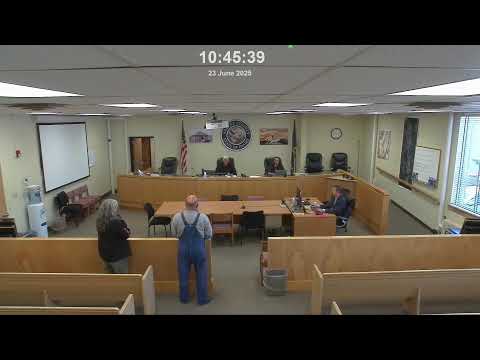
Heather Theory, a paramedic and presenter for Valley County’s winter response team, told the Board of County Commissioners Monday that the team completed its third operational winter season with expanded membership, multiple rescues and outstanding training needs.
The winter response team grew to 17 members for 2024–25, Theory said, with 10 off‑trail responders, 12 hasty‑avalanche responders and four on‑call mission coordinators. The team reported 11 requests for assistance this season: five completed missions, five stood down or canceled and one declined because the unit could not staff a response, Theory said. Incidents ranged from mechanical or stuck snowmobiles to two fatal incidents (one avalanche fatality and one snowmobile fatality) and several overdue or lost-person searches.
The team logged about 400 total training hours for the season, Theory said: roughly 80 collective team hours and about 310 individual training hours. The unit also reported interagency training with Air St. Luke’s and canine avalanche teams validated this season. Theory said the team now fields three validated avalanche canine teams.
Why it matters: commissioners heard that faster mobilization and better equipment directly affect survival in avalanche and remote cold‑weather rescues. Theory noted that response time is critical and that improvements in training, communications and equipment were priorities going into 2025–26.
Details: Theory said training this season included avalanche rescue practice, risk assessment and incident command procedures, communications checks for repeaters, patient packaging and new hypothermia and vacuum‑spine equipment for remote extrication. The team also uses a two‑piece toboggan that can be carried on foot or towed by snowmobile, and teams reported deploying but not needing some of the new equipment on missions this season.
Interagency coordination and air transport: Theory said the team is pursuing a memorandum of understanding with Air St. Luke’s to speed patient transfer and helicopter drop‑off of SAR teams when weather and aircraft availability allow. Theory said other helicopters (for example from the Payette National Forest or private operators) sometimes operate seasonally and may not be available for winter short‑haul operations; those agencies will fly their own personnel but typically will not carry county SAR members under current arrangements.
Gaps and goals: Theory and unit coordinator David Carey said the team is recruiting a southern response cohort to reduce travel times for incidents in the south valley, and requested ongoing interagency avalanche training, monthly team drills, more rope and extrication training, and a dedicated trail sled or vehicle configured to tow casualty loads. Carey and Theory also cited communications challenges in the field and the value of continuing to refine dispatch procedures and mission coordinator checklists.
Commissioners and others praised the team’s volunteer commitment and interagency cooperation. Sheriff Caperry and multiple commissioners thanked team members for their work and noted the complexity of triaging winter calls for service.
Ending: Commissioners did not take a formal vote on funding at the meeting; staff and the sheriff’s office were asked to continue follow up on MOU negotiations and equipment requests and to return with specific cost estimates if county funding is needed.