Get Full Government Meeting Transcripts, Videos, & Alerts Forever!
Get email alerts on the Signage topic
No spam. Unsubscribe anytime.
Glendale council approves start of 10‑year pilot to allow on‑site animated signs on core commercial corridors
Summary
Council directed staff to draft amendments to Title 30 to allow a 10‑year pilot permitting on‑site animated (digital) signs on specified stretches of Central Avenue and Brand Boulevard with limits on hours, brightness, content and orientation; staff will pursue environmental review and a planning commission hearing.
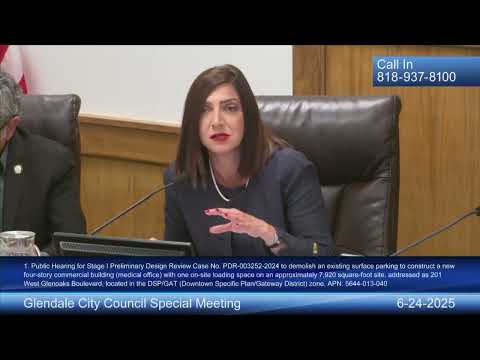
Glendale City Council voted on June 24, 2025, to initiate amendments to the municipal sign code to establish a 10‑year pilot program allowing on‑site animated signs in defined downtown commercial corridors, subject to design, illumination and content limits and subsequent environmental review.
The staff proposal, presented by Bradley Calvert, Community Development director, would allow animated ground or wall signs that display messages related only to activity occurring on the same property (no off‑site advertising). Staff proposed limiting the pilot to Central Avenue (roughly from the 134 Freeway to Los Feliz) and Brand Boulevard (from Colorado to Los Feliz) and applying existing size, height and quantity rules tied to building façade dimensions.
Key elements proposed for the pilot
- Only on‑site messages about activities occurring at the property; no off‑site advertising. - Sign types limited to ground signs or wall signs following current sign‑size rules tied to facade frontage. - Dimmable/adjustable illumination with a maximum numeric level to be established and the ability for staff to require reduced brightness after installation. - Operating hours considered around 7 a.m. to midnight (examples provided by staff). - No flashing graphics or words; visual messages must hold for at least an eight‑second interval before changing. - Orientation and siting that avoid facing adjacent residential uses and that comply with public‑works sight‑line rules. - A 10‑year pilot period to permit installation, study impacts and provide return‑on‑investment time for private installations while staff completes environmental review.
Why it matters: downtown business owners and some council members supported modernizing the code so small businesses can use animated messages for sales and events; others sought clarity about controlling visual impacts, sign sizes on multi‑tenant buildings, impacts on nearby residences and whether existing noncompliant “open/closed” signs should be brought into compliance under any new rules.
Council discussion and public input
Council members asked staff for a timeline and said they wanted small business owners who currently use nonconforming signs to be able to come into compliance. One councilmember asked whether the city should allow “open/closed” style animated signs to be regulated through the same amendments so current businesses could be legalized. Another asked about how sign area would be calculated for multi‑tenant centers; staff said sign size would relate to facade frontage and that a multi‑tenant building would have a rotating element rather than individual ground signs for every tenant.
A caller, Fernando Bridal, urged consideration of accessibility features, suggesting brighter, clearer signs for people with low vision and other accommodations for people who are blind or deaf. A councilmember proposed a friendly direction that, if legally permissible, the city seek arrangements to use private animated signs for limited public service messages in emergencies; staff said they would consult the city attorney and report back.
Next steps and outcome
Council directed staff to draft the code language, route the draft to the planning commission, and begin environmental review for the proposed pilot program. The motion to initiate the amendments passed on a roll call with affirmative votes recorded for the council members present.