Get Full Government Meeting Transcripts, Videos, & Alerts Forever!
Get email alerts on the Economic Development topic
No spam. Unsubscribe anytime.
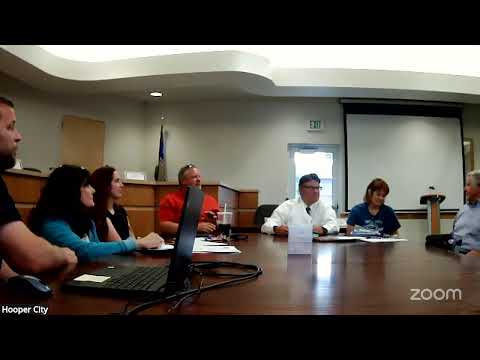
Hooper council narrowly affirms procedural resolution, spends most meeting debating Smith’s development, CRA and who will pay for lift station
Summary
After a roll-call approval of Resolution 2025-04, the Hooper City Council spent the bulk of its work session debating a proposed Smith’s grocery and an associated sewer lift station, whether the city will join a Community Reinvestment Area (CRA), and how to structure developer obligations and impact-fee recovery.
Hooper City Council members approved Resolution 2025-04 by roll call early in the meeting, then devoted most of a work session to a long discussion of a proposed Smith’s grocery project, related rezoning and a lift station needed to serve the site.
Council members and staff focused on three linked questions: whether the city should participate in a CRA or let developers pursue alternative financing (pioneering agreements/impact fees); what conditions should be written into a development agreement before final rezoning; and who would bear the up-front cost of a sewer lift station estimated during the meeting at roughly $1.9 million to $2.0 million.
Why it matters: Council members said the proposal would change the city’s tax base and growth pattern and could require concessions or costs in the near term (construction years) before increased sales and property taxes begin to flow. Several council members said they must weigh constituent opposition in some neighborhoods against longer-term revenue needs for roads, pipes and other infrastructure.
Most substantive points
- Formal action: The council approved Resolution 2025-04 after a motion by Council Member Hill and a second by Council Member Fowers; the mayor called for a roll-call vote and announced, “Motion carries.” The meeting record does not include a complete roll-call tally in the transcript excerpt.
- CRA participation: Council members made clear they do not want the city to be the funding participant in a CRA. Multiple council members said they would be open to letting the developer or other taxing entities pursue a CRA or to permitting the developer to pursue pioneering agreements or impact-fee structures that would not require Hooper City to write checks up front. Several members said those alternative approaches (developer-funded or district-funded mechanisms) are acceptable if they protect city finances.
- Conditional rezoning and the development agreement: Council members repeatedly emphasized that any change to the general plan, future land-use map or zoning should be conditional on a binding development agreement. Staff explained they will not prepare the ordinance and final map changes until the council provides direction and until a development agreement with enforceable conditions is in place. Multiple council members said any rezone should be explicitly conditioned on financing and other commitments in a signed development agreement before construction permits would be issued.
- Lift station financing and cost sharing: The lift station cost was cited in the meeting as roughly $1.9–$2.0 million. Council discussion treated that as a major barrier to city-funded construction; members repeatedly said the city lacks $2 million in unrestricted funds to build a station and should not carry that burden alone. Suggestions included the developer paying upfront and recovering costs via lot sales or impact fees, or the city collecting impact fees or administering pioneering agreements that reimburse the developer as others connect later.
- Housing mix and land-use details: The council discussed the residential component that would accompany the commercial pad(s). Planning commission recommendations mentioned patio homes and higher-density lots behind the commercial frontage; council members discussed a mix of one-third-acre, one-half-acre and patio-home lots and asked that any proposal demonstrate a guaranteed phasing plan (for example, tying residential build-out to commercial milestones so the city is not left with infrastructure paid without commercial activity).
- Fiscal study and timing: Participants referenced an impact/fiscal analysis circulated by the developer’s consultants that produced mixed reactions. Some council members questioned the study’s assumptions and the timing of net revenues (the council discussed several-year “early negative” cash-flow years during initial construction before the tax base grows). One figure mentioned in the discussion was an annual net return estimate in the low six figures in later years; council members requested clearer breakout tables and emphasized that staff and the council need more time to review the study’s methods and assumptions.
What the council directed or suggested
- Staff and the developer: Council consensus (not a formal final vote in this excerpt) was to tell the developer to proceed with exploring financing options but not to expect Hooper City to participate in CRA funding. Council members asked staff to prepare conditional rezoning language and to ensure any rezone/change to the general plan is tied to a written development agreement with enforceable milestones.
- Impact-fee / pioneering path: Several members said they preferred that developers pursue pioneering agreements and impact-fee reimbursements (the city administering impact fees or reimbursing developers as new parcels build out) rather than the city committing tax increment through a CRA.
Voices on record
Speakers identified in the meeting exchange include Council Member Hill (mover of Resolution 2025-04), Council Member Fowers (second), Council Member Wilcox, Council Member Maraboni, Council Member Ryan (referred to by first name in the transcript), developer Stewart (identified in the record as the project representative and described as not being a residential builder), city staff member Reid, and other council members and staff who took part in the discussion. Several council members described substantial constituent feedback against the project from neighborhoods west of the proposed site.
Next steps and outlook
Council members agreed to ask the developer to pursue outside financing and to return with a clearer financing plan and a draft development agreement. Staff stated it will prepare the ordinance language and the conditional rezone package only after the council provides direction and a conditional agreement is in hand. The council also directed staff to reach out to an absent council member before finalizing any motion at a future meeting.
Ending
No final rezoning vote occurred in the excerpted discussion. The meeting ended with staff instructed to communicate the council’s parameters to the applicant (no city CRA participation; proposals may proceed via pioneering/impact-fee reimbursement; any rezone must be conditional on a signed development agreement and acceptable financing). The council set those directions as the basis for further negotiation and possible future action.