Get Full Government Meeting Transcripts, Videos, & Alerts Forever!
Get email alerts on the Bond Financing topic
No spam. Unsubscribe anytime.
Indianapolis Public Library holds public hearing on proposed 2025–26 bond financing; West Indianapolis branch renovation cited as main project
Summary
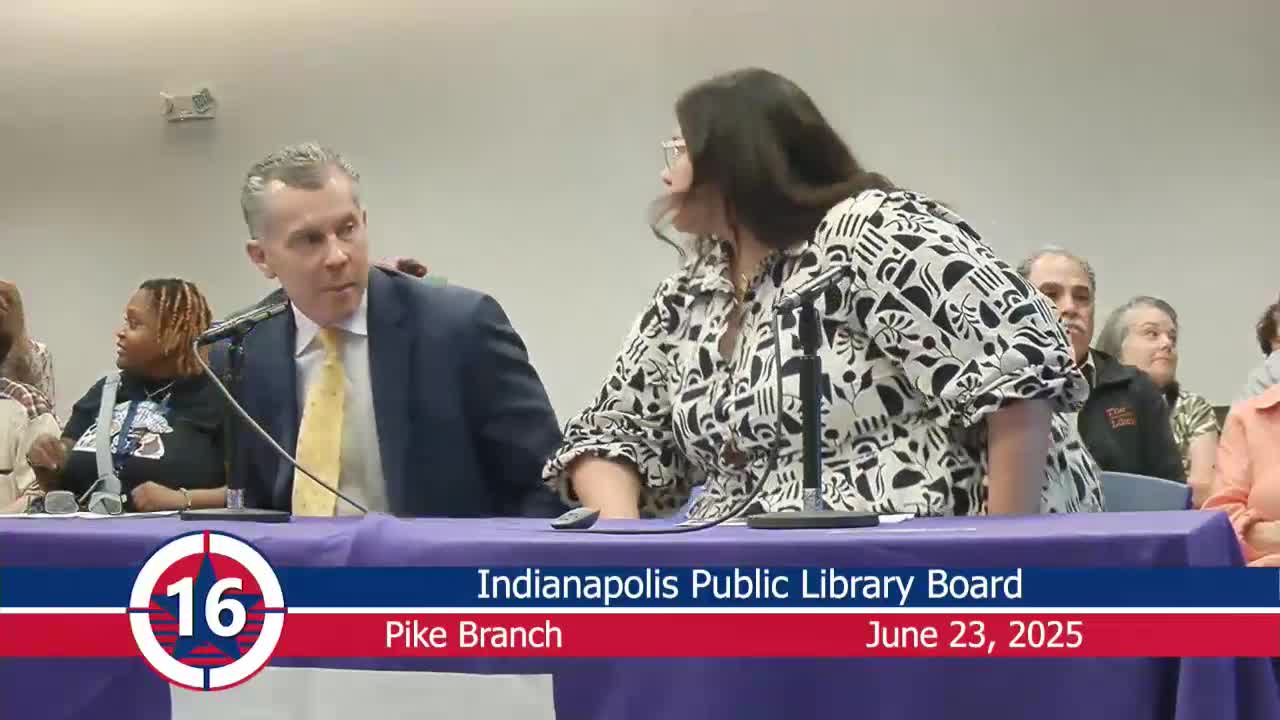
The Indianapolis Public Library Board recessed its regular meeting on June 23 for a public hearing on proposed 2025–26 long-term capital maintenance and equipment bonds, with the West Indianapolis branch identified as the primary project to be addressed.
The Indianapolis Public Library Board of Trustees recessed its regular meeting on June 23 for a public hearing on the proposed 2025–26 multifacility long-term capital maintenance and equipment project bonds, a financing package presenters said would enable branch renovations and other capital work across the system.
Jeff Quackenbush, bond counsel with Barnes & Thornburg, opened the hearing by outlining the legal process required under Indiana law. He said the board must hold two public hearings, publish notices in two newspapers and notify the county clerk; after a second hearing on July 28 the board could adopt a preliminary determination resolution that would be published and create a 30-day public comment period before proceeding to the City-County Council for approval.
Adam Parsons, presenting project-level details, said the principal focus for the bond proceeds is the West Indianapolis branch: Parsons said a 2024 long-term patron services assessment identified West Indy as the next branch requiring design work to determine whether a renovation, expansion or replacement is needed. He said the system issued a request for qualifications for architectural design services and will evaluate submissions in July.
Belvia Gray, a principal with Baker Tilly, presented maximum financial parameters the board would be asked to approve later in the process. Gray said the summary parameters include a maximum borrowing amount of $15,000,000 and an assumed maximum repayment period of six years, although she noted the library is likely to repay the debt more quickly and that current market rates for a three‑year borrowing could be in the mid‑3% range. Gray described the presentation numbers as conservative assumptions intended to avoid repeating the approval process if rates rise.
Gray also described the library’s general obligation debt limit calculation, which is set by state law and based on the most recent net assessed valuation. She said the library’s constitutional limit was roughly $398,000,000 with remaining capacity of about $355,000,000, and emphasized that the statutory calculation does not mean the library intends to issue debt up to that limit.
Quackenbush told the board that if the board approves a preliminary determination at the July meeting, the library will publish required notices and allow 30 days for public comment; if no additional community approval steps are requested, the matter would proceed to the City-County Council and later to bond market financing documents.
No members of the public spoke during the hearing. The board moved to close the public hearing and approved closing it by roll call.
Presenters and staff said the hearing is the first step in a sequence of public actions and that the board will return for a preliminary determination resolution at its July meeting and for a final bond resolution later, if the process continues.