Get Full Government Meeting Transcripts, Videos, & Alerts Forever!
Get email alerts on the Youth Engagement And Workforce topic
No spam. Unsubscribe anytime.
Parks and Youth Services releases youth engagement strategic plan after focus groups with 176 residents
Summary
The Department of Parks and Youth Services presented a strategic plan identifying workforce readiness, soft-skill gaps, transportation barriers and safety concerns as top retention challenges for Toledo youth and proposed mentorships, a youth opportunity portal and a year-round bus pass pilot among other recommendations.
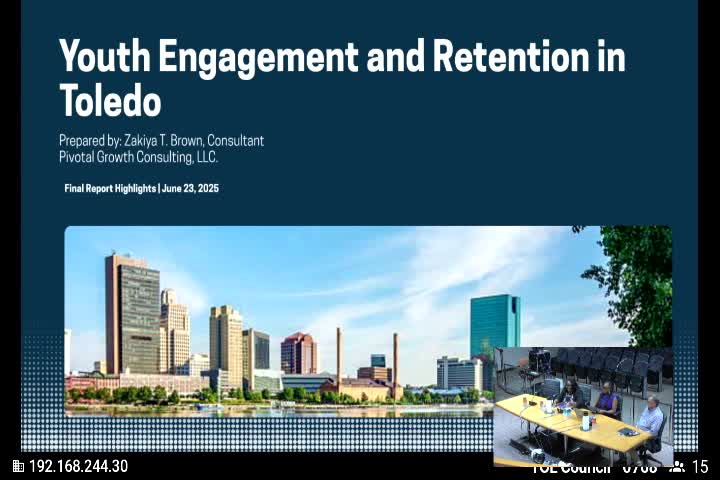
The Department of Parks and Youth Services presented a strategic plan to the City Council Parks, Education, Workforce and Health Committee that aims to increase youth engagement and retention in Toledo through career exposure, expanded youth-centered programming and targeted supports.
Commissioner Stephanie Covington and consultant Dr. Zakiyah Brown summarized a multi-month engagement that included eight individual interviews, four adult community focus groups (57 participants), four youth focus groups (61 participants) and 50 surveys, totaling 176 participants. The study identified key barriers and offered recommendations to connect young people to education and local career pathways.
Dr. Brown described the methodology and key findings: gaps in workforce readiness and career exposure, weaknesses in soft skills and life-preparedness, transportation and infrastructure barriers, safety concerns in public spaces, insufficient youth-centered engagement and communications, housing affordability worries for young adults, and desires for equity, inclusion and belonging. “A lot of the youth were sharing that they wanted some more skills to prepare them for when they go into the workforce,” Brown said.
Recommendations in the report include expanding mentorships, internships and job-shadowing programs; creating neighborhood hubs that provide wraparound supports (laundry, food pantry, social workers); piloting a year-round youth bus-pass program; repairing infrastructure and corridors that limit access; creating a youth impact fund to underwrite youth-led initiatives; establishing equity benchmarks for representation; hosting quarterly youth town halls; exploring housing vouchers or cooperative housing for young adults; and building a digital youth opportunity portal to centralize jobs, internships and programs.
Commissioner Covington said the department will prioritize recommendations for the remainder of the year and into 2026 and will meet with local organizations, educational institutions and industry partners to pursue collaborative implementation. “This project was really great of engaging a number of voices to know what are the gaps, what are the opportunities,” Covington said.
Committee members expressed support and offered to help link students with shadowing, arts and financial-literacy opportunities. Parks director Joe and committee staff said summer youth programs are underway and that program-level site visits show generally strong attendance and quality, with a final report due after programs conclude and paperwork is returned to the department.
Clarifying details: the engagement reached 176 people (8 interviews, 4 community focus groups with 57 participants, 4 youth focus groups with 61 participants, and 50 surveys) and proposed near-term steps including reviewing priorities for late 2025 and 2026 and convening partners for cross-sector implementation (source: Dr. Zakiyah Brown, Dr. Stephanie Covington).