Get Full Government Meeting Transcripts, Videos, & Alerts Forever!
Get email alerts on the Budget Taxation topic
No spam. Unsubscribe anytime.
Wellington sets preliminary FY2026 budget at $155.7 million; millage rate held at 2.47 mills
Summary
At its June 24 meeting the Wellington Village Council adopted preliminary TRIM resolutions and previewed a $155.7 million proposed fiscal 2026 budget while leaving the municipal millage unchanged at 2.47 mills. Council approved the three related TRIM/resolution items unanimously, 5-0.
Wellington Village Council on June 24 adopted preliminary tax and assessment resolutions and heard a presentation of the village's proposed fiscal year 2026 budget, a $155,700,000 spending plan that keeps the municipal millage rate at 2.47 mills and would generate about $31 million in ad valorem tax revenue at the preliminary rate.
The presentation, led by Finance staff during the meeting, said the proposal holds the millage rate steady for the seventeenth-year average of 2.47 mills and budgets a $6.7 million (4.5%) increase over the current year largely for capital improvements, public safety, and resident programs. The council unanimously approved three preliminary TRIM/assessment resolutions on the consent agenda: the village's preliminary ad valorem millage resolution and two preliminary non-ad valorem assessment resolutions for improvement districts, each passing 5-0.
The proposed budget summary released at the meeting lists capital and maintenance as major drivers of the increase and highlights several specifics: the village's proposed utility user-rate increase is 10% (an average monthly bill increase of $8.26) and is described as the last year of that 10% step; the ACME stormwater assessment is proposed at $275 (an increase of $20 from $255); solid-waste assessment adjustments and container fees are included; and the budget assumes a 6.3% increase in taxable value for the community. Staff said the proposal anticipates $31 million in ad valorem revenue using the 2.47 millage and that each one-tenth of a mill equates to about $1,252,000 under the 2026 estimate.
Staff identified major capital focuses for FY2026 as the ACME stormwater pump station renovation program, continued funding for a public safety annex, streetscape and equestrian trail improvements, and intersections and utility projects for water supply and treatment. The preliminary documents presented at the meeting show a mix of one-time and ongoing projects (listed in the village's draft budget book) and identify roughly $1.2 million for personnel expense increases and other adjustments for technology, insurance and debt service.
Staff noted sample taxpayer impacts: for a homesteaded property assessed at $450,000, the proposed millage at 2.47 mills would correspond to about a $32 increase; for a non-homesteaded property the example shown was a $111 increase. Presenters also reminded residents that even with an unchanged millage, a homeowner's tax bill may rise if the property's taxable value increases.
Council members thanked staff for the presentation and praised the multi-month outreach plan; staff said the village will publish a media release and post the draft budget online, and that the village will hold a capital workshop on Aug. 11. Staff also said the village will continue resident engagement via the Budget Balancing Act and other online tools through mid-August and will adjust the draft once the Florida Department of Revenue municipal revenue estimates are received in late July.
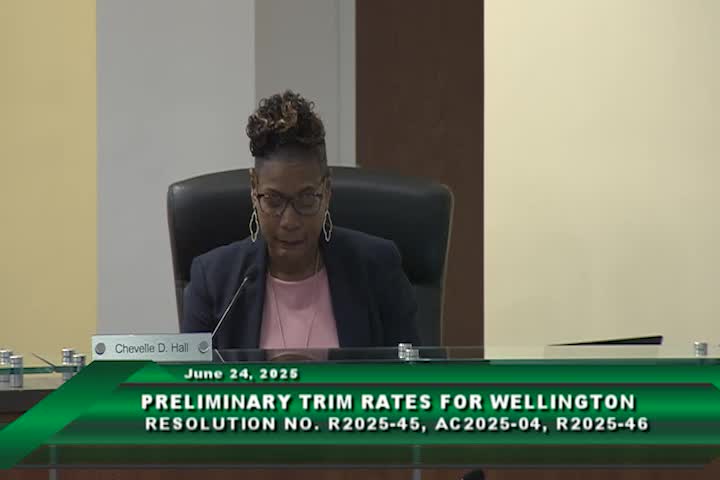
The council took formal action on three resolutions tied to TRIM/ad valorem and assessment rates. Councilmember McGovern moved to approve the village's preliminary TRIM/ad valorem resolution (R2025-405); a second was received and the motion passed 5-0. Council then approved the preliminary assessments for the ACME Improvement District and the Saddle Trail Park Neighborhood Improvement District by similar motions, each passing 5-0.
The council emphasized that this meeting adopted preliminary rates and that further budget hearings and workshops over the summer will examine details before final adoption.