Get Full Government Meeting Transcripts, Videos, & Alerts Forever!
Get email alerts on the Code Enforcement Rental Inspection topic
No spam. Unsubscribe anytime.
City planning staff report 2024 code-enforcement workload; rental inspection ordinance will require staffing review
Summary
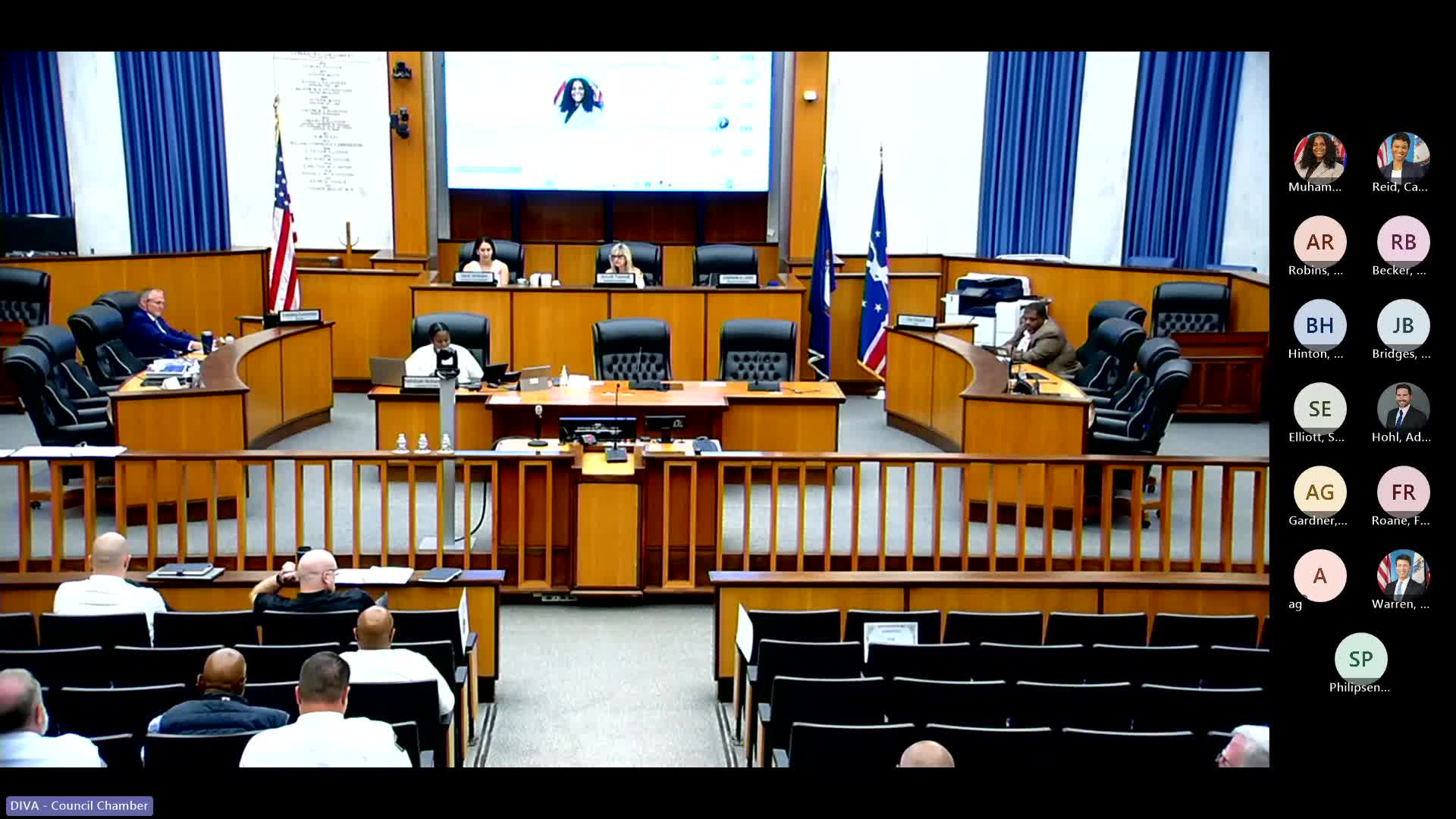
Planning and Development Review staff briefed the Public Safety Standing Committee on property maintenance enforcement statistics from 2024 and said a recently introduced rental-inspection ordinance would require discussion of district boundaries and staffing before implementation.
Planning and Development Review (PDR) staff told the Public Safety Standing Committee that property maintenance and environmental-code enforcement generated thousands of cases in 2024 and that a recently introduced rental inspection ordinance would require detailed planning on resource needs before districts are set.
“Last year in 2024, we had over 4,200 new code cases started. We issued just over 4,000 NOVs,” Kevin Jayvong, director of Planning and Development Review, told the committee. He broke the notices of violation (NOVs) down roughly into 1,000 for defective maintenance, 2,500 for environmental violations, and 308 for unsafe structures.
Jayvong said PDR closed more than 7,500 cases in 2024: about 5,000 were closed as compliant, and roughly 2,200 as “no violation observed” after inspection. He added that staff abated 193 properties (primarily grass cutting and boarding) and issued 70 demolition permits; 69 were at owner request and one was initiated by the city for an unsafe structure. PDR added 199 vacant buildings to a registry, bringing the total on the registry to 550, and updates the registry every six months.
The division explained how it distinguishes outcomes: “No violation observed is like we looked at the property… and we do not see any violation,” Jayvong said. “Compliant means… we issued a notice of violation, and then the property owner complied.” He said a separate category covers noncompliant closures when staff cannot locate an owner.
Jayvong described PDR’s coordinated, proactive efforts: daytime citywide code-enforcement teams, a nighttime team focused on after-hours activity, and monthly operations targeting problem corridors. In 2024 PDR held 25 proactive inspections that produced 80 NOVs across 45 properties and required about 395 staff hours.
Council members asked how a proposed rental residential inspection program would affect staffing. Jayvong said council introduced an ordinance the night before that would authorize a program but does not yet establish inspection districts. “If we went… take a Henrico approach, and look at a very small targeted district, we may be able to capture with what we have in terms of being fully staffed and maybe just a few additional inspectors,” he said. He warned that creating multiple large districts would require more inspectors and suggested district boundaries and unit counts be set before the next budget cycle.
The deputy city attorney, Greg Lukanowski, described enforcement responsibility under state law: either the property owner, landlord or tenant may be held responsible for code violations and the city may pursue the owner. He said most NOVs result in compliance and that fewer than 10% require court action.
Council members raised several operational concerns: the difficulty of enforcing private-property violations (for example, vehicles in backyards), safety of elderly residents tasked with maintaining right-of-way terraces next to high-speed roads, and how “no mow” or pollinator-friendly landscaping would be treated under the environmental code. Jayvong said any allowance for managed pollinator plantings would require a clear standard of “managed” vegetation so enforcement is consistent across districts.
Staff reported that field inspectors are authorized at 32 positions and the department is staffed at 28; Russell Williams, operations manager, provided a precinct breakdown: First Precinct three inspectors, Third Precinct three, Second Precinct four, Fourth Precinct four, special programs five, and four vacancies in total.
Committee members requested a follow-up breakdown of enforcement actions by violation type and geography to inform discussions on rental-inspection districts and budget needs. No formal vote or ordinance adoption occurred at the meeting; council will continue deliberations on rental inspection and district design in upcoming committee work.