Get Full Government Meeting Transcripts, Videos, & Alerts Forever!
Get email alerts on the Building Codes Electrification topic
No spam. Unsubscribe anytime.
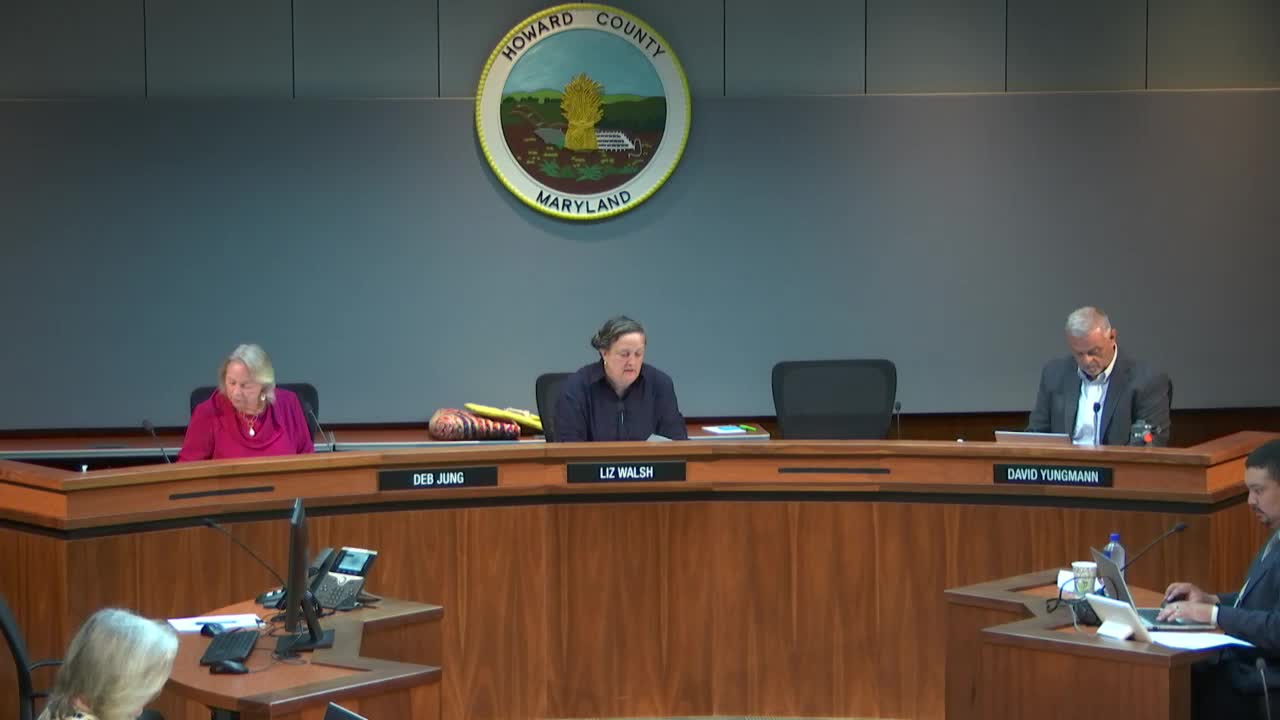
Howard County council advances drafting of electrification, readiness amendments to building code
Summary
At a Howard County Council work session, Rocky Mountain Institute staff outlined 10 code strategies for building electrification and related readiness; councilmembers signaled support for four near-term approaches and directed staff to draft amendment language for pre-filing.
Howard County Council members spent the bulk of a hybrid work session debating how far to push building-code changes that would accelerate electrification and other “readiness” measures for new construction.
Erin Sherman of the Rocky Mountain Institute summarized a memo presenting 10 options ranging from mandatory all‑electric new buildings to narrower measures such as electric‑vehicle and solar readiness, conduit for future wiring, demand‑response capability and heat‑pump readiness. Sherman told the council the memo aimed to give a menu of approaches jurisdictions have used elsewhere and to show tradeoffs among them.
The discussion focused on legal risk, cost and implementability. Councilmembers Christiana Rigby (District 3) and Deb Young (District 4) told colleagues they had identified four items they considered “low‑hanging fruit”: electric readiness for thermal equipment (conduit or wiring to simplify future electrification), enhanced conservation measures in the energy code, policy language to remove a fuel‑type bias in efficiency accounting (called a “level playing field” or debiasing), and a requirement that air‑conditioning equipment capable of being sold as one‑way units be installed as reversible heat pumps when space cooling is provided.
Sherman described the differences jurisdictions have adopted for electric readiness. She said some places, including Montgomery County, require conduit but not wiring to a future equipment location; the model code appendix requires wiring in some cases. “Montgomery County requires conduit for many circumstances. In other words, they require a clear pathway that is safe for electric purposes between the location of the combustion equipment and the electrical panel. They do not require wiring,” Sherman said. She added that wiring raises panel‑sizing and upfront cost implications but can reduce retrofit expense later; she cited studies that show it is substantially cheaper to install full infrastructure during initial construction than retrofit later.
Council members pressed on legal vulnerability. Rigby said jurisdictions that took aggressive approaches have faced legal challenges and urged creating separate legislative vehicles or clear severability language so a successful legal challenge to one part of a package would not block unrelated energy‑efficiency updates. Director Francis (county staff) responded that severability can be written into bills, but the council should consult Office of Law to confirm protections.
Councilmembers and staff discussed costs. Sherman said New Buildings Institute and related studies indicate incremental wiring costs per end use can be on the order of “$100 or $200” in some residential circumstances when installed during construction, and she noted that electric‑vehicle readiness is generally more expensive than other forms of readiness. On heat‑pump‑ready air conditioners she estimated equipment markup for a reversible unit versus a one‑way air conditioner at roughly $1,000 plus variable installation differences depending on installer familiarity; she said many new Maryland homes already use heat pumps.
The council asked staff to convert the conversation into legislative language. Members said they wanted four separate amendment vehicles drafted to reflect the four near‑term items (electric readiness, enhanced conservation, level playing field/debiasing, and heat‑pump primary/reversible requirement), and legislative analysts were asked to prepare draft amendments for pre‑filing. Council members and staff agreed to work with the county director of inspections/permits and Office of Law on implementation and legal protections; Director Francis and legislative staff were named to be involved in drafting. A filing deadline referenced in the session materials was the coming Friday.
Why this matters: the changes under discussion would affect how new housing and commercial buildings are constructed in Howard County, with implications for household energy costs, future retrofit expenses, and greenhouse‑gas emissions. Council members repeatedly emphasized that choices about conduit vs. wiring, and whether to count electric equipment equitably in efficiency tables, carry both practical and legal consequences.
Next steps: legislative analysts will prepare amendment draft language for the four approaches discussed and share drafts with staff (including Director Francis and Office of Law) for review prior to a planned pre‑file. The work session did not record a final vote; councilmembers framed the action as direction to staff to produce draft legislation for the upcoming legislative cycle.