Get Full Government Meeting Transcripts, Videos, & Alerts Forever!
Get email alerts on the Local Provider Participation Fund Lppf topic
No spam. Unsubscribe anytime.
Hernando County adopts Local Provider Participation Fund assessment change; hospitals outline expected returns
Summary
The Hernando County Board of County Commissioners unanimously adopted a resolution to set a 1.48% assessment on gross outpatient revenue as part of the Local Provider Participation Fund; hospital representatives said the fund will boost Medicaid shortfall reimbursements and projected county-wide returns.
The Hernando County Board of County Commissioners on June 20 adopted a resolution to implement changes to the Local Provider Participation Fund (LPPF), approving an assessment set at 1.48% of gross outpatient revenue and asking that the resolution take effect immediately.
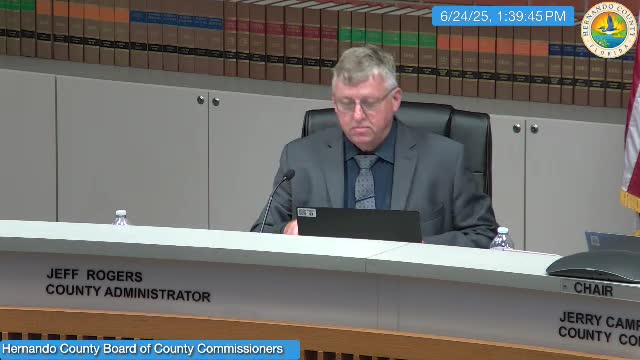
County OMB Director Albert Bertram presented the item, tied to Legistar file 16032, saying the LPPF “was established with a resolution adopted in 2021, ordinance 20 21 20, 20 21 16.” He told commissioners there is no direct budgetary impact to Hernando County because funds flow from local hospitals through the county to the state for disbursement.
The change approved by the board sets the assessment rate at 1.48% of gross outpatient revenue and requests an immediate effective date. Commissioners Champion moved to adopt the resolution and Commissioner Amsler seconded. The roll-call vote recorded Commissioners Amsler, Alaka, Champion and Vice Chairman Campbell as voting aye; the motion carried. The resolution is recorded as resolution number 2025-111 in the meeting minutes.
Nut graf: The LPPF assessment is intended to increase reimbursements for uncompensated care and Medicaid shortfalls by using a locally assessed hospital contribution that triggers enhanced federal and state matching. Hospital representatives told the board the change is timed to align with a narrow window for state and federal action that could yield higher federal match rates than in prior years.
In discussion, a hospital representative identified as Chadborough told commissioners that federal regulations require listing each parcel but that an assessed entity may encompass multiple facilities; “the reason for that is federal requirement...every parcel has to be uniformly assessed,” Chadborough said. Hospital officials emphasized the fund’s role leveling the gap between Medicaid reimbursement and hospital costs for Medicaid-eligible patients.
Steve Harris, senior vice president for payer and government affairs at Tampa General, representing Tampa General’s Brooksville and Spring Hill facilities, said the change comes amid a possible federal reconciliation that could raise the state’s matched rate and that Florida historically reimburses at a lower level. “We are extremely appreciative for [going] from 60¢ on the dollar to 80¢ on the dollar,” Harris said, adding that most states reimburse at higher levels than Florida and that the current policy discussion presents an opportunity to increase the shortfall reimbursement further.
Harris and other hospital speakers provided projected figures: the projected assessment for the county would be about $45,000,000, with projected returns of roughly $75,000,000 for the coming year; they said the previous year’s returns were about $21,000,000. Hospital representatives noted that final federal and state match calculations are determined administratively and that exact returns are estimations.
During the item, a commissioner asked for the county’s Medicaid cost in the budget. A commissioner said “almost $4,000,000,” while another exchange in the record included the numbers “33,500,000 last year” and “4,100,000 this year,” which are inconsistent in the transcript; the record does not provide a clarified, single figure. The board did not change county Medicaid appropriations during this item.
The board heard brief remarks from Ken Wicker of HCA of Florida Oak Hill Hospital thanking the commission for support and noting that increased reimbursements help hospitals that care for the county’s population.
The resolution was adopted by unanimous roll call. The record notes that the resolution’s effective date was requested as the date of the meeting and that the county expects the state to coordinate disbursements through the established LPPF process.
Ending: The commission recessed for five minutes following the item; there were no further votes tied to this agenda item recorded in the transcript.