Get Full Government Meeting Transcripts, Videos, & Alerts Forever!
Get email alerts on the False Alarms Ordinance topic
No spam. Unsubscribe anytime.
Council weighs licensing, cost‑recovery approach for false‑alarm ordinance; attorney to draft code
Summary
City Attorney Heather Kinsley presented options for a proposed false‑alarm ordinance at the June 24 workshop, including licensing monitoring firms, per‑installation permits, escalating fees, and the ability to cut automated responses for repeat offenders. Staff will draft an ordinance for first reading based on council feedback.
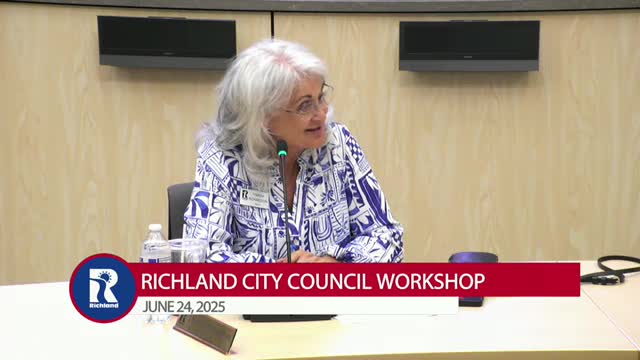
City Attorney Heather Kinsley presented options and sought council direction on a proposed false‑alarms ordinance at the June 24 Richland City Council workshop; she said she will bring a draft ordinance for first reading based on council input.
Kinsley summarized common approaches used by other Washington cities and outlined policy choices for council: require alarm‑monitoring companies to obtain a city license, require property owners to obtain a permit, adopt an escalating penalty schedule for repeat false alarms, or pursue cost‑recovery fees tied to the city’s response cost. She said she plans to present her professional recommendation for a first reading ordinance and asked for council feedback on points such as who should carry the penalty (monitoring company vs. subscriber), whether to distinguish commercial and residential properties, and whether to allow dispatch to be cut off after repeated false activations.
Kinsley said jurisdictions take different approaches; she cited examples such as Bellevue and Everett as models and noted one jurisdiction she reviewed that distinguishes commercial and residential systems. She said most cities pursue cost recovery rather than heavy punitive fines and that some cities simply stop responding after a specified number of verified false alarms.
A police representative provided recent city statistics: in 2024 Richland recorded 1,560 alarm calls, of which about 1.4% were valid; for 2025 the department was on pace for roughly 1,467 calls. In the first quarter of 2025 the department logged 489 alarm calls: nine valid, 363 clearly false and 117 unknown; the unknown category will require tighter call coding and dispatcher training if an ordinance is enacted, the representative said. The police staff also noted that among the eight properties with the most responses, four used the same monitoring company and seven of the top eight were commercial or government sites.
Council members broadly favored a licensing approach for monitoring firms rather than a per‑installation permit, saying licensing lets the city track customers and hold a vendor accountable if many subscribers trigger false alarms. Councilmember Meyer and others said they supported a cost‑recovery fee tied to the city’s actual cost to respond, rather than a highly punitive fine structure, and they urged that any code require monitoring companies to educate subscribers about how to manage alarms.
Council discussed enforcement options for repeat offenders. Kinsley and councilors noted model code provisions that allow the city to suspend automated responses for properties that repeatedly generate false alarms; reinstatement could require proof that equipment was repaired or an inspection, a change of monitoring company, or another remedy, depending on council direction.
Kinsley said she intends to draft an ordinance for first reading that will include recommendations on licensing versus permitting, fee schedules and cut‑off procedures; the draft will be available for council review and revision after first reading.
Ending: Council provided feedback favoring licensing monitoring companies, cost recovery tied to response costs, education/outreach, and the ability to suspend automated responses for repeat offenders; no ordinance was adopted at the workshop and staff will return with the draft for first reading.