Get Full Government Meeting Transcripts, Videos, & Alerts Forever!
Get email alerts on the Impact Fees topic
No spam. Unsubscribe anytime.
Idaho Falls council reviews broad update to impact fee study — policing, fire, parks and roads in focus
Summary
Idaho Falls city leaders reviewed a proposed update to the city’s impact fee study and capital improvement plans, including police vehicle purchases, fire apparatus and stations, a 23‑year parks plan and transportation lane‑mile needs, with staff scheduling further work sessions and a likely public hearing in September.
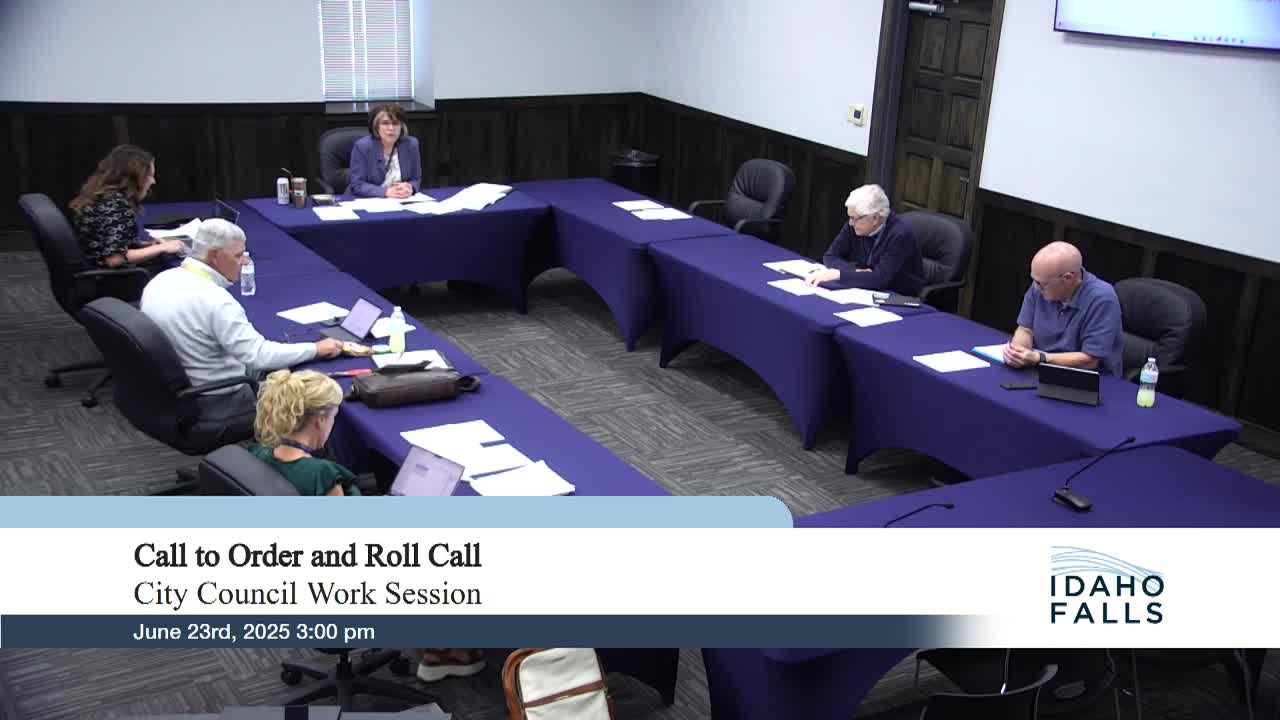
Idaho Falls — City officials on Tuesday spent roughly an hour reviewing a proposed update to the city’s impact fee study and associated capital improvement plans, focusing on how new growth will be charged for police vehicles, fire apparatus and stations, parks and recreation, and transportation improvements.
The work session brought department directors and a consultant from TischlerBise online to walk through the capital projects list that underpins the impact fee calculations and to answer council questions on timing, eligibility and accounting.
Why it matters: The impact fee study determines which capital items new development can be charged for and therefore shapes what facilities the city can afford as it grows. The council’s choices — including how to define building square footage and whether to include or relocate an affordable‑housing incentive — affect fee levels, how fees can be used, and whether developers will opt to build public improvements under reimbursement agreements.
Key points from the discussion
- Police: The police capital list includes repayment of debt for the police facility and vehicle additions. Staff said the department currently estimates a fleet “unit” of 11 patrol vehicles related to growth and anticipates acquiring 1–2 impact‑fee‑eligible patrol vehicles per year. Vehicle cost estimates were given at roughly $65,000–$68,000 each, producing an estimated impact‑fee capital cost in the neighborhood of $1,045,000 for the projected fleet increment. Police staff recommended keeping patrol vehicles on a shorter replacement cycle than 10 years; a 7‑ to 8‑year lifecycle was described as more consistent with industry practice for patrol vehicles.
- Leasing vs. purchase: The police chief and staff described an industry trend toward five‑year lease/lease‑back programs that include guaranteed buyback/resale value and continuous warranty coverage. The chief said the city’s current practice of holding vehicles longer increases lifecycle costs and lowers resale returns, and staff plan to present a financial comparison of the current practice versus a five‑year lease model in several months.
- Fire: The fire capital list shows apparatus and station work tied to the planned Station 6 construction and related equipment. Staff reported that apparatus (engine, ambulance) have been ordered but delivery remains a few years out. Impact‑fee revenue slotted to Station 6 was described as about $3 million toward that facility, with a remaining portion available for storage and related site work; a storage building was projected to receive roughly $729,000 in impact fee funding over the 10‑year plan. A separate, plan‑based calculation covers training facility design (noted as $80,000) and staff recommended careful accounting for plan‑based fees because those funds are collected and tracked separately.
- Parks: Parks staff presented a 23‑year parks capital plan that narrows the earlier draft to focus on civic and community parks rather than neighborhood parks. The plan prioritizes south, then north, then west locations and commits to completing a park before moving to the next, with an anticipated average impact‑fee revenue of “just shy of $1 million per year.” The parks plan breaks projected spending, acreage and amenity counts into five‑year bands. Staff noted the plan uses current‑dollar estimates and must be updated for inflation and project timing; they also plan an appendix with maps and project descriptions to help developers understand planned park locations and reimbursements.
- Transportation and developer reimbursement: Transportation staff and the consultant explained the methodology ties fees to a level of service and a 10‑year CIP of lane‑mile needs (the presentation referenced an estimate of roughly 14 arterial lane miles in need of funding). Staff and the consultant confirmed the city can use development agreements to have private developers construct arterial lane miles and be reimbursed by impact fees later; they recommended explicit language in the roadway chapter calling out that reimbursements to developers for arterial construction are an acceptable use of impact fee funds so long as the constructed project serves citywide arterial demand rather than solely an individual turn lane for the development.
- Square footage metric and affordable‑housing provision: The council discussed the committee recommendation to switch much of the residential fee calculation to a square‑footage metric (excluding some unfinished space such as basements). City attorney materials and comparisons to MLS definitions are being prepared; the work session scheduled July 7 will revisit square‑footage definitions. Councilors also flagged the current affordable‑housing provision in the impact fee ordinance for further review; staff suggested moving the affordability incentive to the city’s economic development or incentives framework because tracking and administration within the impact fee ordinance may be difficult.
Process and schedule
Staff outlined a multi‑meeting cadence leading to adoption: a July work session on the square‑footage definition, a July 28 work session to review proposed ordinance changes (including an affordable‑housing policy discussion), an early‑August review of ordinance refinements and timing, and a public hearing and potential adoption in September. Staff suggested, if adopted in October, a delayed effective date (for example Jan. 1) so developers and departments have time to prepare.
What councilors emphasized
Councilors repeatedly asked about flexibility in the CIPs if growth patterns shift (for example, if development occurs in a different neighborhood than projected). Staff and the consultant said annual CIP review and a conservative level‑of‑service approach let the city remove or add projects without redoing the full impact‑fee study, although plan‑based projects require stricter accounting. Several councilors also asked that the parks plan explore metrics beyond pure acreage (for example, amenities or service measures) so the city can better match service outcomes to fewer acres.
Discussion vs. decision
The session was a policy and technical review; no formal fee adoption or ordinance vote occurred. Staff will return with: a detailed financial comparison of vehicle purchase versus a five‑year lease program; refined parks and transportation CIP language, including developer reimbursement language; a proposed square‑footage definition for council consideration; and ordinance draft language for July/August work sessions.
Speakers quoted
"Specifically, we don't show that you need to hire additional officers or detectives associated with these new cars," said Colin, a consultant with TischlerBise, when council asked whether vehicle additions require a demonstrable hiring nexus.
"I would not recommend expanding that out to 10," said Police Chief Bryce Johnson in explaining industry practice for patrol vehicle replacement and why the department prefers a 7‑ to 8‑year replacement cycle.
Clarifying details
- police_vehicle_fleet_current_units: 11 - police_vehicle_expected_addition_per_year: "1 to 2" - police_vehicle_estimated_unit_cost_usd: "65,000–68,000" - police_vehicle_total_projected_cost_usd: 1_045_000 - parks_plan_horizon_years: 23 - parks_expected_annual_fee_revenue_usd: "just shy of $1,000,000" - parks_five_year_acres_needed_estimate: 53 (mentioned in discussion as the study's five‑year requirement) - fire_station6_projected_impact_fee_slots_usd: 3_000_000 (station revenue slotted) - fire_storage_projected_fee_usd_over_10_years: 729_000 - training_facility_design_allocation_usd: 80_000 - ordinance_process_timeline: "Square footage discussion July 7; ordinance review July 28; early August review; public hearing/adoption September; potential fee effective date Jan. 1 following adoption"
Authorities referenced
- {"type":"statute","name":"state law (impact fee statutes)","referenced_by":["police vehicle lifecycle vs. state law","methodology and level of service discussion"]}
Topical provenance
- topicintro: {"block_id":"s39.870003","local_start":0,"local_end":440,"evidence_excerpt":"Very good. Thank you. So the very first item on our agenda is a conversation, impact fee ordinance and our, the study that we're, working on to update our current impact fee planning. And so, with that, I'm gonna turn the time over to there are multitude of departments that are here that have an interest in impact fees. But Tim is that's our impact fee administrator and, Margaret as another who's coordinating the various departments are here.","reason_code":"topicintro"}
- topfinish: {"block_id":"s4160.77","local_start":0,"local_end":245,"evidence_excerpt":"Alright. So, we thought this might take about an hour and it did. Colin, thank you for being on the line and for listening in for what you could add value to. We appreciate it.","reason_code":"topicfinish"}
Searchable tags:["impact fees","police fleet","fire stations","parks plan","transportation CIP","TischlerBise","square footage","affordable housing"]
meeting_context:{"engagement_level":{"speakers_count":16,"duration_minutes":60,"items_count":1},"implementation_risk":"medium","history":[{"date":"not specified","note":"Update follows previous impact fee study; advisory committee recommendations referenced"}]}
proper_names:[{"name":"Idaho Falls","type":"location"},{"name":"TischlerBise","type":"organization"},{"name":"Station 6","type":"other"},{"name":"Sandy Downs","type":"location"},{"name":"Meppin Park","type":"location"}],
topics:[{"name":"impact-fees","justification":"Primary subject of the work session and the consultant presentation; contains the capital plans that determine fees","scoring":{"topic_relevance":1.00,"depth_score":0.90,"opinionatedness":0.05,"controversy":0.45,"civic_salience":0.85,"impactfulness":0.80,"geo_relevance":1.00}},{"name":"police-fleet","justification":"Detailed discussion about vehicle lifecycle, purchase vs. lease, and unit costs","scoring":{"topic_relevance":0.80,"depth_score":0.70,"opinionatedness":0.05,"controversy":0.20,"civic_salience":0.60,"impactfulness":0.55,"geo_relevance":1.00}},{"name":"parks-and-recreation","justification":"Presentation of a 23‑year parks capital plan linked to impact fee eligibility and acreage/amenity targets","scoring":{"topic_relevance":0.75,"depth_score":0.75,"opinionatedness":0.04,"controversy":0.40,"civic_salience":0.70,"impactfulness":0.65,"geo_relevance":1.00}}],
provenance:{"transcript_segments":[{"block_id":"s39.870003","local_start":0,"local_end":440,"evidence_excerpt":"Very good. Thank you. So the very first item on our agenda is a conversation, impact fee ordinance and our, the study that we're, working on to update our current impact fee planning. And so, with that, I'm gonna turn the time over to there are multitude of departments that are here that have an interest in impact fees. But Tim is that's our impact fee administrator and, Margaret as another who's coordinating the various departments are here.","reason_code":"topicintro"},{"block_id":"s4160.77","local_start":0,"local_end":245,"evidence_excerpt":"Alright. So, we thought this might take about an hour and it did. Colin, thank you for being on the line and for listening in for what you could add value to. We appreciate it.","reason_code":"topicfinish"}]}