Get Full Government Meeting Transcripts, Videos, & Alerts Forever!
Get email alerts on the Municipal Governance Training topic
No spam. Unsubscribe anytime.
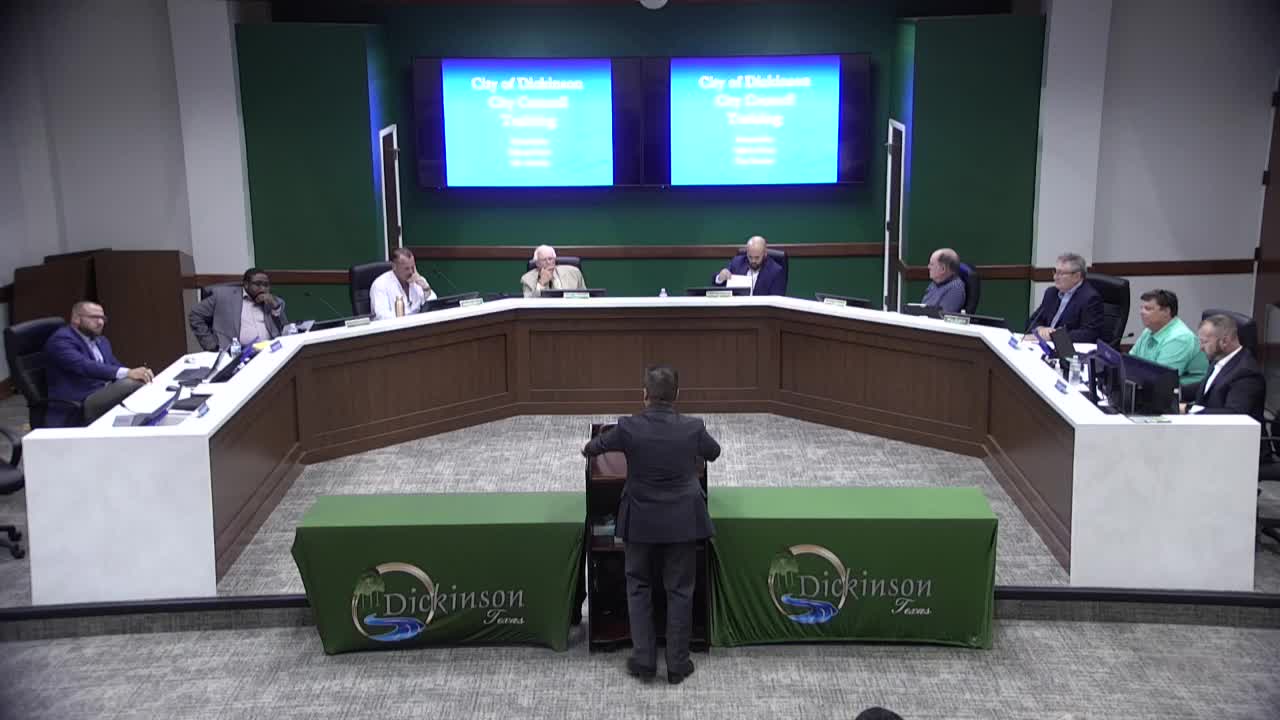
City attorney briefs Dickinson council on rules, conflicts and open-records obligations
Summary
The city attorney delivered training on meeting procedure, conflicts of interest, and Texas open-government laws, reminding council members of two-reading requirements for ordinances and the need to avoid impermissible deliberations outside posted agendas.
City Attorney (name not specified in the meeting record) provided a formal training to the Dickinson City Council on parliamentary procedure, conflict-of-interest rules, and Texas open-government statutes.
The attorney reviewed that the city's code adopts the 10th edition of Robert's Rules of Order and summarized common motions (main motion, motion to amend, motion to postpone, motion to table/lay on the table, motion to move the previous question, and motion to reconsider). The city's charter sets a quorum at five members for the seven-seat council, a point the attorney emphasized when describing meeting requirements.
On ethics, the attorney summarized the two-prong test for conflicts under Local Government Code Chapter 171 and the city's code of ethics: (1) whether a council member has a substantial interest (ownership thresholds, income thresholds, or real property interest), and (2) whether the council action would have a special economic effect on that interest above and beyond others in the city. If both prongs are met, the member must file an affidavit and refrain from participating in deliberation and voting; the standard also applies to relatives within two degrees of consanguinity or affinity.
The attorney also walked through the Texas Open Meetings Act (TOMA) and the Public Information Act (PIA), cautioning that "walking quorums" (serial communications that amount to deliberation among a quorum) are impermissible. The attorney noted that agendas must be posted in advance and that members who conduct city business on personal devices may be temporary custodians of public records subject to public-information requests.
The city attorney recommended practical steps: make motions in the affirmative for clarity, avoid using a "table" motion to postpone substantive debate, and consult the attorney early if a potential conflict exists. The attorney also discussed the 90-day training requirement for officials on open-government statutes and the penalties for violations under state law.
Council members asked procedural questions about quorum, two-reading ordinance requirements, emergency ordinances and vote thresholds, and the attorney explained options including holding special meetings for a second reading if the council wants to act quickly on matters such as holiday-related ordinances.
The training concluded without formal votes; the attorney said he intends to provide the training annually.