Get Full Government Meeting Transcripts, Videos, & Alerts Forever!
Get email alerts on the Local Roads Infrastructure Financing topic
No spam. Unsubscribe anytime.
City engineers: $752 million needed to fix local Milwaukee roads; federal grants increasingly fund arterials, leaving neighborhood streets behind
Summary
A Department of Public Works report presented to the committee finds roughly 25% of the city’s 5,100 lane miles in poor condition, with local streets disproportionately affected; eliminating the backlog on local and collector streets would cost an estimated $752 million.
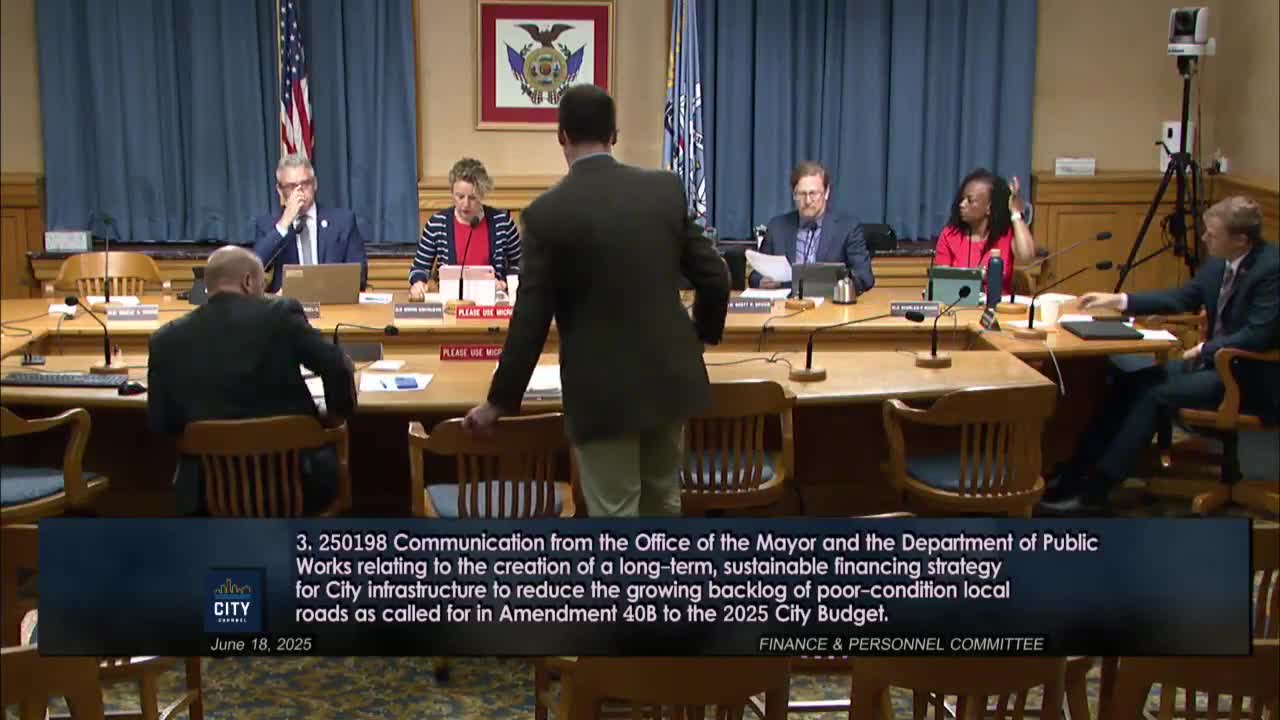
A revised Department of Public Works report presented June 18 to the Milwaukee Common Council Finance & Personnel Committee estimated that it would cost roughly $752 million to repair the city’s local and collector streets currently rated in poor condition.
City Engineer Kevin Muse summarized the department’s pavement-quality surveys and said Milwaukee maintains about 5,100 lane miles of streets. The 2022 pavement survey showed about 25% of lane miles overall in poor condition, with the decline concentrated on local neighborhood streets while arterials have improved over recent surveys.
Muse and Alderman Peter Bergellis — who sponsored the communication and has pushed for increased local‑road funding — attributed part of that divergence to the pattern of federal and state funding. Large federal infrastructure grants and matching funds are structured to pay for arterial projects, often requiring city matches that the city accepts because they cover a high share of cost. Those funding streams are not flexible enough to fund neighborhood local‑street work, Muse said.
The DPW memo outlines why many local streets are expensive to fix: older stone curbs and historic tarmacadam pavement around some neighborhoods make routine high‑impact paving ineffective; those streets frequently need full reconstruction (curb, subbase and pavement) rather than a mill-and-fill overlay. Muse told the committee that roughly 40% of the local/collector lane miles in poor condition can be improved with high‑impact paving, while about 60% need full resurface or reconstruction.
The report identified possible revenue sources to close the backlog, including more levy‑backed borrowing, the city vehicle registration fee (wheel tax), state Local Road Improvement Program (LRIP) grants (reimbursement competitive pool) and a transportation utility concept that would assess a broader user charge. Muse said the city currently receives about $1 million from LRIP every other year and noted the LRIP program’s competitive and limited nature.
Committee members raised tradeoffs. Increasing vehicle registration fees would produce local revenue but is regressive unless structured otherwise and may prompt changes in vehicle registration behavior, Alderman Bauman and others warned. Muse noted every $10 increase in the city’s wheel tax yields about $3 million a year and that even a $100 increase would take decades to fully close the backlog. He and other members also pointed to non‑fiscal constraints, including contractor capacity, required ADA ramp upgrades that add significant cost per project, and internal staffing limits that would be needed to expand work at scale.
The committee placed the communication on file; members said the report will inform capital‑budget discussions in the coming months and signaled the need for further policy work on new revenue options and on prioritization of limited funds.